An autonomous AI company is a real business that a coordinated team of AI agents builds and runs day to day, while a human founder sets the goal and makes the decisions that matter. The word that trips people up is autonomous. It means the work runs without you clicking every button, not that the company runs without an owner.
What makes it a company, rather than a single AI tool, is that the agents run a real business toward a goal, on a budget, and on a schedule. They assemble the brand, ship the storefront, spend toward that goal, and keep selling while the founder reviews the results and points them at the next thing. Platforms built for this, including Pazi, hand a founder exactly that kind of company.
Key takeaways
- An autonomous AI company is a normal business run by a coordinated team of AI agents, with a human founder still steering.
- Autonomous means low-supervision, not ownerless. The founder sets the goal, funds the budget, and approves the big calls.
- The company runs a loop. It works on a schedule, uses real tools, keeps memory, spends toward the founder's goal, then doubles down on what works.
- Some work still belongs to the founder in 2026, including legal accountability and any decision that cannot be reversed.
- It fits a founder who already has an idea and is stuck on where to start. Tools like Pazi exist to close that gap.
On this page
- What is an autonomous AI company?
- Does autonomous mean ownerless?
- How is it different from a single AI agent?
- How does an autonomous AI company actually work?
- What goal does it run toward, and how is it funded?
- Why this became possible in 2026
- What an autonomous AI company can and cannot do in 2026
- Who is building autonomous AI companies, and who is it for?
- Autonomous AI company vs traditional company vs single AI agent
What is an autonomous AI company?
An autonomous AI company is a business where AI agents carry out the day-to-day operating work, and a human owner sets the direction. Think of the agents as a small team that never signs off. They build the product or storefront, market it, handle sales and support, and keep going on a schedule. The founder is not a manager assigning every task. The founder is the person who decides what the company is for and whether each result is good enough to keep.
The plainest version is the one the market cares about. You bring an idea. The company builds itself around that idea as a real website or web app with an online shop, then runs the operations that a small team of employees would otherwise run. This is not a chatbot that answers when spoken to. It is a business that acts.
The concept sits on top of a technology shift that is already mainstream. Autonomous AI companies are what happens when you stop bolting AI onto one task and instead let a coordinated set of agents run the whole thing, from the storefront to the sales.
Does autonomous mean ownerless?
Autonomous does not mean ownerless, and getting this wrong is the most common mistake in the category. Some definitions describe an autonomous AI company as software with "no human in the loop," where the owner is closer to a shareholder than a manager. That framing sounds bold and it misleads people. A company with no one deciding is not autonomous. It is adrift.
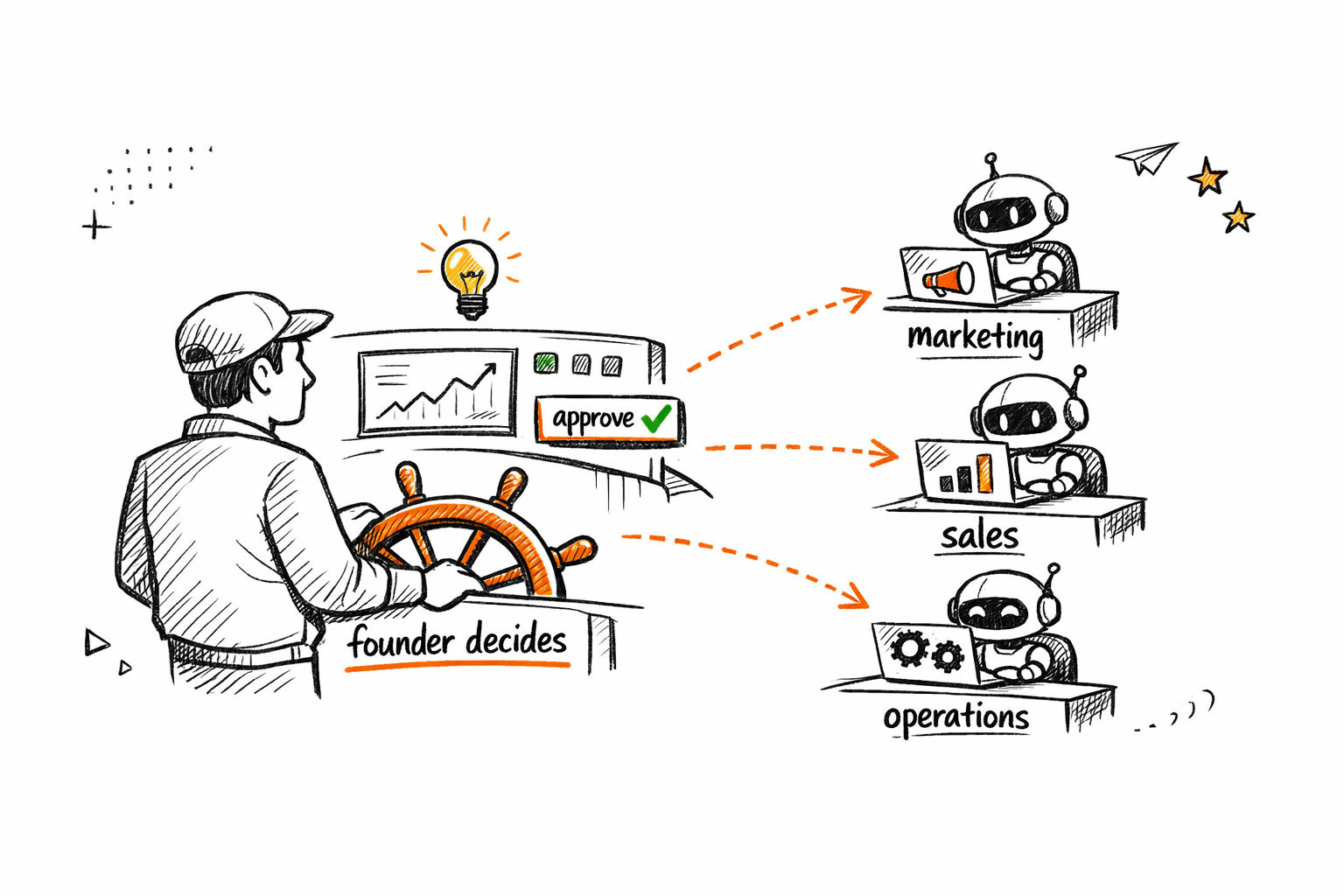
The honest model keeps the founder as the decision-maker. You set the mission. You fund the budget. You approve the choices that carry real risk, like pricing, brand, and spend. Then the agents execute against your direction and report back. Autonomy lives in the execution layer, where a thousand small decisions no longer need you. Judgment stays with you, where it belongs.
Microsoft describes a near future where every organization runs "a constellation of agents" that vary in independence, from prompt-and-response helpers to ones it calls "fully autonomous." The phrase fully autonomous describes how much supervision a task needs, not whether anyone owns the outcome. A founder running an autonomous AI company reads reports the way a captain reads instruments. The ship still has a captain.
How is it different from a single AI agent?
A single AI agent is a worker. An autonomous AI company is the organization that runs many workers toward one goal. This is the difference between hiring one contractor and running a business that employs a team, keeps books, and pursues an outcome across months.
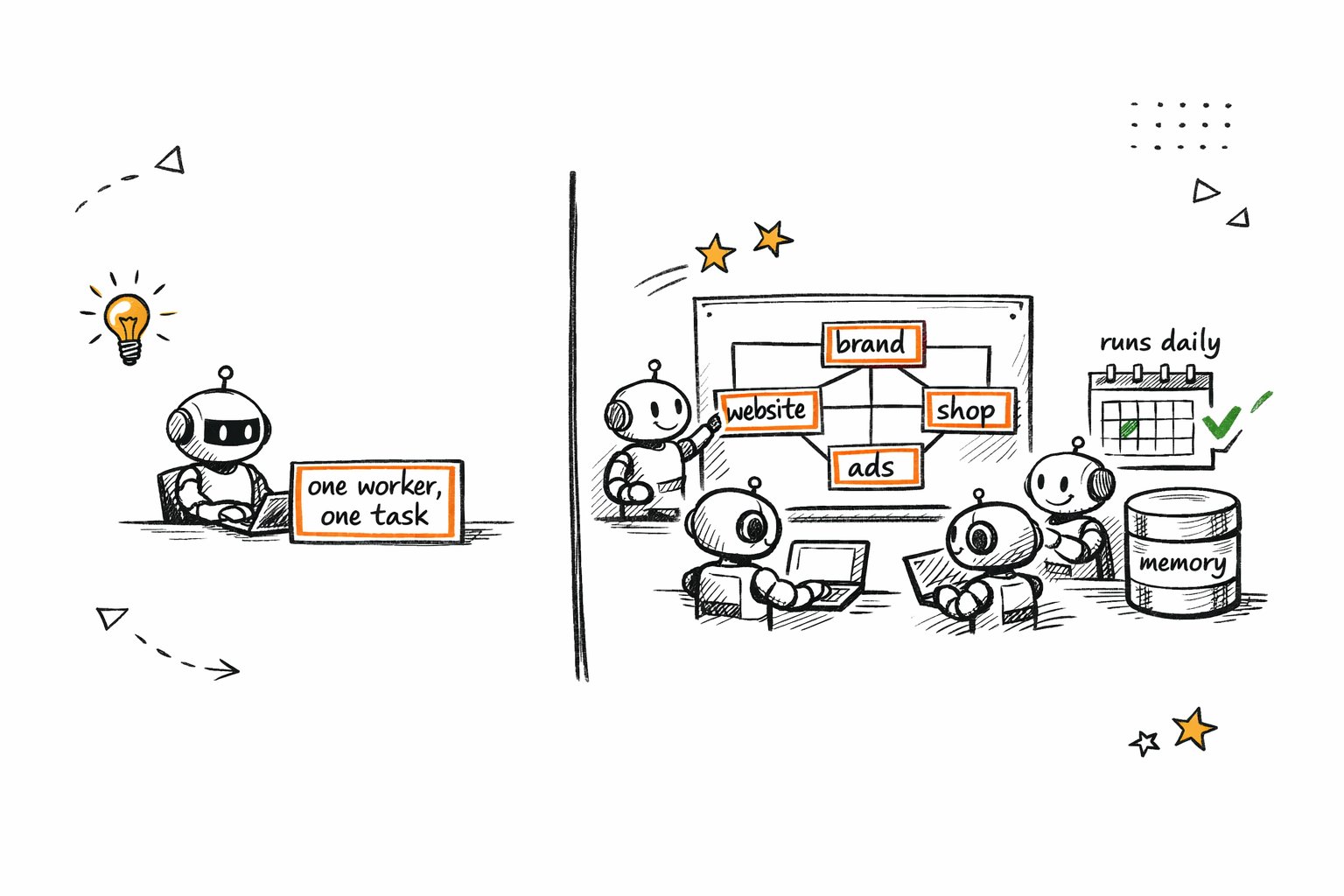
IBM defines the building block cleanly. "Agentic AI is an artificial intelligence system that can accomplish a specific goal with limited supervision," the company writes. One such agent might write a single ad or answer a support ticket. Useful, but narrow. An autonomous AI company wires many of these agents together, gives them a shared objective, and coordinates them so the marketing agent's output feeds the sales agent, and the sales data feeds the next decision. One agent writes the ad. A company writes the ad, runs it, reads the numbers, and changes next week's ad on its own. If you want the underlying mechanics, our explainer on what makes an AI agent truly autonomous breaks down the loop, and multi-agent AI systems for business covers how those agents divide the work.
The jump from agent to company is the jump from a task to a business. A task ends. A business persists, remembers, spends, and adapts. That persistence is what makes the word company accurate rather than marketing.
How does an autonomous AI company actually work?
An autonomous AI company works as a coordinated loop, not one clever model. A few traits separate it from a normal AI tool, and each one maps to something an ordinary business already does.
- It runs on a schedule. Work fires on its own cadence, hourly or daily or weekly, and nobody presses start. A real business shows up every day whether or not the owner is watching.
- It uses real tools. The agents reach a browser, payment rails, email, analytics, and the storefront itself, not a text box. That is the difference between talking about the work and doing it.
- It keeps memory. Last week's results shape this week's, so the company gets sharper about its own niche over time instead of starting from zero on every run.
- It decides within its lane. At small forks the agents pick and ship. At the big forks, a price change, a brand call, a large spend, the decision goes to the founder.
The founder sits at the top of that loop as the reviewer and the direction-setter. A well-built platform surfaces what each run did as a plain report, so approving a direction or correcting course takes minutes, not a full workday. The agents propose and produce. You confirm and steer.
"Think of agents as the new apps for an AI-powered world."
Microsoft's framing is a good mental model. In an autonomous AI company, those app-like agents are not scattered across your desktop. They are organized into a single operation pointed at your goal. The loop is the company. The model is just one part.
What goal does it run toward, and how is it funded?
A loop only becomes a company when it runs toward something and pays for itself. Those are the two pieces most definitions skip, and they are what turn busy agents into a business.
The goal the founder sets
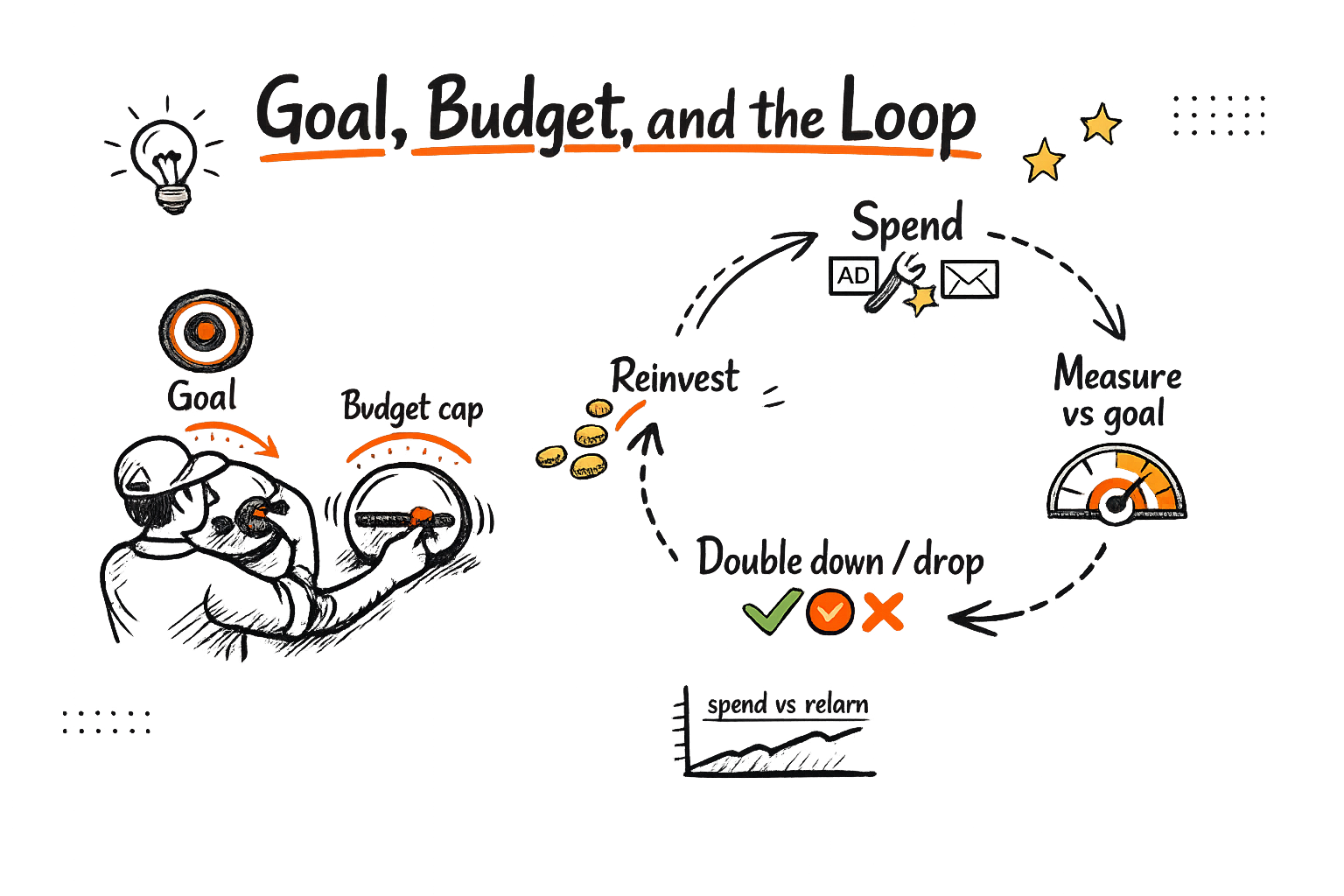
Every autonomous AI company runs toward a standing goal, and the founder is the one who sets it. It might be the first fifty sales, a thousand signups, a revenue number for the quarter, or whatever marks "this is working" for that particular idea. The agents treat that number as the point of the whole operation, not a suggestion they check occasionally.
Each cycle, the company measures its results against that target and adjusts. A campaign that moves the number earns more attention. One that does not gets dropped. The goal is not a fixed law the software obeys forever, and it is not some built-in rule to maximize revenue at all costs. It is the founder's goal, and the founder can raise it, narrow it, or replace it as the business changes. That is what keeps the company pointed at what the owner actually wants rather than at a metric nobody chose.
The budget it spends against
A company also spends money, and this is where an autonomous AI company stops looking like a chatbot. The founder funds a budget, and the agents spend it on real things, ad spend to reach customers, compute to run the work, tools and subscriptions the business needs, and outreach to bring people in. Real money goes to real line items, the same way a small business pays for its own growth.
The company watches the gap between what it spends and what comes back, the cost line and the revenue line any founder tracks. To keep a bad stretch from running away, the founder sets a hard cap the agents cannot cross without asking. Budget and goal are linked, because money is how the company buys attempts at the target and the cap is how the founder keeps those attempts sane.
"A budget is how a company buys attempts at its goal."
The autonomy here is narrow and deliberate. The founder approves the spending envelope and the risky calls, a price change or a big ad push. Inside that envelope, the agents spend without asking every time. That is the whole trade. You set the limits once instead of approving every ten-dollar test.
The engine that keeps it improving
Put the goal, the budget, and the memory together and you get the part that makes an autonomous AI company feel alive. It tries something, measures the result against the goal, doubles down on what works, kills what does not, and reinvests the budget into the next attempt. There is always one more channel to test and one more version to ship. A traditional company that stops experimenting slowly stalls. An autonomous one is built so the experimenting never stops, which is the point of running it as a company instead of a one-time project.
What one week actually looks like
Picture an ordinary idea, a small-batch candle shop. In the first days the agents build the brand and a storefront, and the founder sets the goal at the first fifty orders and funds a budget with a cap. The agents launch a few ads and send some outreach, then read the first results, where one ad converts, two do not, and one email angle lands. The company shifts spend to the ad and the angle that worked, drops the rest, and reports back so the founder can nudge the goal or the cap. That path, from idea to storefront to goal to budget to first results to adjustment, is an autonomous AI company in a single week.
Why this became possible in 2026
The idea of a company that runs itself is not new. What changed recently is that the pieces finally hold together well enough for a non-technical founder to start one. Three shifts did most of the work.
AI agents now stay coherent across long, multi-step tasks instead of losing the thread after a few moves, so a company can run for a week without falling apart. Running each task in its own cheap, isolated sandbox got affordable, so a whole team of agents working in parallel no longer costs a fortune. And tool use became standardized, so agents plug into a browser, a payment system, and a storefront the same reliable way every time rather than through brittle custom glue.
None of this is speculative anymore. The 2025 AI Index Report from Stanford HAI shows how quickly AI went from novelty to normal.
"78% of organizations reported using AI in 2024, up from 55% the year before."
When most organizations already use AI, standing up a company that runs on a coordinated agent team stops being a moonshot and starts being a practical way to begin. The pieces finally hold together. That is what earns the 2026 in the question.
What an autonomous AI company can and cannot do in 2026
An autonomous AI company can build and run the full stack a normal online business needs. This is the part that surprises people who still think of AI as a writing assistant. The capability set in 2026 covers the assets and the go-to-market motion end to end.
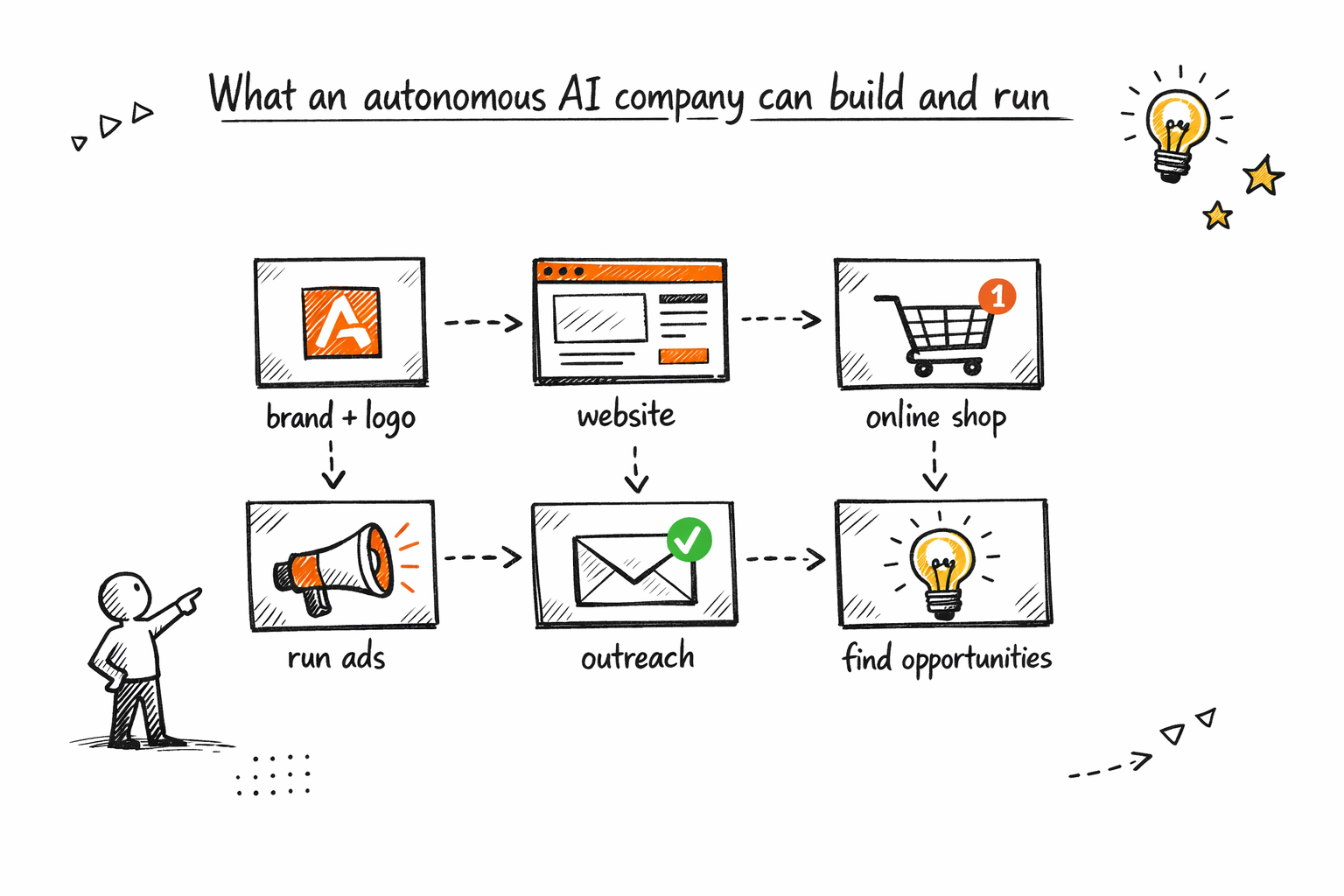
The agents can create a brand and design a logo, build the website or web app, and stand up the online shop, the kind of storefront you would expect on Shopify, Etsy, or Amazon. They can run ads, produce short video commercials, identify new opportunities for the business, and send email and outreach to bring in customers. In practice the founder gives direction at each fork, and the company assembles the pieces and puts them live.
The honest half of the answer is what it cannot do reliably yet, and that half matters just as much.
What still belongs to the founder
Two kinds of work still sit with the human in 2026. The first is anything that carries real legal accountability, such as signing a binding contract, hiring a real employee, or filing taxes. An agent can draft and prepare these, but the name on them and the responsibility for them are the founder's. The second is any one-shot action that cannot be undone if it goes wrong, like spending the whole budget on a single bet, emailing the entire customer list, or making a public claim the business then has to stand behind.
Far from a weakness, this is the argument for keeping a human at the helm. The company runs the reversible, repeatable work at scale, and the founder owns the decisions that are permanent. Agents handle what is safe to automate. You handle what should never be automated.
Who is building autonomous AI companies, and who is it for?
The person this model fits best already has an idea and does not know where to start. That is a precise reader, not a generic one. They are not hunting for a business idea. They have one sitting in a notes app, blocked by the wall of execution, with no team, no code, and no clear first step.
An autonomous AI company removes that wall. You describe the idea, and the company builds around it and starts operating, which turns "someday" into something live this week. The founder still makes the decisions that matter. They simply skip the months of setup that used to gate the whole thing. If that is you, the practical on-ramp is our guide on how to get started with AI agents without a developer.
This is not for everyone, and honesty helps here. It is a poor fit for someone chasing a passive get-rich scheme, because a founder who never reviews anything will steer a company into the ground. It works when you treat it as your business, run by agents, with you at the helm.
Autonomous AI company vs traditional company vs single AI agent
Here is the quick reference. Use it to place the term against the two things people most often confuse it with.
| Dimension | Single AI agent | Autonomous AI company | Traditional company |
|---|---|---|---|
| Scope | One task | A whole business | A whole business |
| Who does the work | The agent, on request | A coordinated team of agents | Human employees |
| Who decides | You, each time | The founder sets direction; agents execute | Founders and managers |
| Standing goal | None, one prompt at a time | A target the founder sets and can change | Set by owners and managers |
| Budget | None of its own | Funded and capped by the founder, spent by agents | Managed by finance and owners |
| Runs on a schedule | No, prompt-driven | Yes, continuous | Yes, during work hours |
| Memory across work | Limited | Persistent, compounds | Human and systems |
| Improves itself | No | Tests, measures, reinvests | Through people and process |
| Cost to start and run | Low | Low | High, payroll and overhead |
| Human in charge | You | The founder | The owners |
The pattern in the table is the definition in miniature. An autonomous AI company has the reach of a real business and the low overhead of software, with a human still holding the wheel.
Start the business you have been sitting on
Pazi is built for exactly this. You bring the idea, and a team of AI agents builds the brand, the website, and the online shop, then runs the marketing, sales, and operations while you steer. You set the goal and the budget. The agents spend within your cap, test what works, and report back, and you stay the founder who decides where it all goes. If you have an idea and have been stuck on where to begin, start building your business on Pazi and watch the first version come together.