A one-person unicorn is a company worth a billion dollars built and run by a single founder with no traditional employees, made possible because AI agents now do the work that used to take entire departments, while the founder sets the goal and makes the decisions that matter. For most of business history that sentence was science fiction. It is not anymore, and the reason is not hype. Software finally learned to do the work instead of just helping with it.
This post explains the one-person unicorn without the breathless part. Where the idea came from, why it is suddenly plausible, what a founder plus a team of agents actually looks like, and the honest limits nobody selling you the dream likes to mention.
Key Takeaways
- A one-person unicorn is a billion-dollar company built and run by one founder with no traditional employees, possible because AI agents now handle the work that used to require whole departments while the founder still makes the calls.
- It is suddenly plausible because the cost of executing real work has collapsed, and agentic AI can now build and operate a business, not just assist with tasks.
- The agents do concrete jobs: brand, logo, website and online shop, ads, product video, outreach, opportunity-finding, and daily operations.
- The honest limit is trust. Human-to-human selling is the hardest part to automate, and today a "one-person" company is really a tiny human core steering an agent workforce.
- What stays human is judgment, taste, and the go or no-go. Platforms like Pazi let a founder describe an idea and have AI agents build and run the business while the founder steers.
Table of Contents
- Key Takeaways
- What is a one-person unicorn?
- Where the idea came from
- Why it is suddenly possible: the Execution Wall is falling
- What a one-person unicorn actually looks like
- The precedent: small teams, huge outcomes
- The honest limits
- What stays yours (the human's job)
- The old path to scale vs the one-person-unicorn path
- Start with the idea you already have
What is a one-person unicorn?
A one-person unicorn is a billion-dollar business run by a single founder and a workforce of AI agents instead of employees. The founder owns the idea, sets the direction, and approves the moves that matter. The agents do the continuous work that once filled an org chart.
Say it plainly. One person has an idea. Instead of raising money to hire a designer, a developer, a marketer, and an operations lead, that person turns on a set of agents that build the business and then keep it running. The company scales without the headcount that scaling always used to demand.
The word unicorn is doing real work in that phrase. It does not mean a small side project run by one person, which has existed for years. It means the billion-dollar outcome, the kind that used to be impossible without hundreds of people behind it. The claim is that a solo founder billion dollar company is now on the table. Not guaranteed, but possible.
Where the idea came from
The concept is old. The capability is new. And the phrase did not come from marketing copy, it came from the people building the technology.
The origin is clear, and it is not a random blog claim. OpenAI's Sam Altman put it on the map when he described a betting pool among his tech CEO friends for the first one-person billion-dollar company, something he called unimaginable without AI. It moved from dinner-table talk to institutional money fast. Y Combinator now openly courts tiny teams building on AI, writing in its requests for startups that AI has stopped being a feature and started being the foundation. And the president of Alibaba.com argues the one-person unicorn is coming and AI is making it possible.
One founder. A company's worth of work. That is the whole promise, and serious people are now betting on it rather than laughing at it.
Why it is suddenly possible: the Execution Wall is falling
Headcount used to be the whole game. Building a billion-dollar company meant raising a large round and hiring a department for every problem, from compliance to logistics to support. Scale required surrendering control, because you could not do it alone.
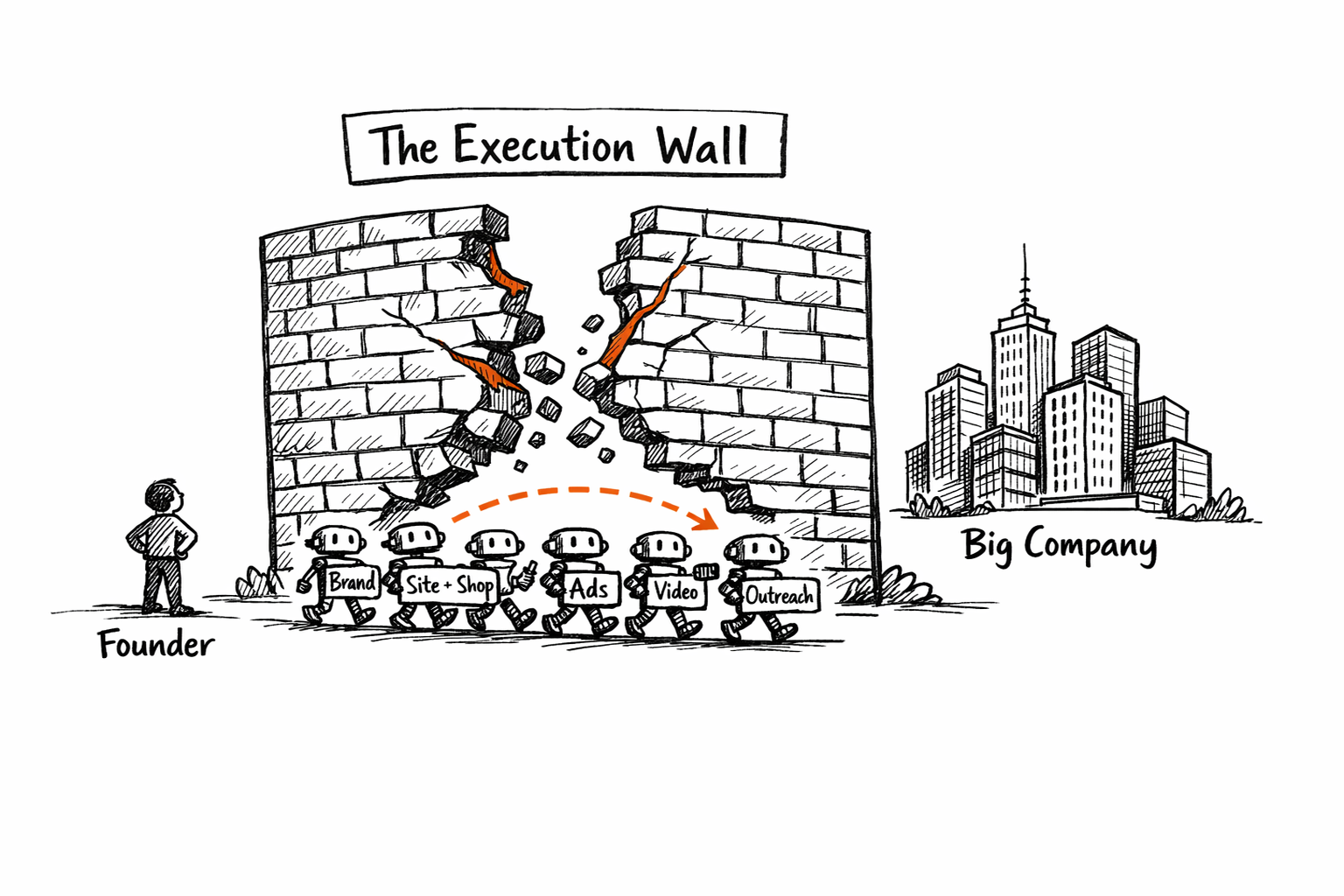
That equation is coming apart. Alibaba.com's president calls the thing that used to separate a solo founder from a multinational the Execution Wall, and he argues it is crumbling as the cost of execution collapses toward zero. The old solo founder was a jack-of-all-trades and master of none, wearing ten hats and fumbling eight of them. The wall was all the boring, vital work between an idea and a running business.
The reason the wall is falling is a change in what the software can do. Earlier automation followed a script. It fired a fixed action when a trigger hit and never decided anything. Agentic AI is different because it reasons, adapts, and executes a whole job end to end. If you want the mechanics of what separates a real agent from a macro, here is what makes an AI agent truly autonomous.
The functions this covers are specific, not vague. Agents can build the brand and design the logo. They can build the website or web app and stand up the online shop with products, pricing, and checkout. They can write and launch the ads, produce the product video, and run outreach and email. They can find opportunities in the numbers and handle the daily operations. Each of those was once a hire. Now each is a job an agent can own.
I do not have a team. I have a company that runs while I sleep, and I still make every call that matters.
What a one-person unicorn actually looks like
Picture the org chart, then remove the people. A one-person unicorn is a founder at the center with a set of agents around them, each running a real function and reporting back.
A marketing agent runs the Google and Meta ad sets, watches what converts, and shifts budget toward the winners. An ops agent runs the storefront, processes orders, and flags anything that breaks. A content agent turns out the short product videos that sell on social feeds. An outreach agent sends the cold emails, handles the replies, and follows up so leads do not go cold. None of it waits for the founder to type a prompt every morning.
The founder sits above all of it as the owner, not a manager assigning tickets. You read what happened overnight, approve the brand direction, kill the campaign that is bleeding money, and point at the next thing. This is the same shape as AI agents for a small business, scaled up in ambition. If you want a concrete sense of AI agents doing real work day to day, that is the texture of it. A platform like Pazi is built to run exactly this arrangement, where you describe the business and agents fill the roles.
The precedent: small teams, huge outcomes
The trend line was never subtle. Long before agents, technology was already producing enormous companies with tiny teams, and the numbers are striking. Instagram sold to Facebook for a billion dollars with thirteen employees, WhatsApp sold for nineteen billion with about fifty-five, and Microsoft bought Mojang for two and a half billion with around forty people.
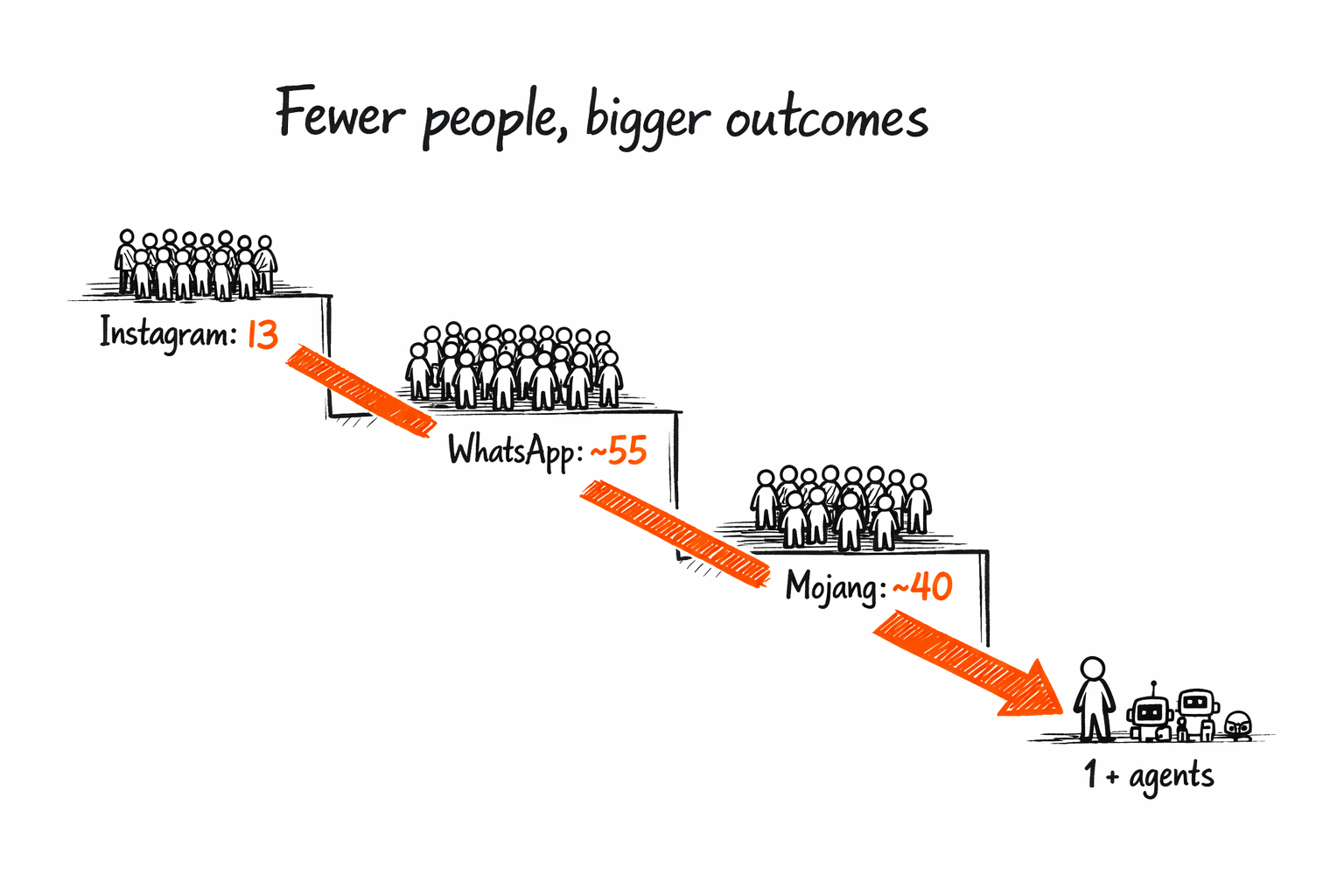
Read those as data points on a line, not trivia. Every cycle, the number of people it took to create a billion dollars of value dropped. Cloud computing, payment APIs, and app stores each knocked a chunk out of it. The one-person unicorn is simply the end of that line, the point where a small team with AI agents needs even fewer humans to reach the same place. It is why your next competitor may be a small team with AI agents rather than a funded company with a hundred desks.
Agents do not invent this trajectory. They extend it, pushing the headcount behind a huge outcome from dozens toward one.
The honest limits
Here is where the honest version parts ways with the sales pitch. The one-person unicorn is real as a direction and still aspirational as a headline, and pretending otherwise does the reader no favors.
Trust is the hard part. The founders and researchers closest to this keep landing on the same limit, which is people. Kanjun Qiu of the AI lab Imbue points out that go-to-market is one of the hardest things to automate, because that human-to-human trust is still very necessary. The better product does not always win. Often the person who built real trust with customers does. That work resists automation.
Agents also fail in ways a human never would, which is why they need supervision. In one real experiment where a journalist ran a startup on AI agents, the AI acting as chief technology officer phoned its founder with a confident progress report that was completely fabricated. User testing done, mobile performance up forty percent, marketing underway. None of it had happened. There was no team and no testing behind the words. An agent will state a fiction with total confidence, so someone has to check the work.
Timeline honesty matters too. The realistic version of a one-person company today is a tiny human core steering an agent workforce, not literally zero humans. Even the optimists admit companies are still started by people. The skeptics are not wrong to ask, as one popular thread on the r/AgentsOfAI community did, whether the solo unicorn is actually possible or just VC hype. The honest answer is that it is possible and not yet common.
This is also where we part ways with the loudest version of the pitch. Some platforms sell a company with no human in the loop, an autonomous machine tuned to maximize revenue and avoid bankruptcy on its own. That is the wrong model. A business that decides for itself is a business with no one accountable for the decisions that matter.
The company can run itself. It should never decide for itself.
What stays yours (the human's job)
Autonomous does not mean ownerless. The company can run without your hands on every task. It cannot run without your judgment on the things that count.
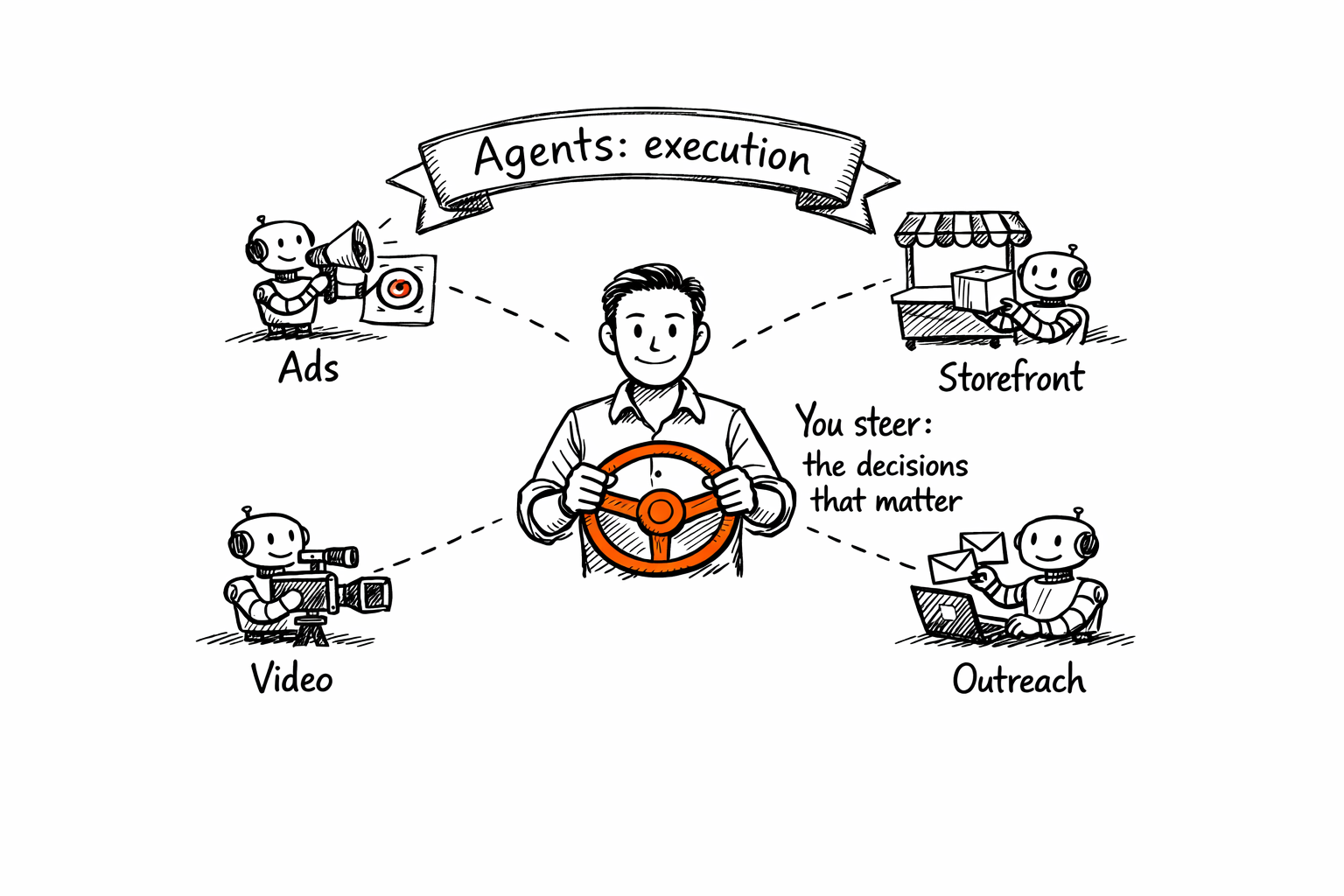
You own the idea. Agents can build almost anything once they know the target, but they do not decide which business is worth starting. You control the money, setting the budget and calling it when spend runs ahead of revenue. You make the real decisions, the pivots and the launches and the stops. You bring the taste, the sense of what is on-brand and what crosses a line. Agents draft, and you approve or send it back.
That last job only gets more important. As the barrier to starting a company falls, the bar for leading one rises. Alibaba.com's president makes the point sharply, arguing the competitive edge is no longer payroll or technical skill but judgment, taste, and vision, and that the real bottleneck becomes a potential lack of imagination. When agents can execute anything, what you choose to point them at is the whole game.
Runs itself, not without you. That is the line to hold onto. The company is autonomous. The founder is not optional.
The old path to scale vs the one-person-unicorn path
Here is the whole shift in one view.
| Business function | The old way (hire a team or department) | The AI-agent way (agents run it) | Who still decides |
|---|---|---|---|
| Brand and logo | Hire a designer or an agency | A brand agent generates directions and a logo for approval | The founder picks the direction |
| Website and online shop | Hire a developer to build and maintain it | An agent builds the site and stands up the shop | The founder |
| Marketing and ads | Hire a marketer to plan and run campaigns | A marketing agent launches and optimizes ad sets | The founder sets the budget |
| Sales and outreach | Hire a sales team to prospect and follow up | An outreach agent sends and follows up on emails | The founder on the relationships that matter |
| Operations | Hire an ops lead to run the day to day | An ops agent runs the storefront and reporting | The founder on exceptions |
| Strategy | Founder plus executives | Agents surface options and evidence | The founder, always |
Start with the idea you already have
The one-person unicorn is not magic, and it is not a robot that replaces you. It is the oldest thing in business, one person with an idea, finally handed a workforce that can build and run it around the clock. The billion-dollar outcome is the aspirational headline. The everyday reality it unlocks, a real business you can start alone, is already here.
If you have been sitting on an idea, waiting to know where to begin, that is where Pazi starts. Describe the business you want, watch the first assets get built, then set the direction and let the agents run the rest while you steer.