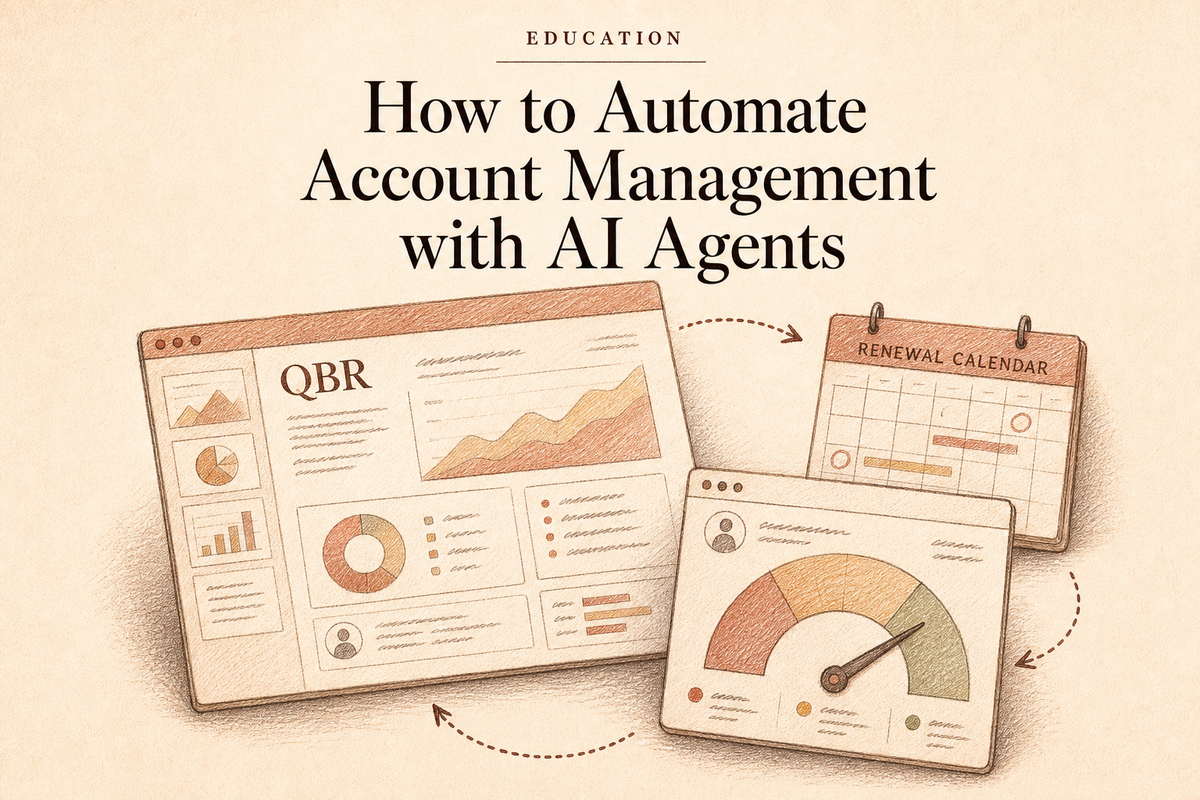
Account management automation is the practice of delegating the repeatable coordination, monitoring, and documentation tasks in an account manager's role to an AI agent, so the AM can focus on the relationship work only a human can do. Most B2B SaaS account managers spend more hours pulling renewal data and assembling QBR slides than they spend in the strategic conversations that determine whether accounts renew and grow, and that imbalance is what AI agents are built to fix.
According to Salesforce's State of Sales report, nine in 10 sales teams use agents or expect to within two years. For account management, the application is direct: the AM's week contains a layer of work that is schedulable, data-driven, and documentable. That layer belongs to the agent. This post walks through each part of it.
Table of Contents
- The repeatable layer: what the agent handles and what stays with the AM
- Where account managers lose their week
- What the agent handles: account health monitoring
- What the agent handles: renewal prep and documentation
- What the agent handles: QBR preparation
- What the agent handles: stakeholder tracking and communication hygiene
- What the agent handles: expansion signal detection
- How to wire in the agent
- What to measure
The repeatable layer: what the agent handles and what stays with the AM
Account management is the ongoing process of managing and growing relationships with existing customers. It centers on retention: keeping customers satisfied, identifying expansion opportunities, and ensuring the product delivers on what was sold. (This post covers account management only: renewals, expansion, QBRs, health monitoring, stakeholder tracking. Customer success work (onboarding, adoption, support) is a different role with different pressures. For that lane, see AI agent for customer success teams.)
That work has two distinct layers.
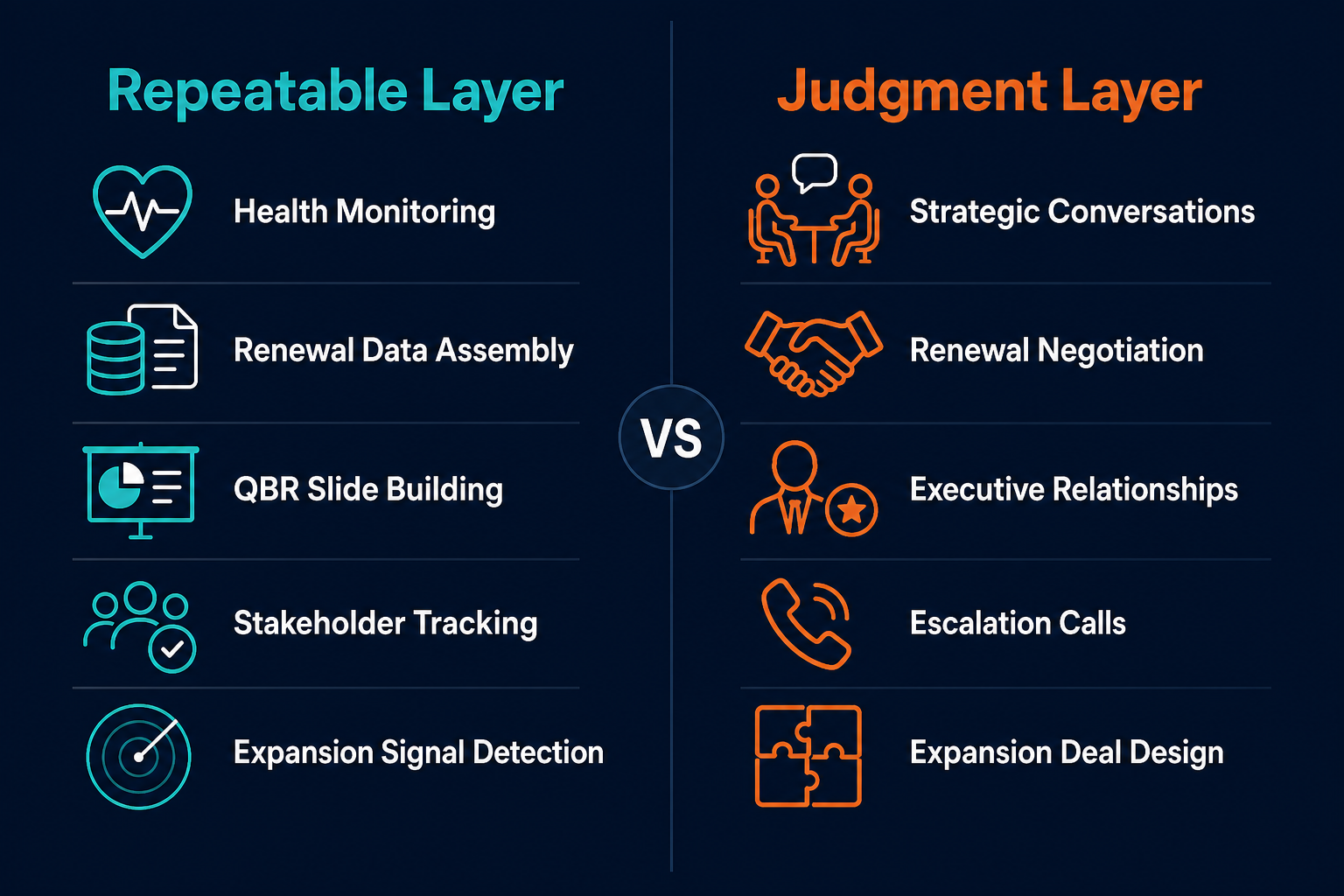
The repeatable layer is everything that can be defined by rules: watch these signals, pull this data, send this format when a threshold is crossed. Health score monitoring, renewal prep, QBR slide assembly, stakeholder activity tracking, expansion signal detection. These tasks have a defined trigger and a correct output. The agent runs them.
The judgment layer is everything that depends on context a machine cannot carry: the conversation where a champion is nervous about the renewal, the negotiation where two stakeholders want different things, the executive relationship that took two years to build. The AM does this work.
| Repeatable Layer (agent) | Judgment Layer (AM) |
|---|---|
| Account health signal monitoring | Strategic relationship conversations |
| Renewal data assembly and narrative draft | Renewal negotiation and pricing |
| QBR slide assembly from connected sources | Executive and stakeholder relationship management |
| Stakeholder contact activity tracking | Escalation calls requiring judgment and context |
| Expansion signal detection | Expansion conversation and deal design |
| Communication thread hygiene | Conflict resolution and trust repair |
Account management automation means moving the repeatable layer from the AM's calendar to the agent's queue. The job description stays the same. The distribution of hours changes.
The repeatable layer is what fills the AM's calendar. The judgment layer is what determines whether accounts renew.
Where account managers lose their week
Research from Harvard Business Review and Bain puts the cost of acquiring a new customer at five to 25 times more than retaining an existing one, and Frederick Reichheld's research at Bain shows that a 5% lift in retention drives 25% to 95% more profit. Account management is the function responsible for that retention. Despite the stakes, most AMs spend the bulk of their hours on tasks that are not the relationship work.
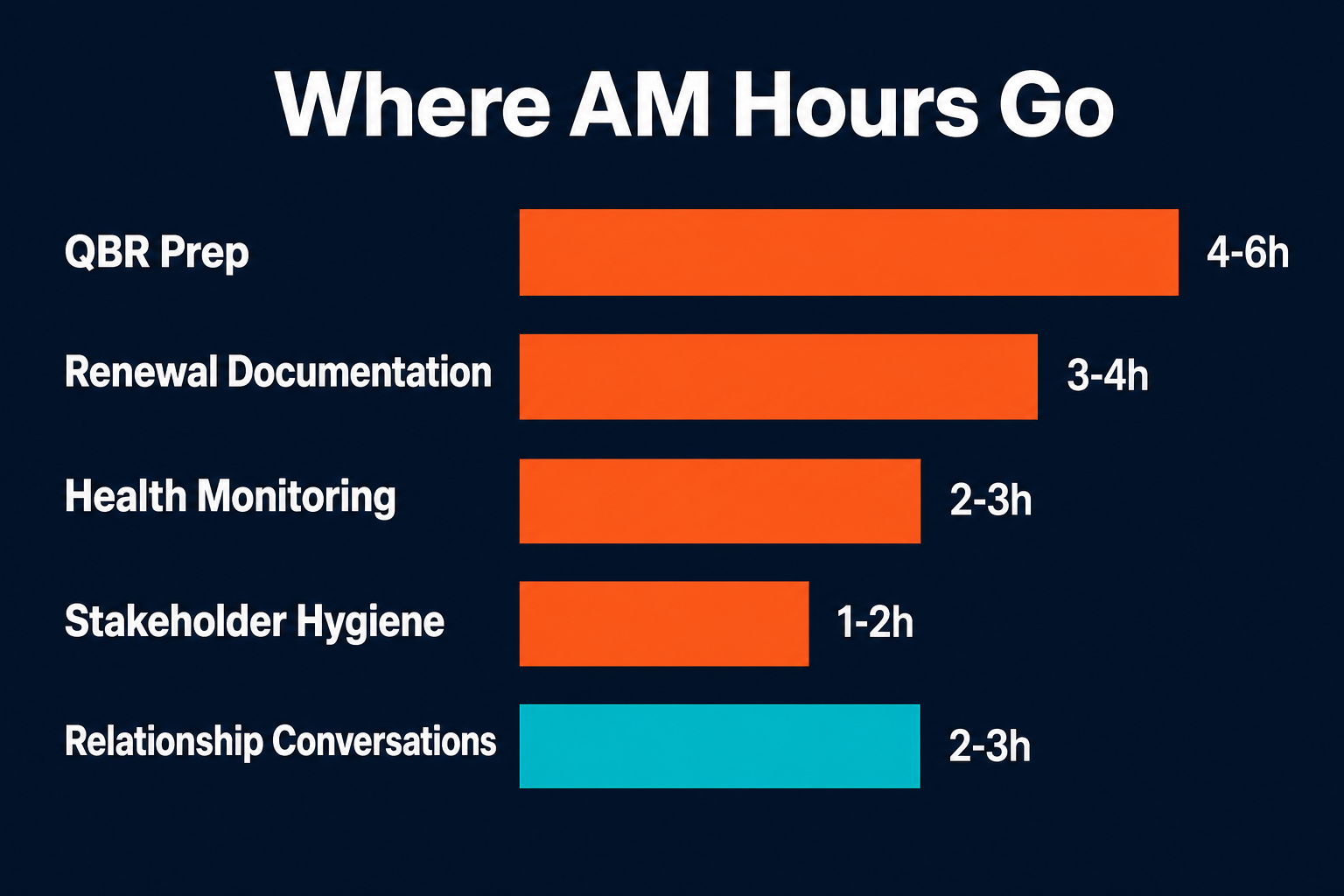
Health score theatrics come first. The AM logs into Gainsight or Salesforce twice a week. The health score has moved. The AM has no context for why, so they open tickets, pull usage data, and reach out to the CSM before they can act. By the time they make contact, the decline has been happening for days.
Renewal documentation is the second drain. An afternoon per account per quarter: pulling data from the CRM, the usage dashboard, the support ticketing system, and six months of email threads. The document that comes out is a narrative the AM writes from scratch each time.
QBR prep is the largest single block. Four to six hours the week before a major account review: pulling the usage slide, the goal progress slide, the open issues log, the next-quarter proposal. Every piece of data lives in a different tool. The AM assembles it manually.
Stakeholder drift accumulates silently. The champion who sponsored the deal 18 months ago has changed roles. The AM finds out during the renewal call, when a new stakeholder with no relationship history is on the other side.
Expansion signals go undetected between QBRs. Usage patterns that would have supported an upsell conversation in October sit in the product analytics tool undisturbed until the annual review in February.
The conversations that build trust and close expansions require an undistracted AM. The admin layer guarantees distraction.
What the agent handles: account health monitoring
Account health monitoring is the agent's most direct contribution to the AM's week. The problem is not that AMs ignore health signals. The problem is the detection lag: the gap between when a signal changes and when the AM learns about it.
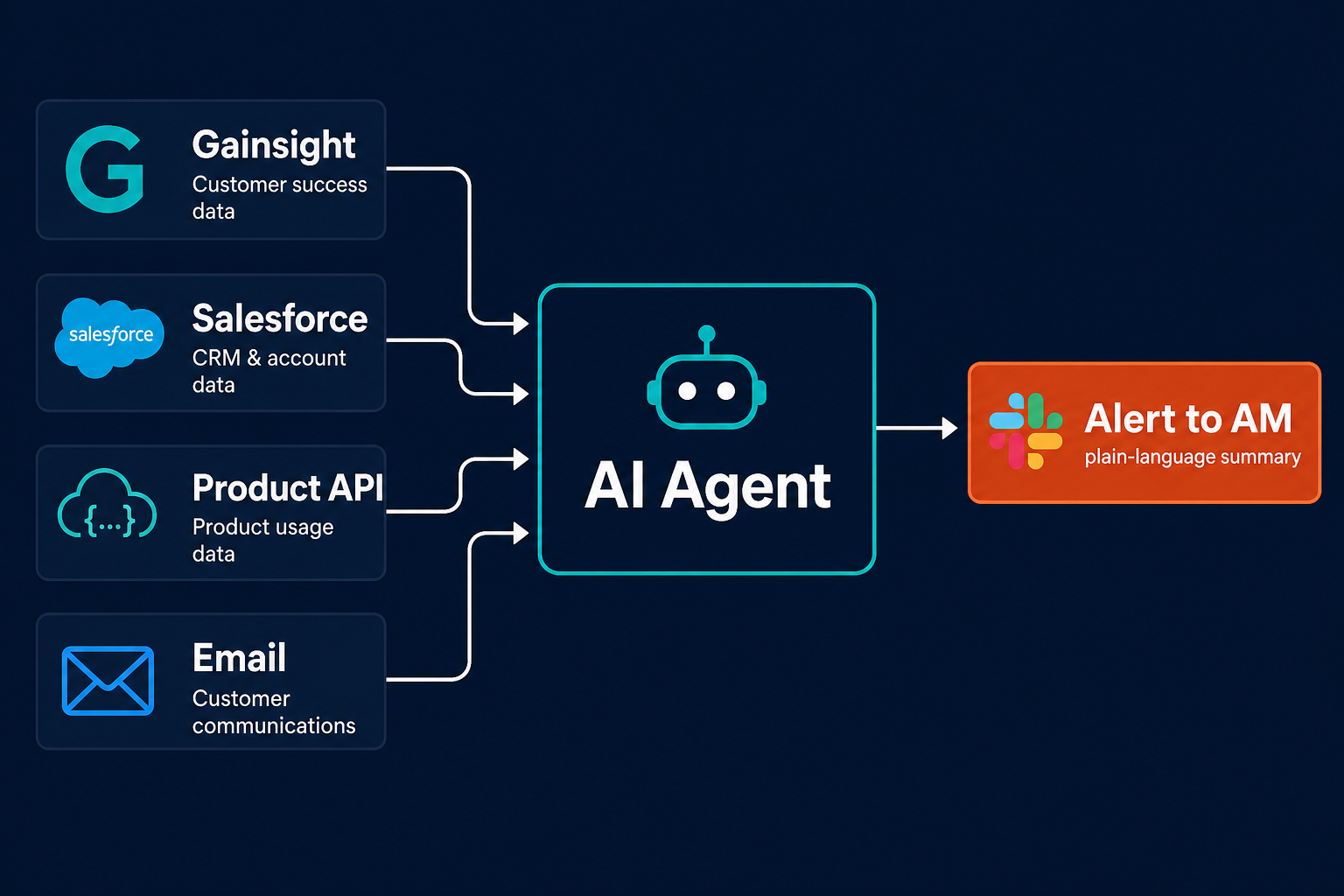
Before automation, the AM checks the health score dashboard twice a week. If the score has moved, the AM investigates which component dropped, what caused it, whether it warrants outreach. This takes time, and still leaves a 3 to 7 day gap between signal and awareness.
The agent closes that lag. It watches health signal components continuously: product usage delta against the prior period, support ticket volume and severity trend, engagement with materials sent to the account, contract milestone proximity. When a component moves past the defined threshold, the agent writes a one-paragraph plain-language explanation and posts it in the AM's Slack channel: the account name, what changed, and what it means.
The AM sets the conditions. The agent flags. The AM decides whether to act and how. Nothing goes to the account without the AM's review.
What the AM gets back is not a faster version of the same reactive process. It is a different process: proactive contact before the customer notices the problem, rather than response after the score has already dropped.
What the agent handles: renewal prep and documentation
Renewal prep is the most time-consuming repeatable task in the AM's quarter. For a book of 20 to 30 accounts with staggered renewal dates, there is always a renewal coming.
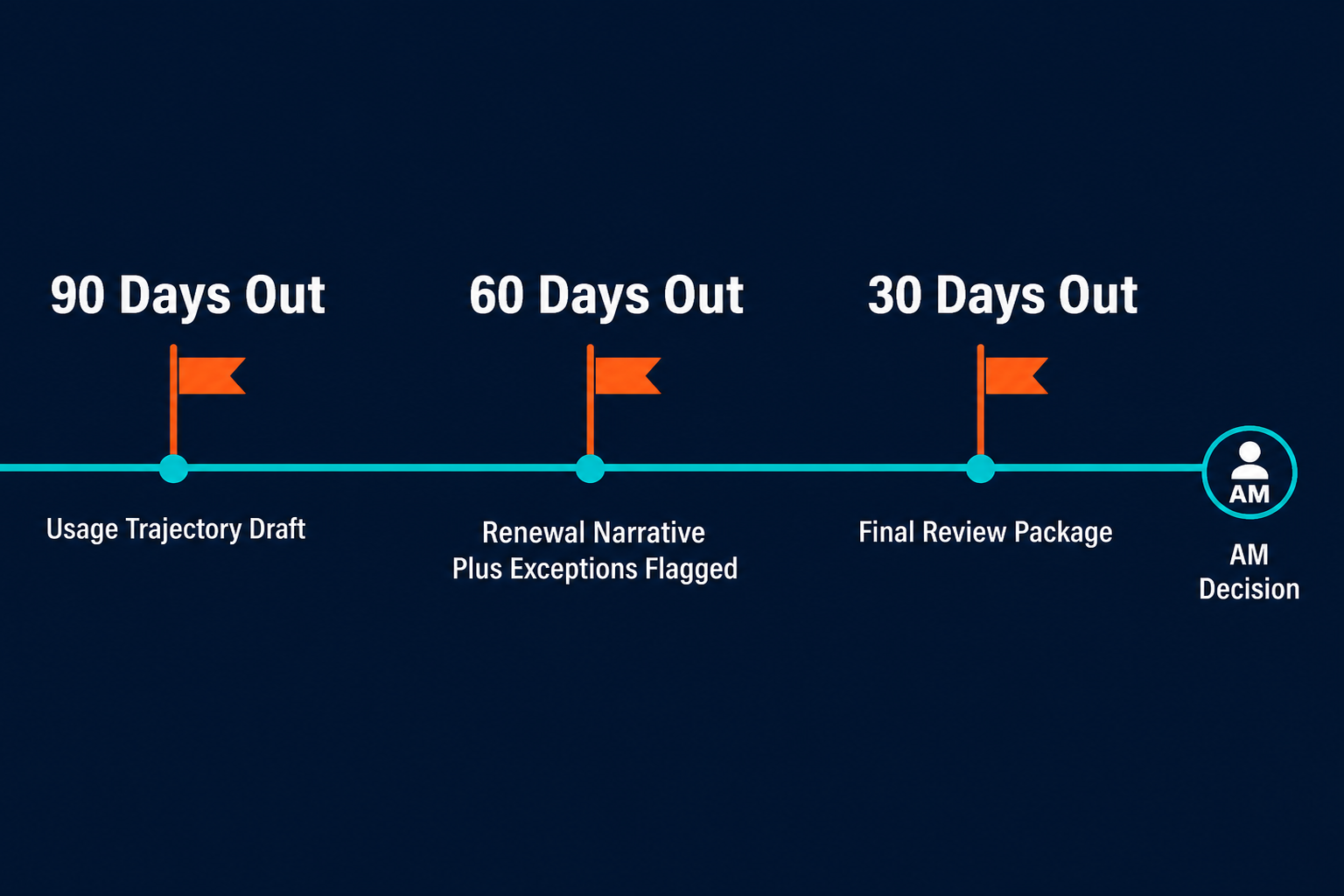
Before automation, the AM starts the renewal document by opening Salesforce, the usage dashboard, the support ticket history, and the prior QBR notes in separate tabs. They pull data manually and write the renewal narrative from scratch. If data is inconsistent across tools, they spend additional time reconciling it.
The agent replaces that first step. It watches the renewal milestone calendar. At 90 days out, it assembles the usage trajectory from the connected data sources and drafts the opening sections. At 60 days, it adds the full renewal narrative draft: account history, current usage trends, open issues, prior commitments. At 30 days, it surfaces the final review package with flagged exceptions.
Flagged exceptions are where the AM's judgment enters. Anomalous churn signals the data does not explain, unresolved issues with no ticket, inconsistencies between what the CRM shows and what the AM knows from conversation: these surface as questions for the AM, not silent gaps.
The AM reviews the draft, adds the relationship narrative and forward framing, and makes the call on how to position the renewal. The data assembly is done. The judgment work remains.
What the agent handles: QBR preparation
QBR preparation consumes more AM time per event than any other single task. For accounts that require detailed quarterly reviews, preparation can run four to six hours: pulling usage data from the product dashboard, goal progress from the CRM, open issues from the ticketing system, and previous commitments from meeting notes, then assembling them into a presentation structure.
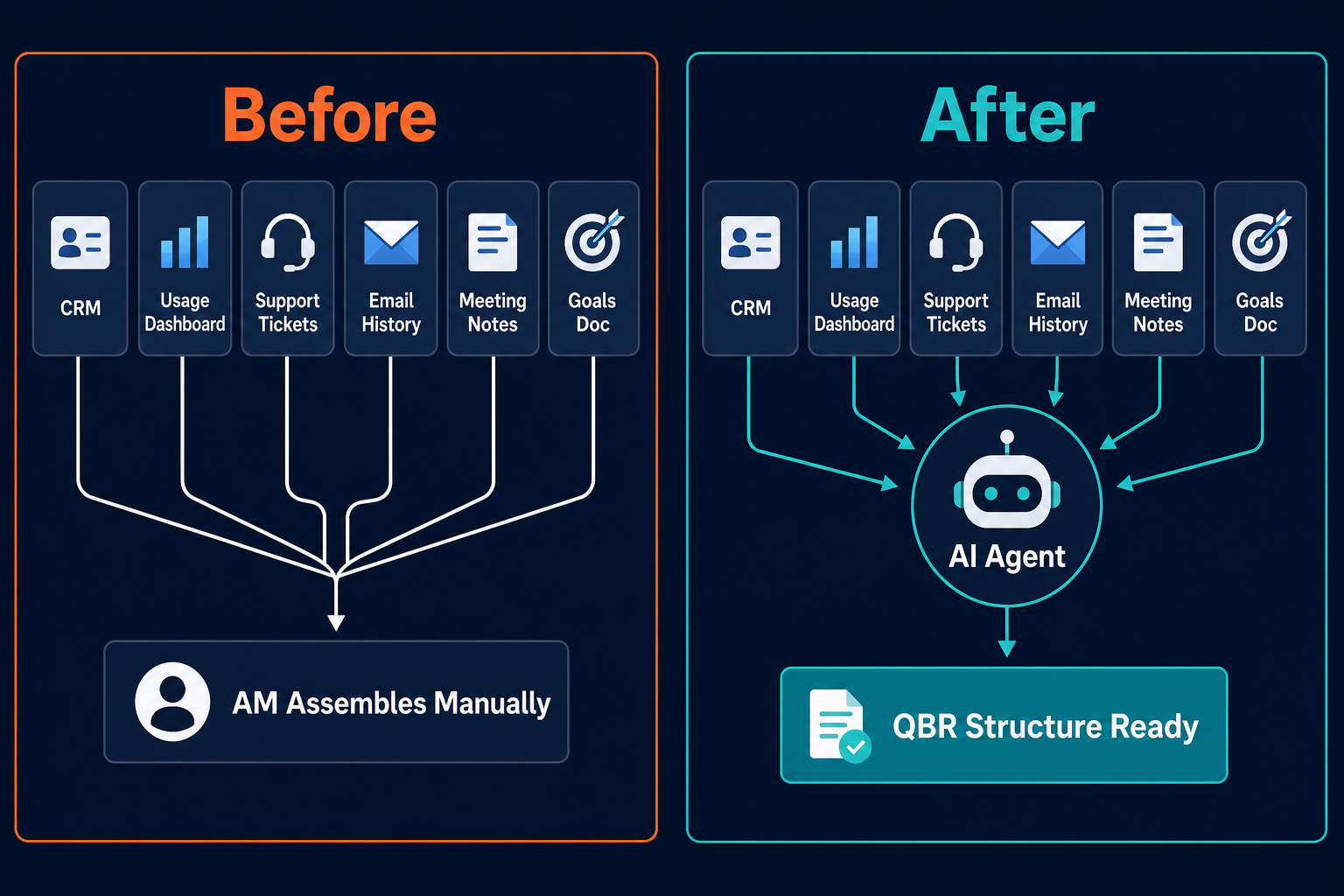
The agent connects to the same sources and does the assembly. It produces the QBR structure: usage trend, goal progress, open issues log, upcoming milestones, and prior commitments. It fills in the measurable data and flags the sections where AM judgment is required: the strategic narrative, the forward goals, the agenda items that depend on relationship context.
What stays human is the agenda design, the relationship framing, and the next-steps conversation.
The QBR is the conversation, not the deck. The deck is what the agent builds so the AM can focus on the conversation.
The AM who walks into a QBR with the data already assembled can spend preparation time on what the data means for the relationship, rather than on where the data lives.
What the agent handles: stakeholder tracking and communication hygiene
Stakeholder tracking is the least visible AM task until it fails. Contact churn is a silent renewal risk: the champion who built the relationship with the AM changes roles or leaves, and the AM finds out at the worst possible moment.
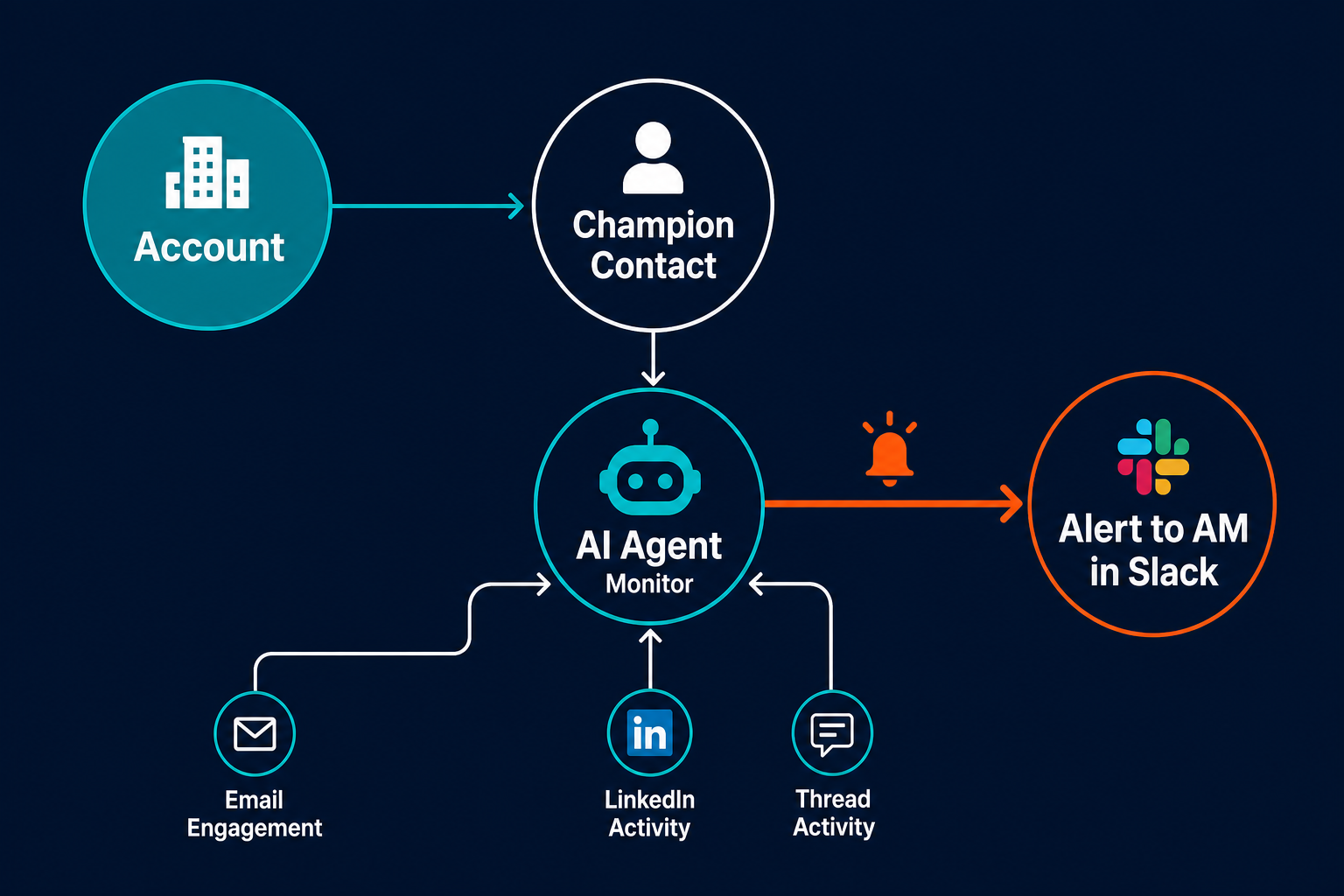
Before automation, stakeholder drift happens between touchpoints. The AM's contact log in Salesforce reflects who was relevant six months ago. A champion's departure shows up in a LinkedIn notification the AM may or may not catch, or in an email bounce the AM notices only when a renewal communication fails to land.
The agent watches contact activity signals continuously. Email engagement drops below the defined threshold: flagged. LinkedIn role change detected through integration: flagged. A thread within the renewal window goes quiet past the defined period: flagged. In each case, the agent posts to the AM's Slack channel with the account and contact name, what changed, and a drafted re-engagement prompt for the AM's review.
The AM who knows the champion has changed can establish the new relationship before the renewal conversation. The AM who discovers it at the renewal conversation is starting from scratch.
Communication hygiene follows the same pattern. The agent monitors active threads and surfaces ones that have gone quiet within the renewal window, so the AM can act while the relationship is still warm.
What the agent handles: expansion signal detection
Expansion signals have a detection lag problem that is longer and more expensive than health signal lag. A usage pattern that would support an upsell conversation often appears 6 to 12 months before an AM notices it.
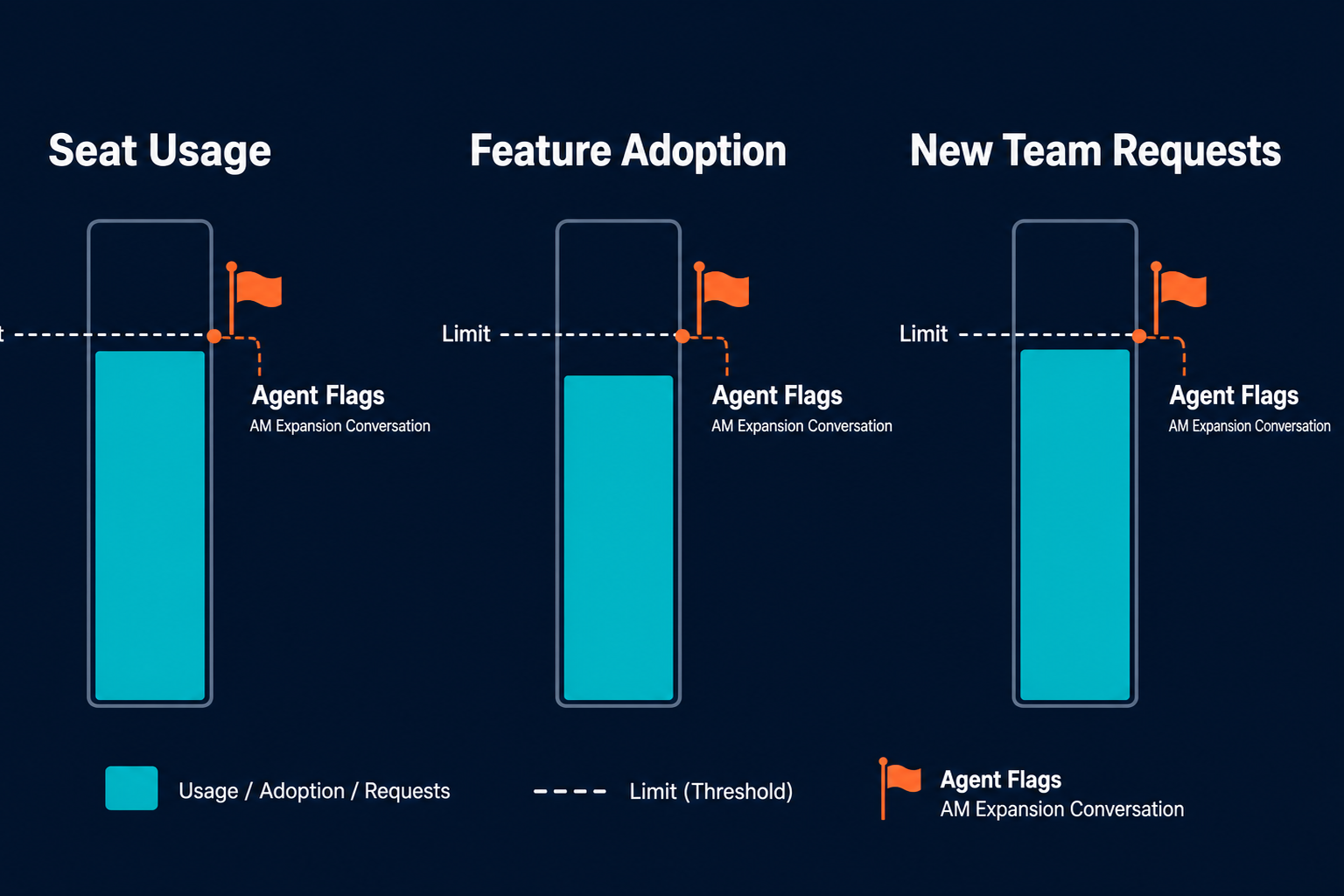
Before automation, expansion discovery happens in QBRs or annual reviews. By then, the account has been operating at or above its contracted tier for months, often with informal workarounds: team members sharing seats, users skipping premium features they would adopt if available. The expansion conversation opens with the customer already experiencing friction.
The agent watches usage against the account's contracted tier: users approaching the seat ceiling, feature adoption climbing toward a premium tier threshold, new-team adoption patterns that indicate demand for broader deployment. When a signal crosses the defined threshold, the agent surfaces it with context: which users, which features, over what period, against what contracted limit.
The AM makes the expansion conversation. It opens with evidence rather than a cold ask. The timing is driven by product behavior rather than renewal-window pressure.
How to wire in the agent
The implementation path for an account management agent follows four steps. Each step depends on the output of the prior one: the data connections in Step 2 depend on knowing what the agent needs from Step 1, and the escalation rules in Step 3 depend on knowing what the data can actually surface.
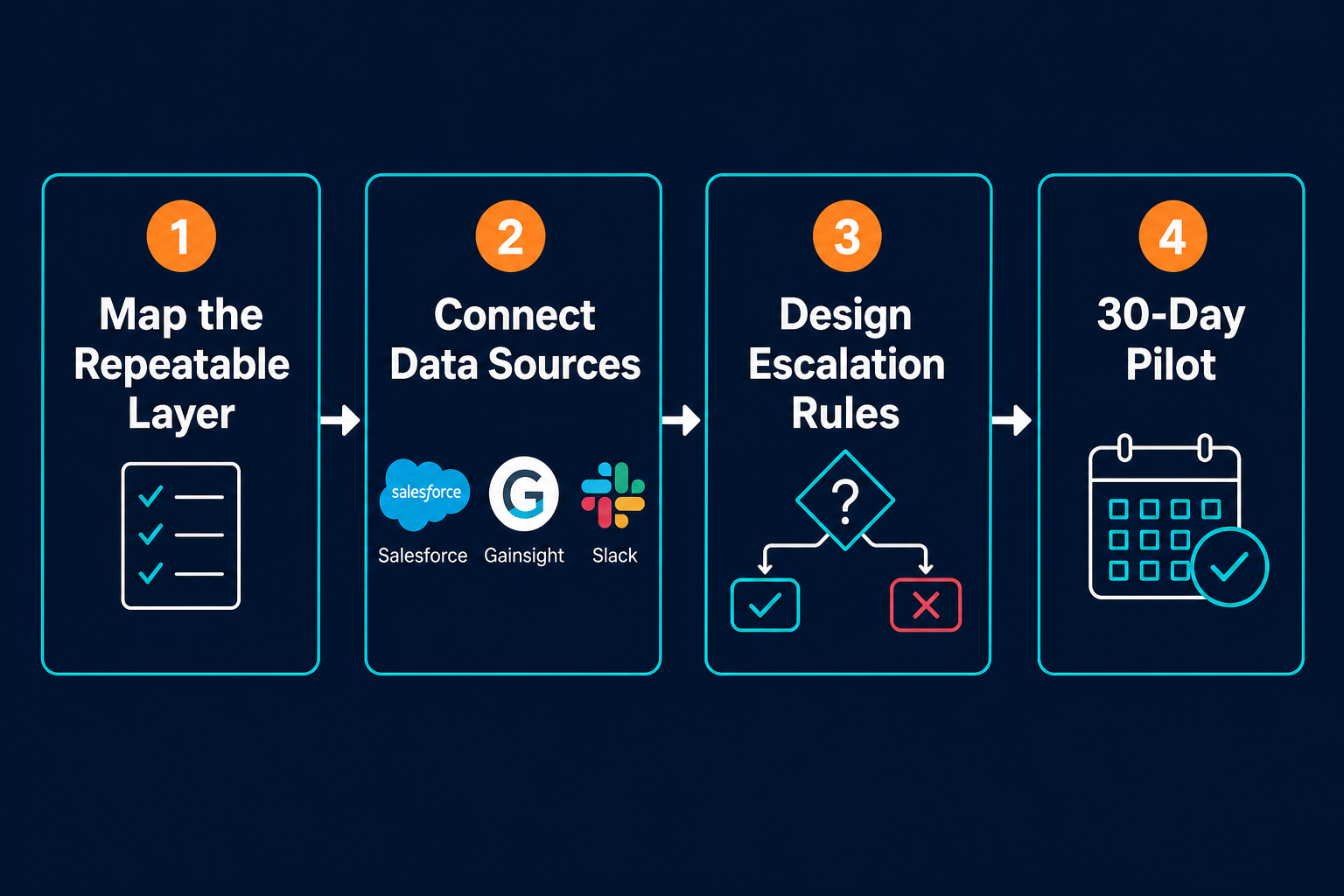
Step 1 is mapping the repeatable layer. For each AM workflow, document which tasks are rule-based: they have a defined trigger, a data source, and a clear output format. Separate those from judgment tasks. The map becomes the agent's scope definition. Anything outside the map stays with the AM.
Step 2 is connecting the data sources. The agent needs read access to the CRM (Salesforce or HubSpot), the customer success platform if one is in use (Gainsight or ChurnZero), the product usage API, and communication channels (Slack and email via integration). The connections establish the signal layer.
Step 3 is designing the escalation rules. For each signal type, define: what threshold triggers a flag, what format the flag takes, which channel it goes to, and what response the AM takes. For how to design this human oversight layer so the agent flags and the AM decides rather than the agent acting unilaterally, see Human-in-the-Loop AI Automation: Designing Oversight Without Killing Throughput. The agent never sends external communications to customers without AM review.
Step 4 is a 30-day pilot on 2 to 3 accounts before scaling. Pilots surface three things: signal noise (thresholds that fire too often or not often enough), format gaps (escalation messages that do not give the AM enough context to act), and integration gaps (data sources that are theoretically connected but practically incomplete). Adjust before scaling.
Pazi is a platform for building account management agents that connect to your existing AM stack and run inside Slack, where the escalation messages surface in the channel where your team is already working.
| Step | Action | Tools | Owner |
|---|---|---|---|
| 1. Map | Document repeatable vs. judgment tasks | AM workflow audit | AM lead + ops |
| 2. Connect | Wire data sources to the agent | Salesforce, Gainsight, product API, Slack | Technical setup |
| 3. Rules | Define escalation triggers and output format | Agent configuration | AM lead |
| 4. Pilot | Run on 2-3 accounts for 30 days | Agent + AM review | AM + ops |
What to measure
Six metrics determine whether the account management agent is working. The first four are operational: they measure whether the agent is handling the repeatable layer correctly. The last two are outcome metrics: they measure whether recovering AM time from the repeatable layer is changing results.
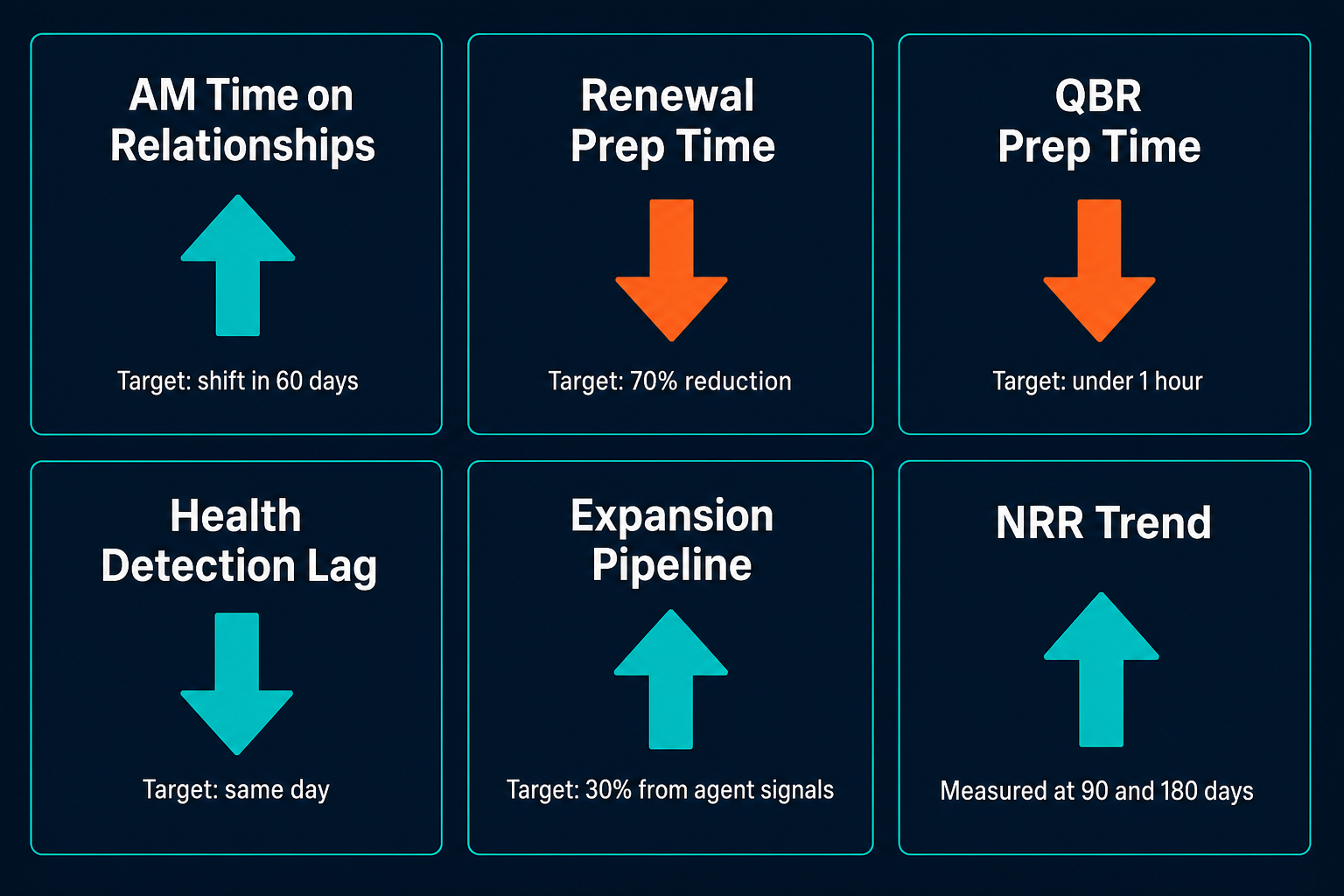
1. AM time-on-relationship vs. time-on-administration. Track the before/after ratio via calendar audit or time logging. Target: a shift toward relationship time within 60 days of full deployment. If the ratio does not change, the agent is running but the AM is spending recovered time on other admin work rather than on strategic conversations.
2. Renewal prep time per account. Hours from "renewal work begins" to "narrative complete." Baseline this before deploying the agent. Target: 70% reduction. If prep time does not fall significantly, the data connections in Step 2 are incomplete or the agent's output format requires too much AM rework.
3. QBR prep time per quarter. Hours per QBR, before and after. Target: from 4 to 6 hours for data assembly down to under 1 hour. The remaining hour is the AM's preparation for the conversation.
4. Health signal detection lag. Days between first measurable signal change and AM awareness. Before automation: 3 to 7 days, depending on dashboard check cadence. After: same day. If detection lag does not improve, the health monitoring thresholds need tuning.
5. Expansion pipeline from agent-surfaced signals. Track which expansion opportunities originated from agent detection versus QBR discovery or AM initiative. Target: 30% or more of expansion pipeline from agent signals within two quarters. This measures whether the agent is finding opportunities the AM would have missed.
6. NRR trend. Net revenue retention at 90 and 180 days post-implementation. This is not a direct agent metric; it is the outcome metric the automation is designed to support. A functioning repeatable layer frees the AM for relationship work. Relationship work drives renewals and expansion. NRR is where that chain ends.
Related reading
- AI agent for customer success teams: customer success (onboarding, adoption, support) is adjacent to account management but a different role with different tools. This post covers the CS lane.
- AI agent for outbound sales: the pre-sale motion that feeds the AM's book of business.
- Human-in-the-Loop AI Automation: Designing Oversight Without Killing Throughput: how to design escalation rules so agents flag and humans decide.
Pazi is a platform for building account management agents that live where your team already works, in Slack, where the AM gets health alerts, renewal drafts, and expansion signals without switching tools. If you are managing renewals and expansion for a B2B SaaS book of business, Pazi is where you build the agent that handles the repeatable layer so your account managers can do the work only humans can.