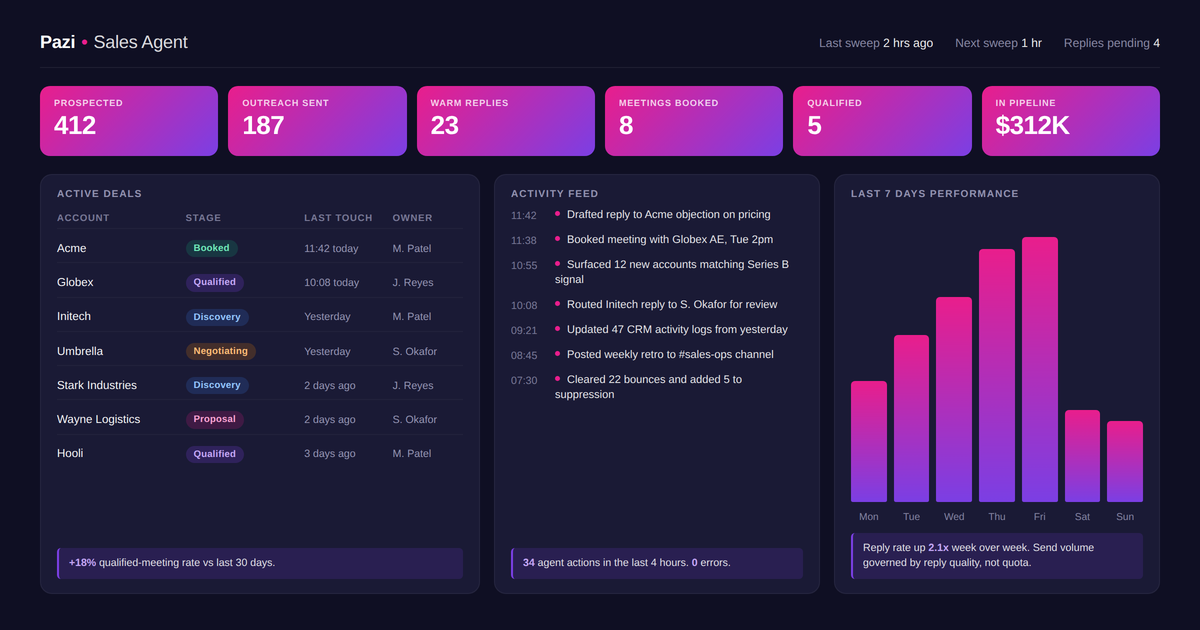
An AI agent for outbound sales is one accountable software agent that owns the full outbound loop, from prospect-list build through CRM hygiene and the after-action retro. It runs on a schedule, not a click. It uses the same CRM, mail, and calendar a human operator would, and shows its work where the team already decides. The shorthand IBM Think uses is the one the field has settled on: software that perceives, decides, acts, and learns in real time.
An outbound agent is not a sequencer pacing emails for a human SDR. It is not a multi-agent suite where the operator stitches the bots together. It is not a character-named AI BDR pretending to be a hire. It is one agent that holds the whole job, runs on a cron, and surfaces the moments that need an operator's call.
What an AI agent for outbound sales actually is
The category has converged on a consensus capability stack and split into camps. Vendors that ship "AI sells, rep reviews" pair the agent with a human SDR at every gate: HubSpot Breeze, Salesloft Rhythm, Outreach. Vendors that ship "AI replaces the BDR" frame the agent as a hire: 11x's autonomous AI BDR, Artisan's autonomous AI BDR. Platform vendors pitch a constellation: Salesforce Agentforce, Microsoft Copilot, Google Gemini Enterprise.
None of those shapes match what most operators want to evaluate. The real question is whether one accountable agent can own the loop, from a flat list of company names through the after-action retro, without the operator stitching four tools together.
How an AI agent for outbound sales works
The four components map cleanly to the field's canonical mental model. Outreach, Copy.ai, IBM Think, and Salesforce all describe agents in sales as a perception-decision-action-learning cycle. The shapes are the same; the difference is whether the agent runs the cycle for one stage of outbound or all of them.
Perception
Perception is the input layer. The agent watches the CRM for stage changes, the inbox for replies and threads going cold, and the calendar for booked and no-show meetings. It also reads the signals the operator has wired in: web visits, hiring pages, funding announcements, product launches, intent feeds, LinkedIn activity. Static account data decides ICP fit: industry, size, tech stack, geography. The agent reads from the tools you give it; perception expands as you connect more of the surface.
Decision-making
Decision-making is the part where most stacks break. It is the part nobody automated cleanly before agents. The agent scores a company against the ICP, then scores the signal against a threshold. The decision is one of three things: send, hold, or skip. It picks the channel the contact is most likely to respond on, and the angle that maps to the trigger rather than a generic template. McKinsey puts the productivity lift from generative AI in sales at 10 to 20 percent.
Action
Action is the send. The agent drafts the email, the LinkedIn touch, the call opener, and queues them at the right cadence. Humans approve external sends by default, and every send shows up in Slack first. When a reply lands the agent reads it, classifies it (warm, objection, ask, unsubscribe, bounce), and either drafts the response or surfaces the thread. Booking is part of action: read calendar availability, propose times, send the invite, write back to the CRM.
Learning
Learning is the loop that keeps the agent from drifting. After every campaign the agent reads outcomes against inputs: which signals produced replies, which channels worked for which segments, which subject lines landed, which messages got marked unsubscribe. It updates scoring weights, sender variants, and handoff rules accordingly. Every action shows up in Slack so the operator can correct in real time, not in a quarterly retro nobody runs.
The full outbound process the agent owns
Outbound is not four phases. It is eight, and the field has consolidated around that count. The agent owns each stage; the operator owns the strategic calls and the configuration. The shape extends to other Pazi agents the operator can pull in for cross-functional work; the influencer-marketing agent is the closest sibling inside the marketing motion.
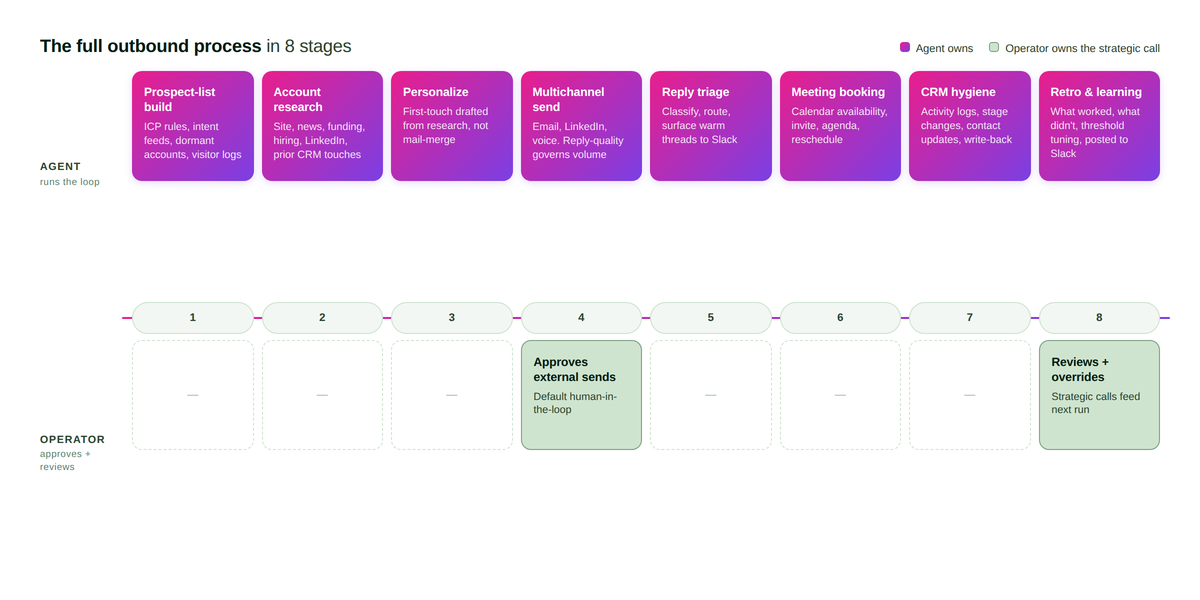
Stage 1: Prospect-list build. The agent ingests ICP rules and pulls candidates from the providers the operator wired in: data vendors, intent feeds, dormant CRM accounts, anonymous visitor logs. It deduplicates against accounts in motion, filters closed-lost cooldowns, and returns a ranked list with reasoning attached.
Stage 2: Account research. For each target the agent reads the site, recent funding or hiring news, product launches, the likely buyer's LinkedIn profile, and any prior CRM touches. HubSpot's Breeze product copy claims up to a 95 percent decrease in time reps spend researching and personalizing; a half-day per twenty accounts becomes a few minutes of operator review.
Stage 3: Personalize. The agent drafts a first-touch message per contact. Personalization comes from the research, not a mail-merge field. Brand voice is configured up front in the agent's instructions, not trained from a generic template. That is what stops the slop pattern r/sales keeps calling out.
Stage 4: Multichannel send. Email, LinkedIn, voice, in the operator's order of preference. The agent paces against deliverability rules, governs volume by reply quality rather than quota, and waits for warm-up windows. HubSpot reports up to 2x higher response rates versus traditional sequences on its own Breeze data, with BDRs editing only 3 percent of AI-drafted emails before send.
Stage 5: Reply triage. The agent reads every reply, classifies it, and routes accordingly. Warm replies surface into Slack with the thread and the next move. Objections get drafted responses for operator review. Unsubscribes and bounces feed the suppression list.
Stage 6: Meeting booking. The agent proposes times against live calendar availability, sends invites with a context-loaded agenda, and reschedules around no-shows. Bridge Group's SDR benchmarks put average ramp at three to five months and attainment around 70 percent; the agent's ramp is the time it takes to wire the calendar.
Stage 7: CRM hygiene. Every action writes back: activity logs, meeting outcomes, call notes, contact and stage changes. The CRM stays current because the system that took the action also updated the system of record. Salesforce's State of Sales has put non-selling time at roughly 70 percent of a rep's week, and CRM admin is one of the reasons sellers spend time outside the deal itself.
Stage 8: Retro and continuous learning. After each campaign the agent posts a retro: which signals produced meetings, which messages got replies, which thresholds need tuning. The operator reviews, overrides where they disagree, and the next run incorporates the changes. The retro is automatic, not a meeting the team keeps moving.
AI agent for outbound sales vs AI SDR vs sequencer + copilot
The shapes the buyer is evaluating come down to scope and accountability. A sequencer plus a copilot (Outreach, Salesloft) automates pacing and suggests next-best actions while a human SDR drives every step. An AI SDR persona (11x, Artisan) takes the prospect-to-meeting sub-loop and pitches itself as a hire. A signal-to-action workflow brain (Salesloft Rhythm, Apollo) prioritizes what the rep should do next without taking the action. A platform constellation (Salesforce Agentforce, Microsoft Copilot) positions the sales agent as one tile in a wider platform surface.
Pazi's shape is none of those. It is one accountable agent that owns the loop end-to-end and runs inside Slack as the operator surface. When work crosses team lines, it hands off to other Pazi agents: DevOps when a deliverability issue traces to infra, Exec when a deal qualification needs a leadership call. The handoff destinations are configured by the operator, not a fixed pipeline.
A tool helps you do outbound. An agent runs outbound with you. The difference is accountability when the loop runs at 2am on a Tuesday. A sequencer plus a copilot puts the answer on the operator's calendar. An outbound agent puts it in the agent's job description, with the operator reviewing the moments that matter.
What changes when one agent owns the whole loop
When all eight stages run on one agent instead of three or four, the operator's day changes. Salesforce's State of Sales has tracked sellers spending around 70 percent of their week on non-selling tasks. CRM admin, prospecting, and reporting carry most of that load. An agent that owns those stages takes them off the rep's calendar, including the competitive-intel monitoring that informs which accounts to chase next.
Pipeline stays current because the agent writes back as it works, not because someone scheduled a Friday hygiene block. Deliverability stays clean because send volume is governed by reply quality, not quota, and humans approve external sends by default. Every send, reply, and miss is logged with the agent's reasoning attached, which makes "what changed" a one-line query.
The operator only sees the moments that actually need their judgment. The rest of the time the loop just runs. Feedback loops close, because every handed-off action has a due date and a chase, and the retro lands in Slack on a cron whether anyone asked for it or not.
Challenges and considerations
An agent owning the full outbound loop is not plug-and-play. Brand voice and ICP rules need a real configuration pass. Defaults are a starting point; most teams settle into their actual priorities once the agent has cycled through a few campaigns under operator overrides. Deliverability tooling (warm-up, domain rotation, suppression) is wired in by the operator with the right credentials. The agent runs whatever inputs it has been authorized to run.
The compliance baseline is an honest conversation. Field leaders ship formal posture: Outreach is ISO 42001 certified, Salesforce ships a Trust Layer, Conversica carries SOC 2 and GDPR. Pazi doesn't ship formal compliance posture today; humans approve external sends by default, every action shows up in Slack as the first guardrail, and certification work is on the roadmap. The agent removes the manual work; the operator still owns the strategic calls, the brand-voice configuration, and the compliance posture that fits their company.
Build the agent
You can build your outbound agent on Pazi today, configured against your ICP rules, signal sources, channel mix, send-volume governance, and your handoff destinations when work crosses team lines. The agent works inside Slack, runs on a cron, and doesn't add another dashboard. The work moves out of a stack of tabs, the loop keeps running while you sleep, and the operator gets back to the parts of outbound that actually needed an operator.