Over 76% of customer service and CS leaders say their tech stack holds their team back from achieving their goals. The post-sale work piles up because the dashboard the CSM logs into twice a week is the tool that has the data, but Slack is where the work happens. The CSM's day fills with renewal narratives, health-score reviews, QBR prep, NPS follow-ups, and churn-risk escalations. A customer success AI agent sits in your channels as a real coworker, triages every CX touch-point, and alerts the CSM when something needs eyes.
Why customer success teams are the least automated revenue function
Post-sale is where the money is and where the tooling is thinnest. Acquiring a new customer costs five to twenty-five times more than retaining one, and the same Bain research tucked inside that piece shows a 5% lift in retention drives 25% to 95% more profit. The customer side knows it too: 49% of customers who left a brand they were loyal to in the past twelve months blame poor experience, and 70% expect anyone they touch to have full context.
The numbers make CS look like the obvious place to invest, and most teams have. Gainsight, ChurnZero, Totango, Vitally, Catalyst. Every CSP on the market now ships an AI surface bolted on top of the dashboard. They are good at what they do. The problem is where they live. The CSM has Slack open all day, with the customer in shared channels and with the AE in internal threads. The CSP gets opened twice a week, when it is time to write the QBR or stare at a renewal pipeline. The intelligence is in the dashboard. The work happens somewhere else.
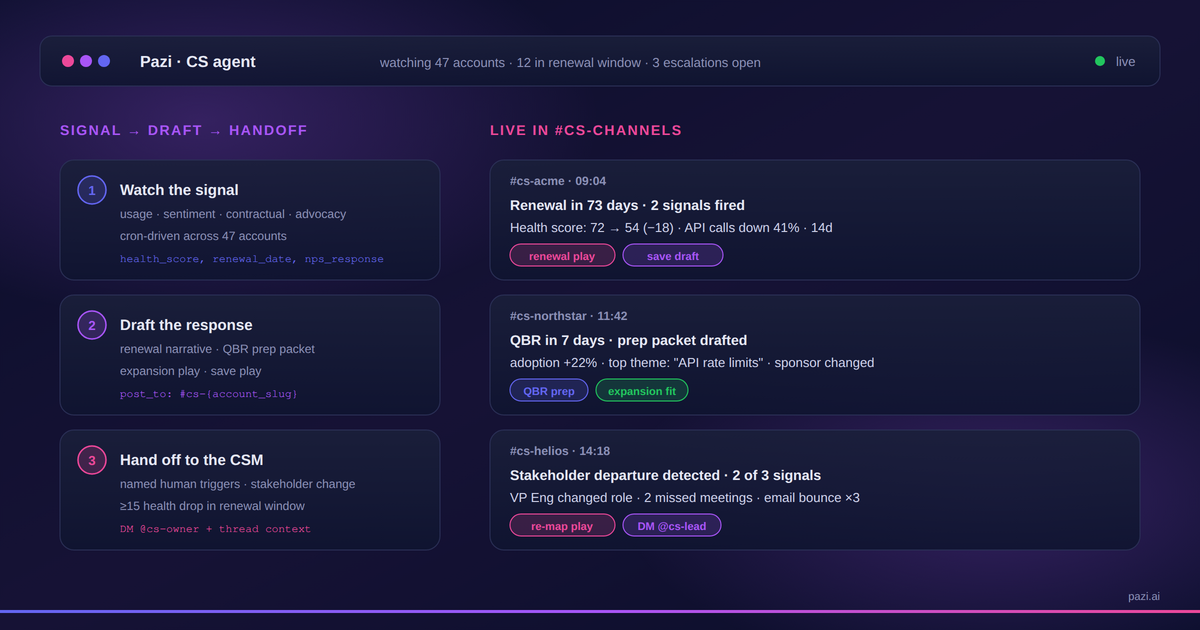
Pazi sits in your Slack; you describe what you need and it does it. Here is what its daily output looks like in your channel.
Eight customer-success automations to build with Pazi
These are the eight automations CS leads have asked us about most. The agent runs all of them the way a coworker on the team would, and you pick the ones that fit how your team works.
1. Onboarding milestone tracking and time-to-first-value alerts
The problem: the early days set the renewal. A new account that hits its onboarding milestones on time renews at a different rate than one that drifts. CSMs intend to track milestones per account, but the spreadsheet falls behind and nobody notices the slip until the kickoff retro.
What Pazi does: the agent watches the milestone events streaming from your product against the onboarding plan you sent the account at kickoff. When a milestone slips past target, it drafts a check-in for the CSM and posts it in the account's Slack channel.
2. Health-score watcher across usage, sentiment, and contractual signals
The problem: CSPs compute a health score, but the score is a single number that hides the why. By the time it has dropped enough to flag, the customer has been quietly disengaged. The CSM sees the red badge in the dashboard the next time they open it.
What Pazi does: the agent watches the score in your CSP, but it also watches the underlying components. When the composite drops, it writes a one-paragraph reason in plain language and posts it where the CSM works. When two or more components move in the same direction inside the renewal window, it tags the right person.
3. Renewal-narrative drafting from account history
The problem: the renewal narrative is the most important written artifact a CSM produces, and it is also the most procrastinated. The CSM reads through ticket history, Slack threads, QBR notes, and product usage to write a one-pager that the AE then negotiates against. Hours of work per renewing account, mostly retrieval.
What Pazi does: the agent assembles the narrative draft from the inputs the CSM already has open: ticket history, recent sentiment shifts, usage trends, support resolution, expansion conversations, executive sponsor changes. It writes the first draft the CSM edits, not a paragraph the CSM rewrites from scratch.
4. QBR prep automation
The problem: QBR prep is research work that does not need a CSM doing it. Pulling adoption metrics, summarizing support volume, surfacing the feature areas the customer used most, sketching the agenda. ChurnZero's analysts flag QBR-deck pre-population (adoption metrics, support volume, account history) as one of the highest-yield AI surfaces in CS.
What Pazi does: ahead of a scheduled QBR, the agent assembles the prep packet. Adoption metrics by feature area, recurring support themes, expansion mentions in customer threads, decision-maker changes, recent trend lines. It posts the packet in the account's Slack channel and outlines the slide deck.
5. Churn-risk escalation when two or more signals trigger inside the renewal window
The problem: churn is rarely one signal. It is usage drift plus a sentiment shift plus a stakeholder change, all inside the renewal window. Each signal alone reads as noise; together they are the renewal call the CSM should be making this week, not next month.
What Pazi does: the agent runs a continuous watch on your account list. When two or more signals trigger inside the renewal window, it escalates. ChurnZero's human trigger library framing is the right pattern here: the agent identifies the moments that pause its own automation and pull a human in. The agent does not write the save play; it surfaces the case, lists the signals, and hands off.
6. Expansion-opportunity surfacing from product-usage thresholds
The problem: expansion conversations are missed when usage crosses a meaningful threshold and nobody notices. A customer's seat count jumps, the API rate ceiling is hit, or the workflow rolls out to a second department. Each of those is a conversation the AE should be having that quarter. Most never reach the AE.
What Pazi does: the agent watches usage thresholds you define (seat counts, API volume, feature breadth, departmental rollout) against the expansion playbook the team agreed on. When a threshold trips, it drafts the expansion outreach and queues it for the CSM and AE.
7. NPS and CSAT follow-up sequencer with sentiment routing
The problem: survey responses come in at a steady trickle and most never get followed up. A 6 on NPS deserves a CSM ping the same week. A 9 deserves a case-study ask, not silence. The follow-up backlog is the surface where most CS teams already accept they are dropping the ball.
What Pazi does: the agent reads survey responses as they come in, classifies sentiment beyond the score (the comment matters more than the digit), and routes. Promoters get an advocacy ask drafted for the CSM. Passives get a check-in. Detractors get the right escalation, the right same-week, with the comment context attached.
8. Stakeholder-departure detection across LinkedIn, email, and missing meetings
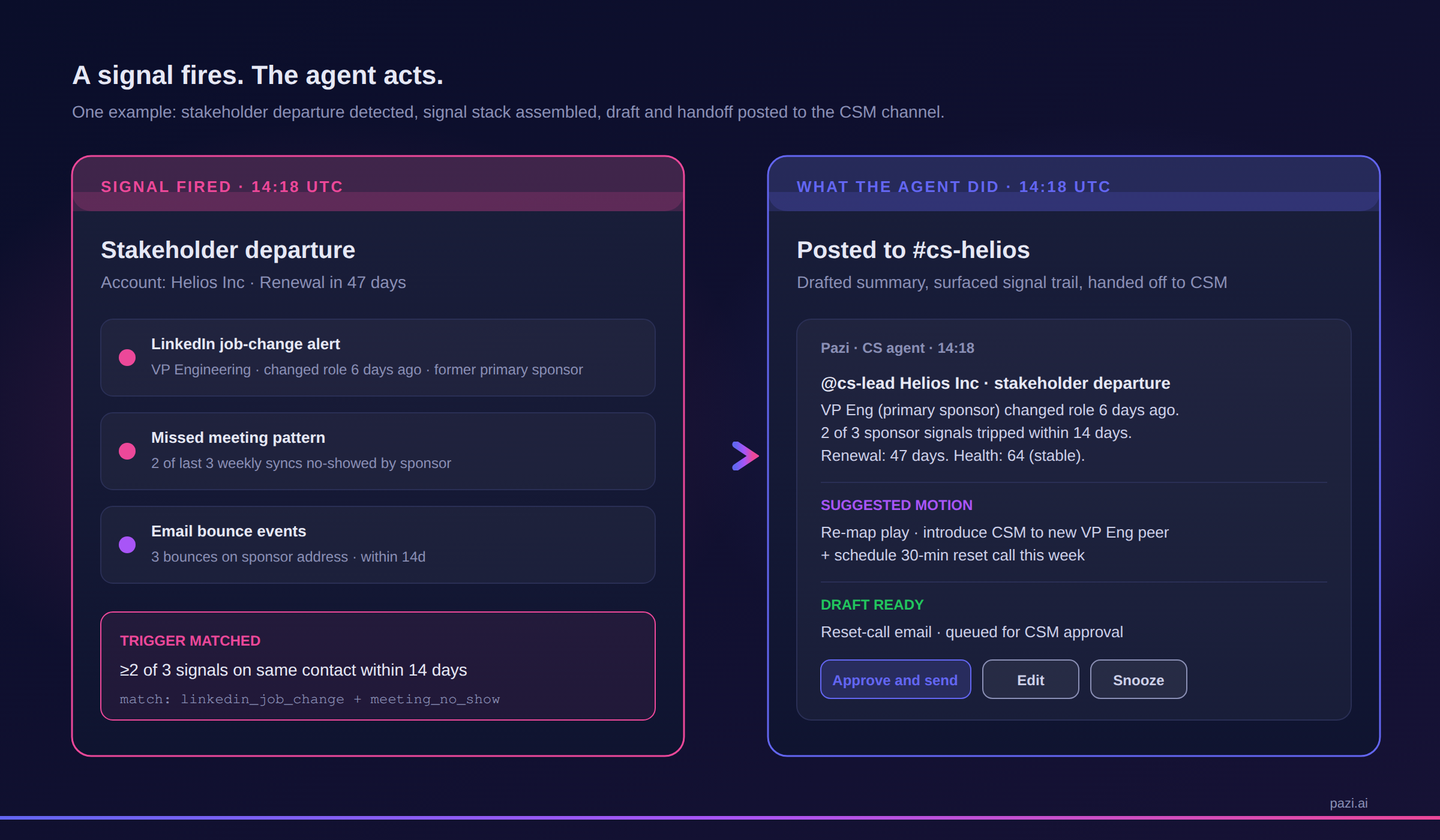
The problem: the executive sponsor leaving the company is the single hardest signal to catch and the one that most directly predicts churn. The CSM often finds out late, after the renewal has already started slipping. ChurnZero, Velaris, and most CS analysts converge on stakeholder change as the most evidence-backed human trigger in the entire CSP signal stack.
What Pazi does: the agent watches three sources for departure signals: LinkedIn job-change alerts on named contacts, email-bounce events on the contact list, and missed-meeting patterns from the meeting calendar. When two of three trip on the same contact, it flags the account.
Hire your CS coworker
Slack-resident, triages CX touch-points, hands off when judgment matters.
Where the CSM stops and the agent starts
The agent sits in the channel as a real coworker, triages every CX signal as it fires, and hands off to the CSM the moment judgment is needed. The boundary is where the empowerment-first wedge sits: the agent expands what the CSM covers, the CSM keeps the relationship work.
Cluster the agent's work by the signal type that fired it.
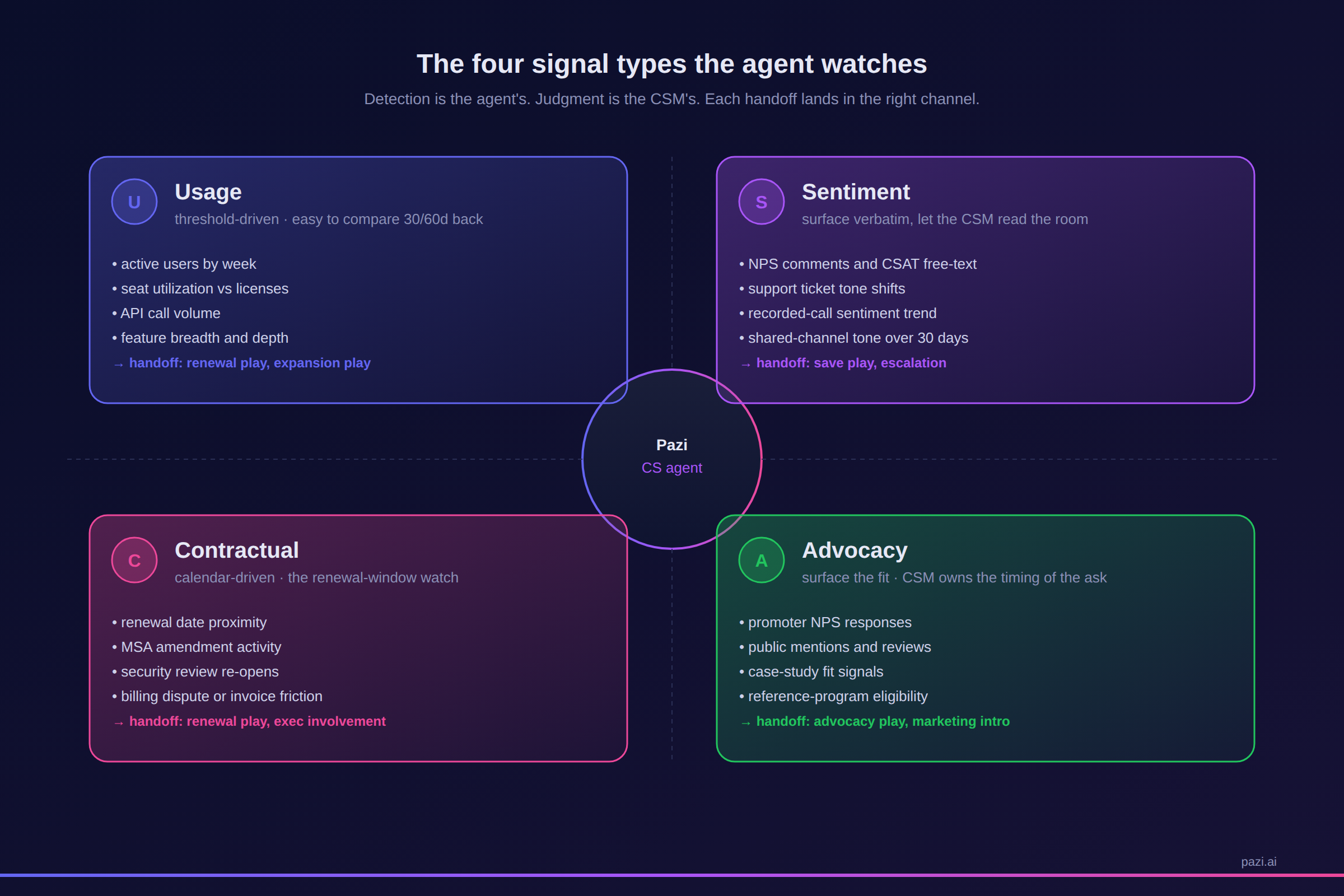
Usage signals are threshold-driven: active-user drops, seat utilization, API calls, feature breadth. The agent watches them continuously and drafts a response, and the CSM decides whether it is a usage problem or a stakeholder problem expressed as a usage drop.
Sentiment signals live in NPS comments, support-ticket tone, recorded-call sentiment, written-channel tone. The agent surfaces them with the verbatim quote attached: a negative line from the sponsor lands differently than one from a power-user IC, and only the CSM knows which is which.
Contractual signals are calendar-driven (renewal date proximity, MSA-amendment activity, security review re-opens, billing dispute), and the agent runs the renewal-narrative drafting and renewal-window churn-risk watch on these. The CSM owns the negotiation.
Advocacy signals show up as promoter NPS responses, public mentions, case-study fit, reference-program eligibility. The agent surfaces; the CSM has the relationship-warmth to ask and the timing to ask well.
The handoff destinations are renewal play, expansion play, save play, and advocacy play. The play is the human work; the signal-detection, the draft, and the prep packet are the agent's. The specialist agent for the CS surface covers this scope for the same reason a CS lead would not ask a marketing analyst to run a renewal call: the work has its own shape.
Post-sale silence is itself a silent failure mode, and an agent that never tells you what it did not do is worse than no agent at all. The agent's runs land in the channel as much when nothing happened as when something did. A daily "no signals fired today on these accounts" line in #cs-renewals is what the agent owes the team.
Connecting Pazi to your CX stack
Pazi reads from the surfaces where customer signals already live. Your CX platform feeds conversation sentiment, ticket volume, CSAT trends, and escalation flags. Your CSP feeds health-score deltas and renewal-pipeline shifts. Your CRM feeds lifecycle-stage changes and account-level alerts. Public-mention feeds and LinkedIn surface stakeholder departures and advocacy moments. Your product-event stream provides the threshold-driven signals the §2 cards reference. The integrations run on webhooks and scheduled API calls; Pazi outputs land in Slack, and the CX stack stays the system of record. Onboarding the agent looks a lot like onboarding a new CSM hire: the team teaches it which signals matter, which thresholds count as risk, and which moments need a CSM in the room.
The two operational siblings worth reading next are the inbox-management agent for the email half of CS work and the outbound-sales agent for the multi-touch sequencing the renewal and expansion plays inherit from GTM.
When the silence becomes signal
Post-sale silence is the failure mode that never shows up on a dashboard: the customer who stops opening tickets, the renewal that lapses without an escalation in the channel, the QBR that never happens. Once the agent watches the signal stream from inside the channel the CSM already works in, that silence becomes the input the CSM responds to, in the same window, in the same hour, before the renewal slips.
The CSM keeps the relationship, the judgment, and the negotiation; the agent handles retrieval, drafting, prep packets, and the continuous watch. NRR depends on how fast the team responds when the signal fires.
Hire your CS coworker
- Sits in your Slack and triages every CX touch-point
- Drafts the response, hands off when judgment is needed
- Free to start