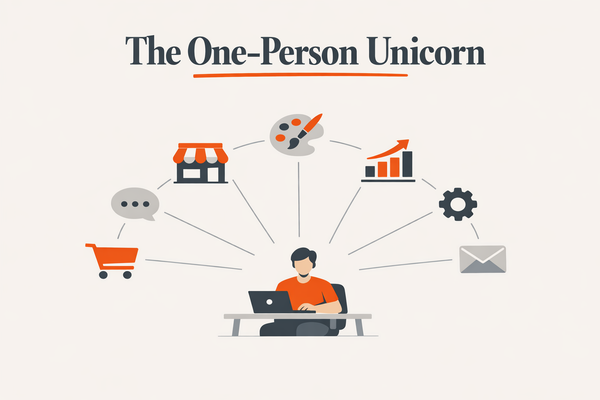
The standard business school answer is that the most money lives in the largest companies. Bigger capital, bigger spend, bigger headcount, bigger moat. That answer has been right for two centuries. I think it has about five years left, ten if it gets lucky.
The shift is already starting. Small teams, sometimes one person, are running operations that used to require a few hundred. Not "doing the work of a few hundred people" in the slide-deck sense. Actually shipping product, serving customers, compounding. The reason this is happening is simple. Operations have been the moat for a long time, and operations are the first thing that gets commoditized when you can hire an agent the way you used to hire a junior.
This isn't a "AI changes everything" post. Capital-intensive things still require capital. Regulated things still require regulators. If you're trying to fab a chip or run a bank in your garage, the next ten years will not save you. But if your company's moat is that you have more people doing more operations than the next company, that moat has a clock on it now. The category-defining competitor in your market over the next five years is more likely to be a 4-person team than a 4,000-person enterprise. That is the shift.
Two centuries of company size
To understand why this is happening, walk back through the last 200 years. The shape of the most valuable companies changes every 50 to 75 years, and every time it changes, the reason is the same: whatever used to be scarce gets commoditized, and whatever was the bottleneck moves somewhere new.

In the 19th century and most of the 20th, the biggest companies were factories of tens of thousands. Capital and labor in lockstep. To build a single pair of pants you needed cotton sourcing, a mill, dye, looms, cutters, sewers, finishers, packagers, a warehouse, a distribution network, retail. None of those steps could be skipped, and each step needed people. The companies that won were the ones that could afford to vertically integrate the whole stack and then run it at scale. Headcount was the moat because each step of production was a manual operation and you couldn't get the operation without the people.
The internet changed that, slowly at first and then quickly. Suddenly a 500-person team could serve thousands of customers, then millions. Software started doing what people used to do, the part where forms were filled out, transactions were posted, inventory was tracked, customer questions were answered. Distribution stopped being a thing you bought with capital, it became a thing you addressed with code. The shape of the most valuable companies shrank. The Fortune 500 of the late 20th century had names like GM and US Steel with hundreds of thousands of employees each. The Fortune 500 of the early 21st century has names like Stripe and Shopify and Airbnb where the per-employee output is an order of magnitude higher because most of the operations are software, not headcount. 50-1,000 person teams started to look normal for billion-dollar companies. WhatsApp had 55 employees when Facebook acquired it for $19 billion in 2014.
We're at the next inflection now. You can hire an agent, tell it what to do, and it will do it. Not always perfectly, not always without supervision, but enough that operations are commoditizing the same way distribution did 25 years ago. The work that used to take a team starts to take a config file.
Operations were never the moat. Scarcity was.
Every era's moat was the scarce thing. In 1880 it was machinery and labor. In 1995 it was distribution. In 2010 it was a sales team that could close. None of them were intrinsically valuable. They were valuable because they were rare.
Operations have been rare for 25 years. Hiring 50 customer success reps was hard. Hiring 50 marketers was hard. Building a content engine that shipped daily across X, LinkedIn, the blog, Reddit, podcasts was so hard that most companies just didn't do it. The companies that could afford to do it had a real advantage.
That rarity is collapsing. The work still needs to happen. But the per-unit cost of doing it is dropping toward zero. McKinsey estimates that current AI could technically automate 60 to 70 percent of activities that absorb employee time today. That's a ceiling, not a committed gain. But it tells you which direction the floor moves. What's scarce now is the idea, the taste, and the speed to ship. A small team has more of all three than a big team does. Every approval layer is a friction surface, and a team of 1,000 has a lot more friction surfaces than a team of 4.
When something is a commodity, you don't pay enterprise prices for it. That's the shift. Not AI replacing humans, not founders firing half their team and replacing it with chatbots. Just operations getting cheap, the way distribution got cheap 25 years ago, and a new shape of company emerging on the other side.
What a small team with AI agents actually looks like
We run Pazi this way. Not as a thought experiment, as the actual operating model. We are not the only ones. Stripe disclosed that more than 700 AI-agent startups launched on its platform in 2024 alone. The shape is becoming the default. The marketing function, the dev-ops function, the content function, the analytics function, the creator outreach function, all of those are running with agents in the loop, talking to each other in shared chat threads the same way a team of humans would.
The agents are not perfect. They mess up. They confuse one thread for another. They sometimes deliver work twice or skip a step. We've written about the kinds of failures we hit and the way we catch them: silent failures in agent systems, scheduled tasks that don't deliver. None of this is magic. The work that previously required a person is now mostly happening without one, and when it breaks the failure is recoverable.
What's interesting is the shape that emerges. There's no clear boundary between "the human team" and "the agent team" in practice. There's a shared set of channels where work gets done. People assign work, agents do it, agents assign work to other agents, humans review when judgment is needed. The same review and approval flows that you'd build for a 50-person team work, just with most of the names being not-people. The hardest part isn't the agents themselves, it's getting the orchestration right, the handoffs, who owns what, what happens when something fails.

That last part is where the next few years of platform competition will live. The agent isn't the moat. Anyone can buy a model. The moat is the operating layer, the thing that lets ten agents collaborate, recover from each other's mistakes, and ship work end-to-end. That's what we're building Pazi for.
The honest counter-argument
I don't want to over-claim. There are real reasons big companies will still exist five and ten years from now, and the inversion I'm describing has real limits.
Capital-intensive industries don't get smaller because of AI. You still can't run TSMC out of a garage. Semiconductor fabs, container shipping, oil refining, automotive manufacturing, all of these have physical, capital, and supply-chain constraints that headcount commoditization doesn't touch. The big companies in those industries will keep being big.
Regulated industries don't either, at least not on the same timeline. Banks, insurance carriers, pharma, defense contractors, all carry compliance, audit, and risk overhead that is itself headcount, but it's headcount you cannot just replace with an agent without regulators noticing. Some of this work will get more automated. The companies will probably get smaller. But the structural minimum is higher than in software.
And distribution lock-in is still real, even though it's eroding. If you're trying to compete with Google in search or with Amazon in retail, you're not going to win because your team is 4 people and theirs is 400,000. Network effects compound on the side of the incumbent for as long as the network exists.
So the argument isn't "small teams will eat every category." It's narrower than that. In any market where the existing competitors are big mostly because operations and headcount are the moat, the next competitor is probably going to be a small team with agents. That covers a lot of markets: marketing services, customer support, most B2B SaaS in the long tail, professional services, content production, sales operations. The economy is mostly these things now, and they're all about to get smaller and faster.
Even where the small-team thesis doesn't fully bite, incumbent companies are statistically expiring. The average tenure of a company in the S&P 500 has fallen from 61 years in 1957 to under 20 today. The next index is being assembled right now.
What this means if you're operating now
If you're a founder, the implication is direct. The right team size for an early-stage company is smaller than it was three years ago, and shrinking. You don't need a head of growth, a head of content, a head of community, a head of partnerships. You need one person who can orchestrate agents across all four. Hire for taste and judgment, not for execution capacity. Execution is the thing the agents are going to do.
Inside a bigger company, the implication is more uncomfortable. The functions that look most secure today, the operations-heavy ones with the biggest teams, are the most exposed. Marketing, customer support, content, analytics, parts of sales. The smart move isn't to wait and see, it's to start running the team the way a small team would run, today, with the agents you already have access to. Most of the work to "AI-enable" a function is just rewriting the operating model, not adopting a new tool.
Closing
A 19th century textile mill: five thousand people in a building, each doing one part of one operation, coordinated through a hierarchy of foremen and managers. That was the most efficient way to make a pair of pants. Then it wasn't.
The most valuable companies in the world today still look more like that mill than we usually admit. Most of the people in them are doing pieces of operations that, in a different shape of company, wouldn't need a person at all. The shift toward smaller teams isn't a prediction. It's already happening, it's accelerating, and the question for the next five years isn't whether it happens but who builds the operating layer that makes it run.
The next category-defining company in your market will be a small team with the right ideas, the right taste, and the right agents.
That's the bet I'd take.
Pazi is the operating layer for that small team. pazi.ai.