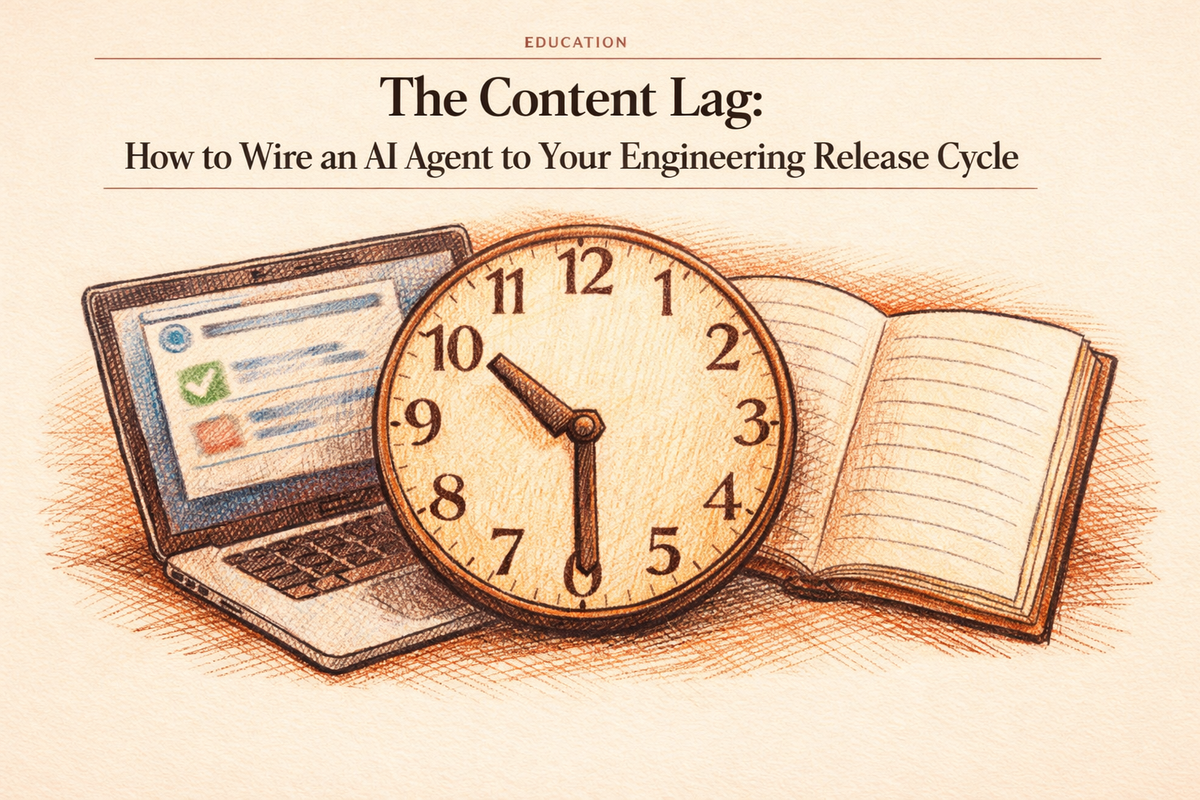
The content lag is the gap between when engineering ships a feature and when marketing publishes about it. In fast-moving teams that deploy every day, that gap runs weeks. The information needed to write an accurate brief exists right at the moment of ship: in the pull request, the ticket, the deploy event. It degrades with every day it sits unwritten.
Wiring an AI agent to the engineering surface closes the gap. The agent reads each deploy event, pulls context from the engineering record, and delivers a plain-language brief to the marketing queue. The marketer gets a brief. No engineer has to remember to send an update.
Table of Contents
- Lag versus Gap
- Why the Lag Persists: Three Structural Causes
- The Engineering-Surface Agent Pattern
- How to Wire the Agent
- Five Metrics for the Content-Lag Agent
Lag versus Gap
The content lag is a specific, measurable timing problem. It is not the same as the broader marketing-engineering alignment gap that teams discuss in planning cycles. The alignment gap refers to strategic misalignment: marketing building messaging around last quarter's roadmap while engineering is already weeks ahead. The content lag refers to a timing failure: a feature shipped today still has no published content about it two weeks later.
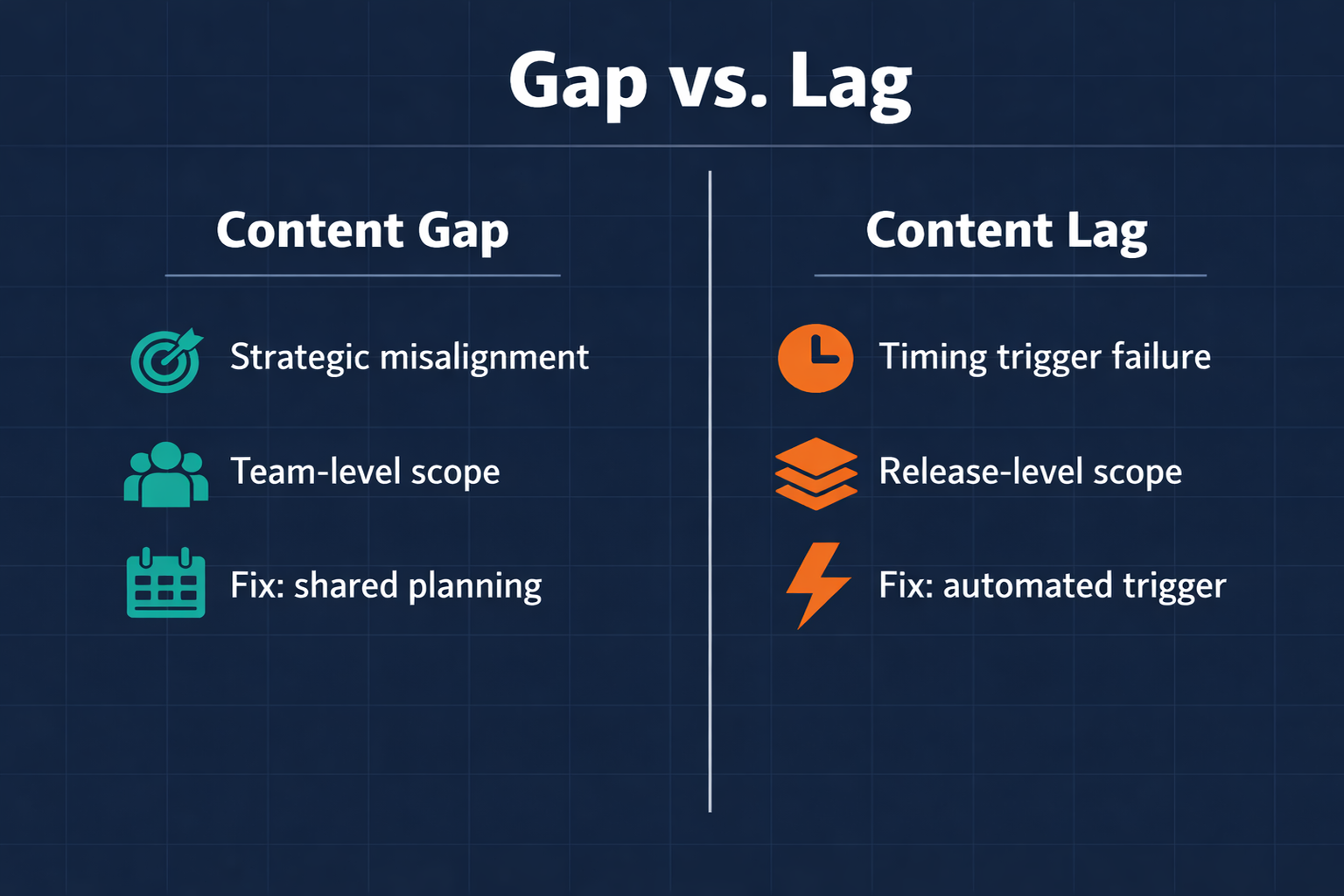
The difference matters because the fix is different for each. Closing the alignment gap requires shared planning, roadmap visibility, and cross-functional OKRs. Closing the content lag requires a different mechanism: an automated trigger that converts a deploy event directly into a content signal, without requiring any human to initiate the handoff.
| Content Gap | Content Lag | |
|---|---|---|
| Definition | Strategic misalignment between marketing messaging and engineering roadmap | Timing delay between feature ship and published content |
| Root cause | Separate planning cycles, different OKRs | No automated trigger from engineering output to content queue |
| Scope | Team-level, org-wide | Workflow-level, release-specific |
| Fix requires | Shared planning, roadmap visibility | Automated trigger and context preservation |
| Measurement | Roadmap coverage rate, messaging accuracy | Release-to-brief lag, feature coverage rate |
The lag compounds in fast-shipping teams. Engineering deploys multiple times a day. Every deploy that has no corresponding content brief is an undocumented feature. The backlog of undocumented work grows faster than it clears, because the trigger that would start the content cycle never fires.
Teams that recognize this often try to solve it by adding more process: a product changelog ritual, a content request form, a release notes template. These help for the features that go through the process. They do not help for the features that don't, and at high shipping velocity, a large fraction of deploys always fall outside whatever process was designed for them.
The structural fix is not more process. It is removing the requirement for humans to initiate the content trigger at all.
Why the Lag Persists: Three Structural Causes
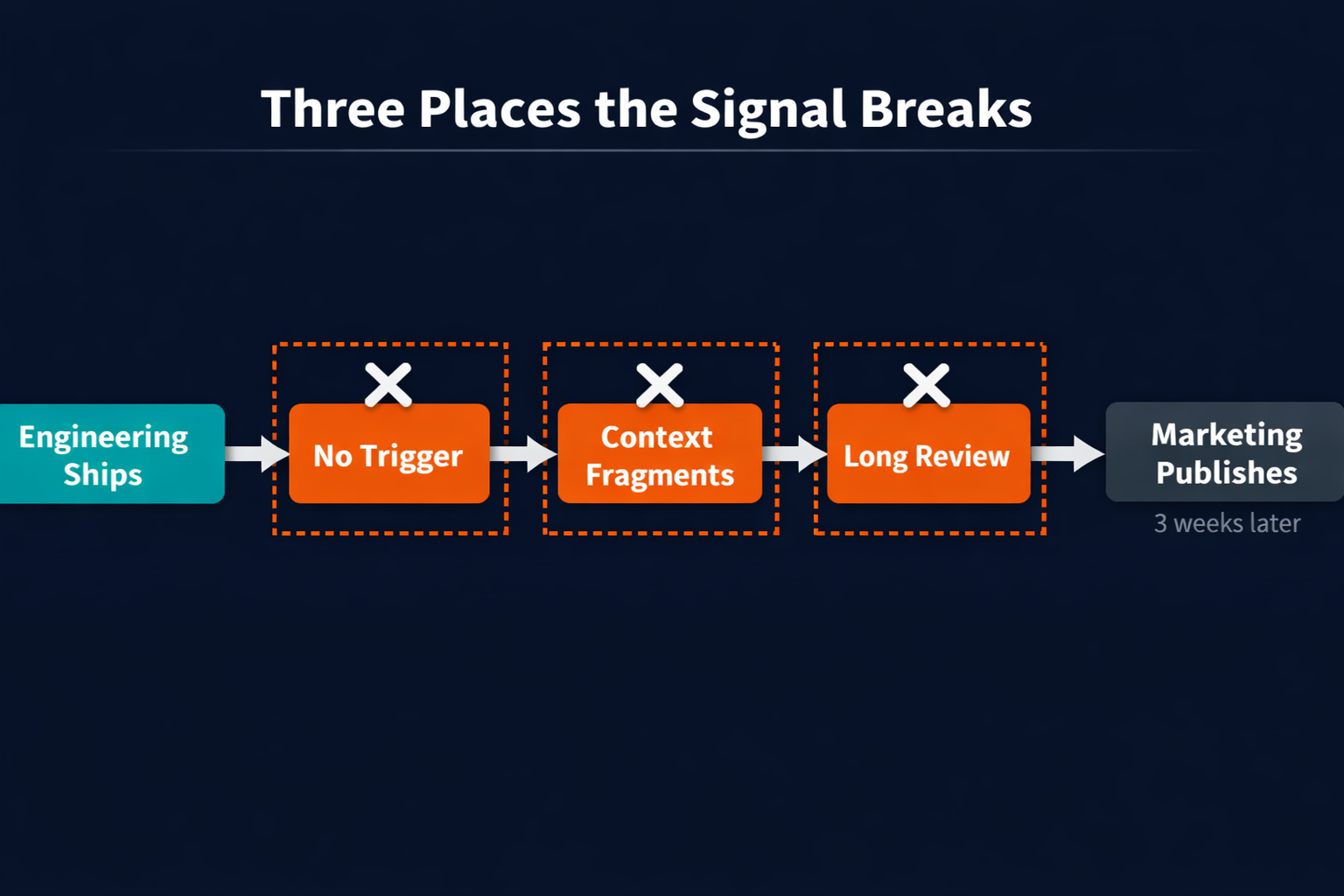
Most teams know they have a content lag. Many have tried to fix it. The fixes reduce the lag temporarily, then it drifts back. The reason: the three causes that sustain the lag are structural, not behavioral. Better communication habits do not eliminate them.
"The trigger problem is what keeps content three weeks behind every release. Marketing isn't slow; it's waiting for a signal that never reliably arrives."
Cause 1: No automated trigger. Engineering ships a feature. Marketing waits for someone to tell them. In most teams, that notification is a human posting in a Slack channel, filing a ticket, or updating a brief. When the team is moving fast or the feature is small, nobody posts. The feature is complete but the content queue has no knowledge it exists. The lag begins at the moment of ship, before any writing has started, because the system has no way to convert a deploy event into a content work item without human action.
This is not a failure of discipline. Engineers are optimizing for shipping velocity. Adding a "post in #content-requests after every merge" requirement creates friction and gets deprioritized under pressure. The trigger problem persists not because engineers are careless but because the trigger depends on a human context-switch that competes with the primary job.
Cause 2: Context loss through the handoff chain. The engineer who built the feature holds the full context: what it does, what user problem it addresses, what technical constraint it removes, what edge cases still exist. That context lives in the PR body, the linked ticket description, and the commit messages.
By the time a content brief reaches a marketing writer, that context has passed through team updates, a Slack thread, and possibly a second-hand description from someone who was on the demo call. Each transfer compresses the original context. The writer receives a one-sentence description where the PR body had twelve paragraphs. They either write thin content and loop back for clarification, adding another week to the cycle, or they write inaccurate content that engineering has to rewrite during review.
A non-technical marketer is particularly exposed here. Without the ability to read the code or the ticket directly, they depend entirely on what gets communicated through the handoff chain. The more the context degrades, the less they have to work with.
Cause 3: Accuracy review bottleneck. Marketing does not own technical accuracy. Every draft that references product behavior, technical specifications, or engineering decisions has to go back to an engineer for accuracy review before it can publish. A 1,200-word blog post can take a senior engineer one to two hours to review properly: reading for technical errors, flagging overclaims, correcting terminology.
If that engineer is working on a high-priority feature, the review sits in their queue for days. The lag extends not because writing is slow but because the accuracy gate is slow, and the accuracy gate is slow because it lands at the end of a long handoff chain, when the engineer's context is stale and the review competes with current work.
These three causes compound. No trigger means the content process starts late. Context loss means the first draft has accuracy problems. Accuracy problems mean a long review cycle. The lag is the product of all three, not any one of them in isolation.
The Engineering-Surface Agent Pattern
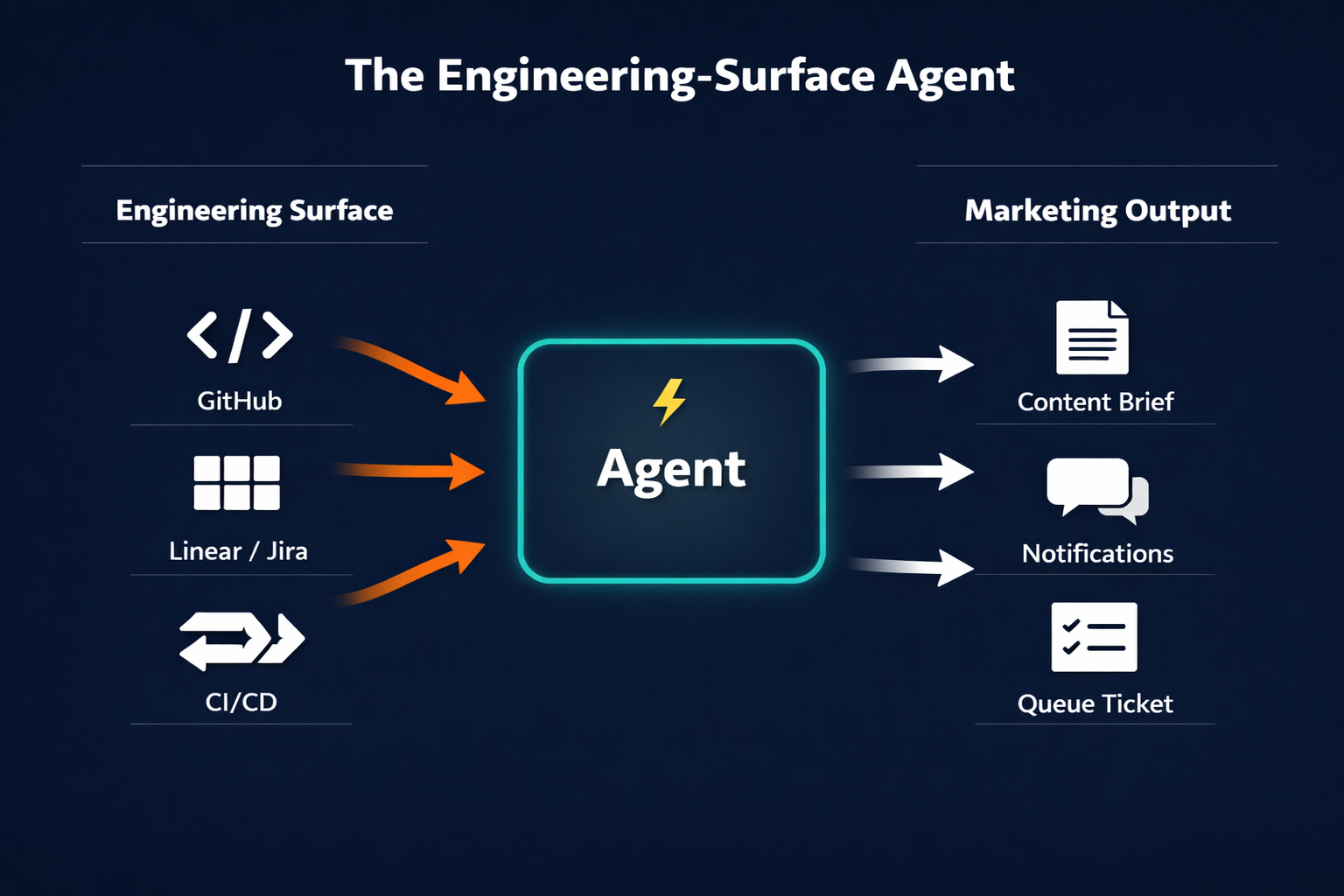
The engineering surface is the set of systems where engineering work is tracked and completed: GitHub repositories, Linear or Jira ticket boards, CI/CD pipelines, changelog files. These systems contain everything needed to understand what shipped, why it shipped, and who benefits from it. They also generate discrete events: PR merges, successful production deploys, ticket state transitions, changelog commits.
The traditional approach places the content agent on the marketing side. It waits for a brief, writes from whatever input it receives, and loops back to engineering when the draft requires technical correction. This configuration automates the writing step while leaving the trigger problem and the context loss problem intact. The agent is fast at writing; it is still dependent on a human to initiate the cycle and supply context.
The engineering-surface pattern inverts this. The agent sits on the engineering side, reading the systems where work is already recorded. It does not wait for a human to hand off context; it reads the context directly from the source. Every production deploy, merged PR, or resolved ticket fires the agent automatically. The trigger is embedded in the engineering workflow, not dependent on anyone remembering.
OpenAI's Practices for Governing Agentic AI Systems defines agentic AI as systems "that can pursue complex goals with limited direct supervision." The engineering-surface pattern achieves exactly that limited supervision: the agent monitors the engineering surface continuously, reading each event as it occurs, without requiring a human to initiate each content cycle.
What the agent produces is not the final post. It produces a structured content brief in plain language: feature name, what changed, who benefits, key technical constraint to note, the angle a content writer can build from, and internal links to related existing content. The brief is written to be readable by a non-technical marketer. The translation happens at the engineering surface, before the context degrades.
"An agent on the engineering surface doesn't replace the marketing writer. It makes sure the marketing writer has everything they need before the context disappears."
The distinction between the agent's output and the final content matters. Teams that configure the agent to produce finished blog drafts produce drafts that need heavy engineering revision. Teams that configure it to produce structured plain-language briefs produce briefs that pass engineering review in minutes and give writers everything they need for an accurate first draft. The same scoping principle applies in other agent use cases: an AI agent handling incident response works better when it escalates structured context to the on-call engineer than when it attempts final resolution on its own.
| Manual Handoff | Engineering-Surface Agent | |
|---|---|---|
| Trigger mechanism | Human posts in Slack or files ticket after ship | Automatic on PR merge, deploy event, or ticket close |
| Context at brief time | Compressed through 3-4 handoff steps | Preserved directly from engineering record at time of ship |
| Time to first brief | 2-7 days after ship | Same day, within hours of trigger |
| Engineering review load | Full draft review, 1-2 hours per feature | Brief review, 10 minutes per feature |
| Accuracy of first draft | Low to medium; context already fragmented | High; written from source-of-truth records |
Anthropic's research on building effective agents documents a finding consistent across teams: "The most successful implementations weren't using complex frameworks or specialized libraries. Instead, they were building with simple, composable patterns." The engineering-surface pattern is exactly that: an event listener connected to a brief template, configured to fire on specific engineering events. Nothing more complex than the problem requires.
How to Wire the Agent
In a small team, the setup divides naturally: the engineer connects the agent to the engineering surface once, and the marketer defines what the brief looks like and where it lands. Neither needs to understand the other's side in detail. The engineer owns the trigger; the marketer owns the template.
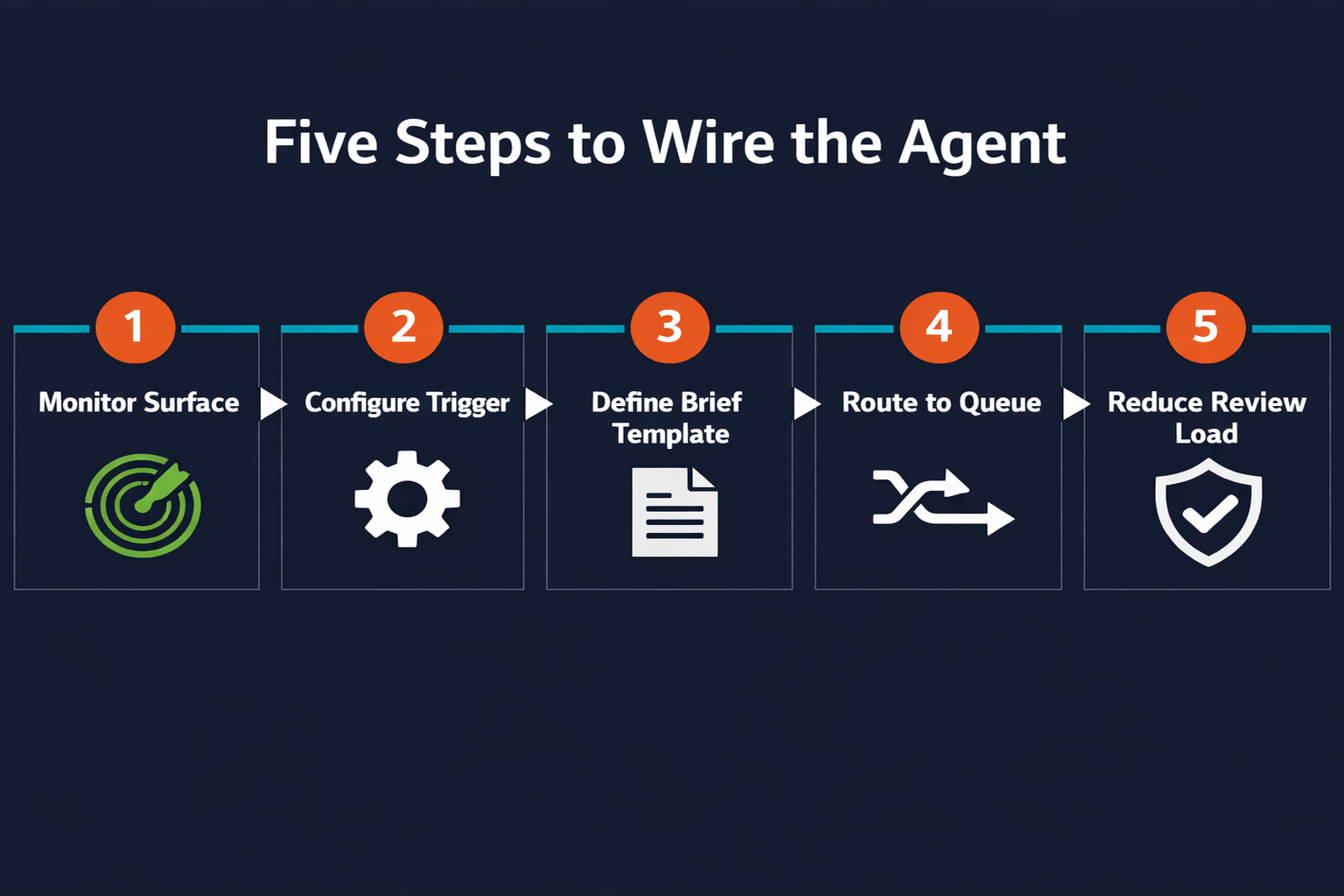
Step 1: Pick one engineering surface. The engineer chooses where the agent reads from. The three most common starting points: GitHub (the agent reads a PR when it merges to main with a release tag), a project management tool like Linear or Jira (the agent reads a ticket when it moves to Done), or the deployment pipeline (the agent reads a deploy event when it completes successfully). One surface is enough to start. The marketer does not need to understand how this connection works; they just need to tell the engineer which tool the team already uses for tracking shipped work.
Step 2: Set a narrow trigger. The engineer configures what fires the agent. The rule should be specific enough that only meaningful, user-facing ships trigger a brief. A merged PR that fixes a typo in a doc should not fire. A shipped feature that changes how a user does something should. In GitHub, this is a label filter. In Linear or Jira, it is a status or workflow column. The marketer's input here: tell the engineer what counts as "something worth writing about." The engineer translates that into a filter rule.
Step 3: Define the brief template. This is the marketer's step. Six fields give a content writer everything needed for an accurate first draft without a follow-up call: 1. Feature name as it appears in the product 2. What changed, in plain language 3. Who benefits and how 4. Key constraint or limitation to note 5. The angle a practitioner would search for when facing the problem this feature solves 6. Internal links to related existing content on the blog or in the docs
The sixth field is the one most teams skip and most regret. Internal links are how new content connects to the existing cluster. A brief without them produces a standalone post; a brief with them extends the reach of every related post. Calibrating the brief template is similar to onboarding any AI agent: the first several outputs will be rough, and improvement comes from correcting each brief until the template consistently produces what the writer needs.
Step 4: Route the brief to where the marketer works. The agent delivers the completed brief wherever the content writer already spends time. Slack is the most common destination for small teams. Notion works well for teams that already manage content calendars there. A project management tool works if that is where writing tasks already live. Pazi runs the agent inside Slack and routes the brief into the team channel, so the marketer sees new briefs alongside everything else without switching tools.
Step 5: Reduce the review load. Once the brief is in the queue, engineering reviews the brief before any writing starts, not the draft after it is written. A six-field plain-language brief takes ten minutes to check while the engineer's context is still fresh. A 1,200-word draft can take one to two hours to review after the engineer has moved on to other work. Shifting the accuracy gate from the end of the content cycle to the beginning cuts total engineering review time per feature significantly: the difference between a ten-minute brief review and a one-to-two-hour draft review.
| Engineering Surface | What the Engineer Sets Up | What the Marketer Receives |
|---|---|---|
| GitHub | Trigger on PR merge with a release label | Brief with feature name, change description, and who benefits |
| Linear / Jira | Trigger on ticket moved to Done in the shipped column | Brief drawn from ticket title, description, and acceptance criteria |
| Deployment pipeline | Trigger on successful production deploy | Brief drawn from deploy notes and tagged commit message |
| Changelog file | Trigger on changelog commit to main | Brief drawn from changelog entry and linked PR |
"The goal is engineering reviewing a six-field brief in ten minutes, not a 1,200-word draft in two hours."
Anthropic's Model Context Protocol provides pre-built connectors for GitHub, Slack, and Git that an engineer can configure without writing custom integration code. For teams already using those tools, the connection from engineering surface to brief delivery is a single configuration step.
Five Metrics for the Content-Lag Agent
Deploying the agent without measuring the outcome makes it impossible to distinguish a working configuration from a misconfigured one. Five metrics provide clear signal on whether the agent is closing the lag and whether each component of the configuration is functioning.
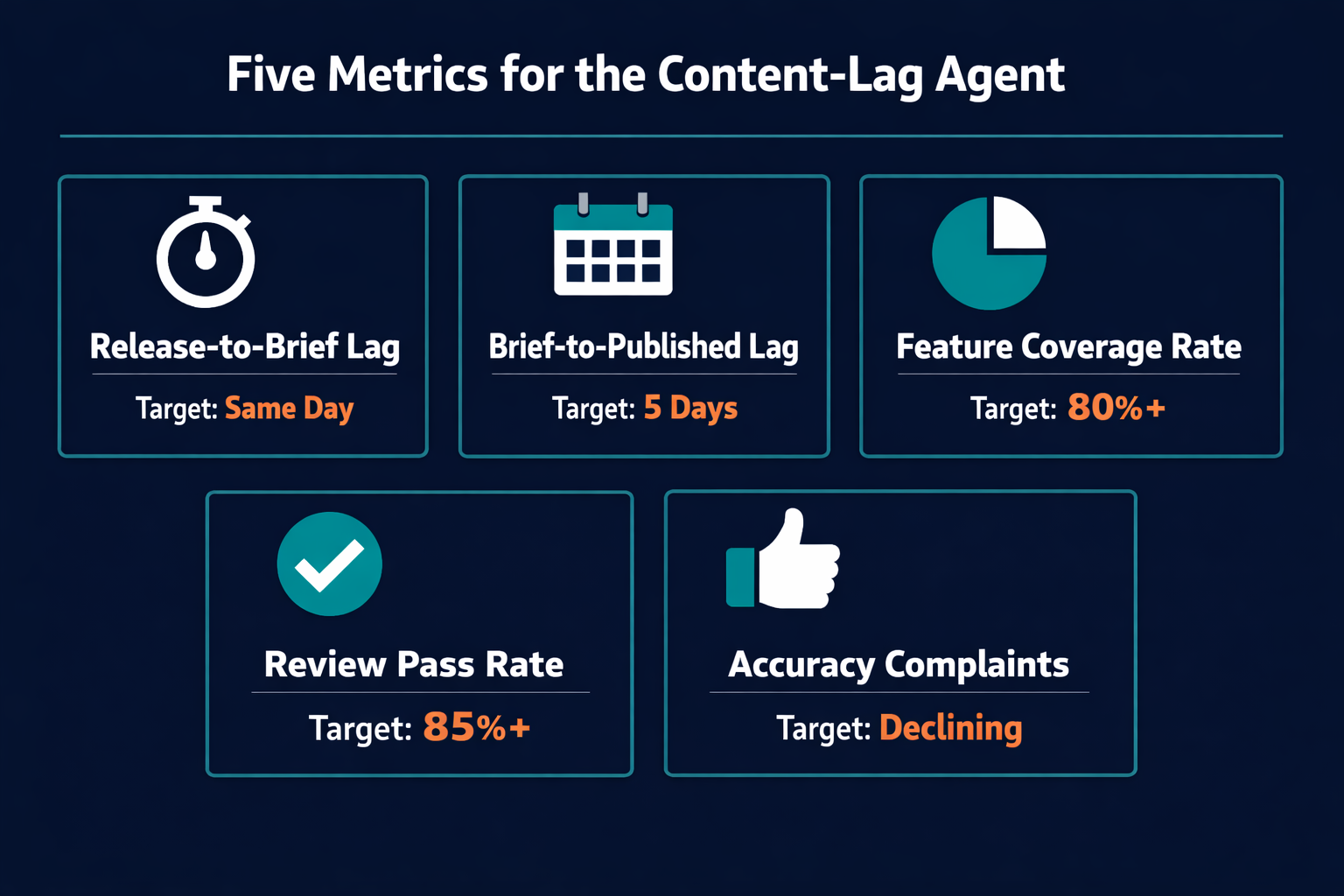
Metric 1: Release-to-brief lag time. Time from the trigger event to the brief arriving in the content queue. Before deploying the agent, measure this manually for two weeks: how long does it actually take for marketing to receive usable context after a deploy? The agent's target is same-day delivery, typically within two to four hours of the trigger firing. If release-to-brief lag is still measured in days after the agent is live, the trigger is either misconfigured, too narrow to capture all ships, or the agent is failing silently on certain event types.
Metric 2: Brief-to-published lag time. Time from brief in the queue to published content. This is the marketing workflow metric, separate from the engineering trigger. Target depends on content type: release notes and social posts should publish within one working day of the brief; blog posts should publish within five working days. If this metric is not improving after the agent is live, the bottleneck has moved downstream from the trigger into the writing workflow itself.
Metric 3: Feature coverage rate. Percentage of shipped features that have corresponding marketing content within seven days of ship. Calculate by counting ship events over a two-week period and comparing against published content in the same window. If coverage is below 80%, the trigger configuration is missing a category of deploy events. Common gaps: hotfixes deployed outside the normal release process and features shipped on branches that do not match the trigger filter.
Metric 4: Engineering review pass rate. Percentage of agent-generated briefs that pass engineering accuracy review without corrections. Target: above 85%. A low pass rate means the agent is reading the wrong part of the engineering record or the brief template is not capturing enough context. The most common cause is reading PR titles only rather than PR body and linked ticket descriptions. Adding a recurring check that verifies brief quality on a set cadence, as described in how to add self-monitoring to your agent, catches configuration drift before it appears in the pass rate.
Metric 5: Content accuracy complaints after publish. Qualitative, tracked via Slack or post comments. A declining trend over four to six weeks confirms the agent is preserving context effectively from engineering source to brief to published draft. An increasing trend usually means the trigger has drifted: the engineering team changed their labeling convention or workflow without updating the agent's trigger rule. Schedule a quarterly trigger audit as a standing calendar item for whoever owns the configuration.
Related reading:
- How to automate incident response with AI agents
- AI agent best practices: 7 rules from running them at Pazi
- How to add self-monitoring to your OpenClaw agent
Pazi is a platform for building AI agents that run where your team works. For the content lag, that means an agent connected to your GitHub, Linear, or deployment pipeline that reads each release event and delivers a plain-language brief to your marketing queue before the context degrades. Build your first content-lag agent at pazi.ai.