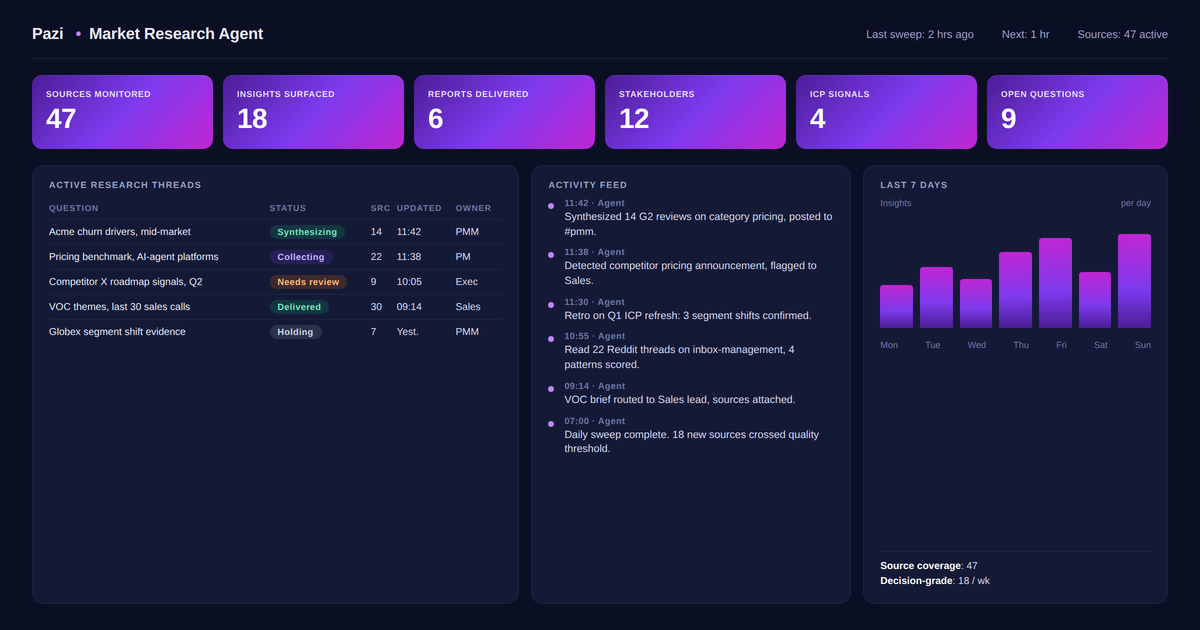
Most market research today dies in a Notion doc nobody opens, and the case for an AI agent for market research starts there. The research question lands in a meeting. Someone goes off and reads social, pulls a few G2 reviews, scans some sales-call transcripts, drafts a synthesis, ships it to a Slack channel three days later. By the time anyone reads it the segment already shifted. The work was done. The decision still didn't move.
The agent is the part of the workflow that fixes the gap. The category today is split four ways: social-listening tools watching one channel, competitive-intel scrapers firing alerts on competitor pages, search copilots answering one query without durable memory, and audience-mapping tools owning a single question shape. Each gives a slice. None of them claim the loop. IBM Think describes an AI agent as software that perceives, decides, acts, and learns; the loop the four-way split keeps refusing is exactly what that pattern owns.
The HubSpot 2025 State of AI Report finds 47 percent of AI-using marketers already apply AI to research, and the buyer question now is whether the agent can own the whole loop or whether research stays a stack of point tools with a human stitching the synthesis pass by pass.
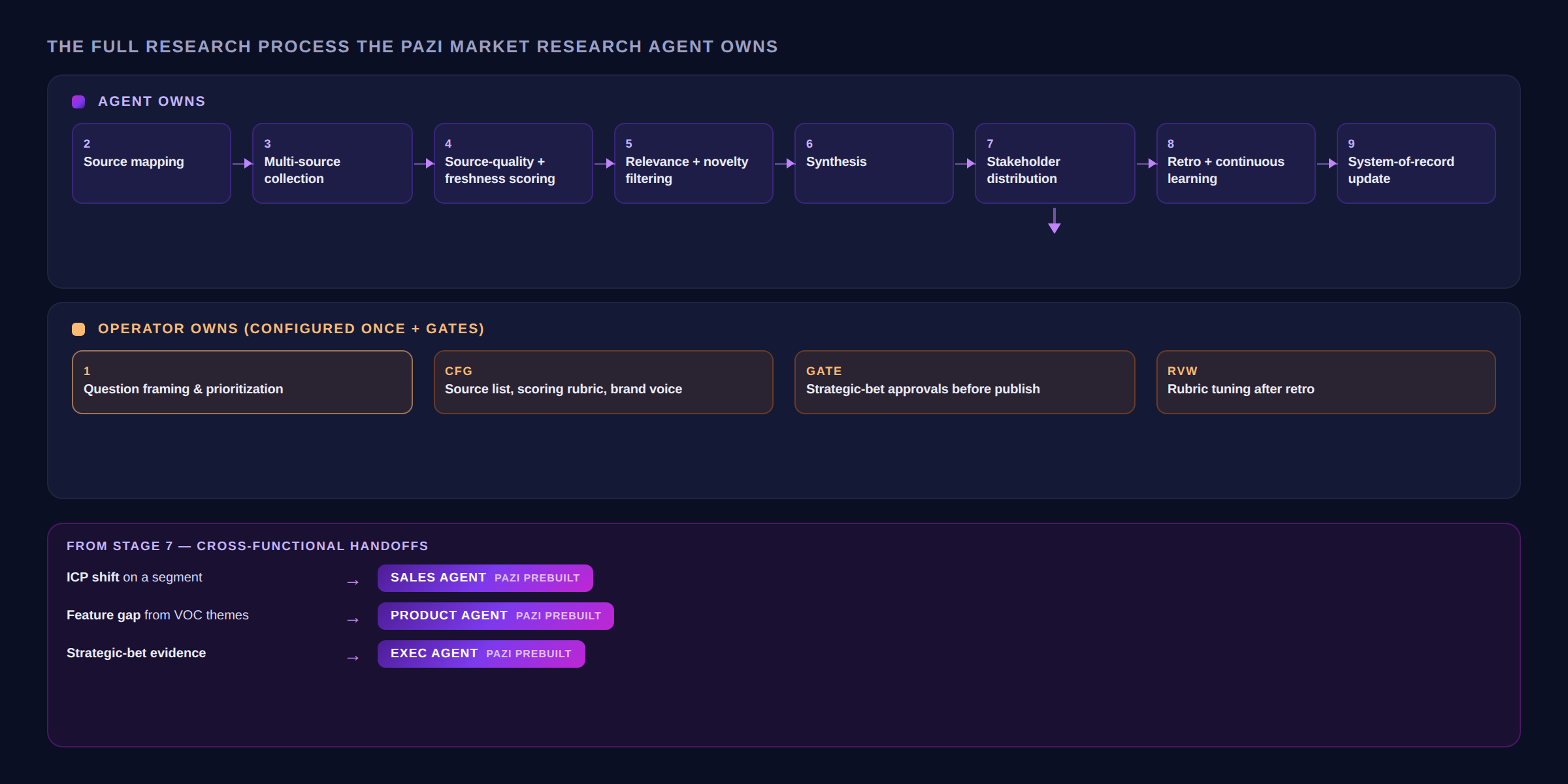
Pazi today ships six prebuilt agents: DevOps, Developer, Product, Exec, Sales, and SEO. A market-research agent is configured through Build Your Own. The runtime is the same; the operator wires the agent against their own research questions, source list, scoring rubric, brand voice, and handoff destinations. The handoff destinations matter because the configured agent talks to the prebuilt Sales, Product, and Exec agents when its outputs cross team lines. That's the cross-functional structure the rest of this post argues from.
Where the research workflow actually breaks
The work splits into nine stages: question framing, source mapping, multi-source collection, source-quality scoring, novelty filtering, synthesis, stakeholder distribution, retro learning, system-of-record update. The research function in 2026 typically runs three of those stages well (collection, light filtering, partial synthesis) and four of them badly (question framing falls on whoever has time, distribution dies in Notion, retro doesn't happen, system-of-record drifts). The shape of an AI research agent is something that runs all nine on one accountable runtime.
The four break-points worth naming up front:
Question framing fragments. The PMM has a question. The founder has a different question. Sales has an ICP-shift question. Nobody has time to scope what the research function should actually be running this week, so the function defaults to whatever the noisiest stakeholder asked for last.
Source coverage stays siloed. Brandwatch listens to social. Crayon watches competitor pages. SparkToro maps audience. Perplexity searches and cites. Each gives a slice. The researcher's job becomes stitching four slices into one read, every research cycle, by hand.
Synthesis falls on a human. The Crayon 2025 State of Competitive Intelligence Report finds AI adoption inside CI teams up 76 percent year over year and daily AI use rising from 48 to 60 percent. AI is in collection now. It is mostly not in synthesis yet. The synthesis pass, turning fifteen scored signals into one defensible read of the pattern, is still where the human researcher spends most of the cycle.
Distribution dies in a Notion doc. The brief gets written, someone shares the link, three people open it, nobody acts on it before the next research cycle starts. The research that ships is research that lands in the team channel where the decision actually gets made, attached to the people whose job it is to act on it.
What a researcher gets back when one agent owns the loop
The PMM gets the question reframed. The agent intakes whatever lands in the team channel, pulls forward the prior cycle's open threads, and returns a scoped research question with a source list before anything runs. The PMM agrees, disagrees, or refines. The hours that used to go into "what should we even be researching this week" go back into the part of the job that actually needs PMM judgment: deciding which of the agent's recommendations ships externally.
The founder gets strategic-bet evidence on a cron. When the agent's read of the pattern crosses a threshold the operator configured (a segment shift, a competitor pricing move, a sustained VOC theme), the agent escalates with the source URLs, the freshness timestamps, and the rationale attached. The founder is not reviewing every signal. The founder is reviewing the moments the rubric says are decision-grade.
The product team gets feature gaps without a separate meeting. When customer-interview transcripts and support tickets line up around the same product gap, the agent hands off to the prebuilt Pazi Product agent at brief-draft speed. The cross-functional handoff is configured up front; the trigger is the rubric the operator set.
Sales gets ICP refreshes that don't wait for the next quarterly. When the agent surfaces a segment shift, the prebuilt Pazi Sales agent picks up the thread, picks up the competitive-intel monitoring thread the configured competitor agent already has open, and recalibrates outbound. Nobody books a meeting for it. The handoff is the product.
Where the synthesis pass actually changes
Synthesis is the load-bearing step nobody automated cleanly before. The agent reads outcomes against scope: which sources keep producing decision-grade signals, which signals repeat last cycle's noise, which questions stayed open longer than they should have, which stakeholders engaged with which briefs. It updates the scoring rubric and the source-quality weights against that read, not against a generic template.
The HubSpot report puts AI-driven time savings on manual research and admin work at 78 percent of using marketers reporting it, and finds 66 percent of marketers say AI surfaces insights they otherwise would not find. Both numbers are about the synthesis pass, not the collection pass. Collection has been instrumented for years. Synthesis is what the agent unlocks.
What the researcher does at this stage is calibrate the rubric. The first two cycles run, the agent hands back synthesis briefs, the researcher reviews what landed and what missed, the rubric updates. By cycle three or four the agent's calls match the team's calls eighty to ninety percent of the time. The remaining percent is the operator override, the part of the job that genuinely needs a human researcher's read of organizational context the rubric does not have.
What an agent doesn't do (the trust questions, in order)
Hallucination on competitive intel is the load-bearing risk operators raise first. The discipline is mechanical: every claim ships with a source URL and a freshness timestamp, the standard Brandwatch and Crayon hold themselves to. The HubSpot report finds 43 percent of marketers say generative AI sometimes produces inaccurate information; the agent's defense against that is making source attribution and freshness non-optional in the brief output.
Source quality degrades fast in research-grade work, and the rubric has to score sources before it scores signals. Stale inputs get downweighted. Sources that produce signals the operator overrides get downweighted. The rubric is configurable up front and tunes itself across cycles against operator feedback, which is what makes Build-Your-Own setup possible without the operator becoming a full-time rubric engineer.
Brand voice for stakeholder-facing summaries comes from up-front instructions, not from a generic template. The agent ships a brief that reads like the team's brief, not like a chatbot's. That is what stops the slop pattern operators flag when they evaluate AI research tooling.
Compliance posture is honest. Customer-interview transcripts, CRM records, and sales-call recordings are higher-stakes data classes than public web reading. Pazi today is a platform-stage product; SOC 2 and the GDPR data-handling work for those classes is on the roadmap, not the standing posture. The HubSpot report finds 41 percent of marketers cite data privacy as a top AI concern, and the agent's authorization scope is the gate against that concern: the operator wires the agent into the surfaces their data-handling policy permits, and the agent runs only against those.
McKinsey puts the productivity lift from generative AI on knowledge work at 10 to 20 percent, with gains concentrated in teams that govern source attribution and review gates carefully. The agent removes the manual research work; the researcher still owns the question prioritization, the strategic-bet calls, the brand-voice configuration, and the compliance posture that fits the company.
Configuring the agent
You configure your market-research agent on Pazi against your own setup: research questions you want answered, sources the agent is authorized to read, the scoring rubric that defines decision-grade, the brand voice the briefs ship in, and the handoff destinations when work crosses team lines. The configuration is upfront and revisable; it is not a code project.
After cycle one, the agent retros against what landed and updates the rubric. After cycle two, the calls start matching the team's calls. By cycle four, the researcher is back to the part of the job that actually needed a researcher.
Frequently asked questions
What does an AI market research agent do?
It runs the full research loop on one accountable runtime: intake a question, map it to source classes, pull evidence across web, social, internal corpus, and customer surfaces, score quality and freshness, synthesize the read, and route the brief to the people who decide on it. Configuration happens once; the loop runs on a schedule.
How is this different from a listening tool?
A listening tool watches one channel and hands synthesis to a human. An AI market research agent watches every authorized source class in one synthesis pass, ships the brief to the stakeholders who decide on it, retros after the cycle, and starts the next cycle with prior memory. A listening tool stops at the alert; the agent owns the loop through the after-action retro.
How does an AI market research agent handle source quality and hallucination?
Every claim ships with a source URL and a freshness timestamp. The rubric scores source quality before signals, downweights stale inputs, and runs human-approval gates on strategic-bet recommendations rather than every source-pull. Brand voice is configured up front in agent instructions, not trained from a generic template.
Can an AI agent replace a human researcher?
No. The agent removes the manual research work. The researcher owns the question prioritization, the strategic-bet calls, the brand-voice configuration, and the compliance posture. The researcher reviews the moments that need their judgment; the rest of the time the loop runs against the rubric the researcher set.