About 25% of newly introduced SKUs were no longer being bought one year after launch, and roughly 40% had failed by the end of year two, according to a longitudinal study summarized by Marketing Letters product launch statistics. That changes the definition of a launch. The public announcement is only one moment inside a 24-month risk window where positioning, distribution, pricing, repeat purchase, and product iteration determine whether early attention becomes durable demand.
Product launch planning that ships on time treats launch as staged risk management. It gives product, marketing, sales, support, and finance clear evidence thresholds, assigns approval gates before money is spent, and keeps the work moving from research to acquisition without allowing one team's deadline to become another team's surprise.
Table of Contents
- Why Product Launch Planning Decides the First Two Years
- Your 13 Week Product Launch Planning Timeline
- Defining Ready Across Product Marketing and Sales
- Building Your MVP Landing Page and Store Without Fragmentation
- Driving First Visitors With Paid Campaigns and Email Outreach
- Launch Day Operations and What Happens After You Ship
Why Product Launch Planning Decides the First Two Years
A launch can attract attention in its first week and still be commercially unready. Existing contacts, launch communities, paid promotion, and curiosity can produce activity without showing that customers understand the offer, can find it through ordinary distribution, or will purchase again. Planning must therefore manage risk across the vulnerable first two years, not concentrate approval and budget decisions on launch day.
The failure pattern is more useful than the claim that almost every new product disappears immediately. A study of 1,729 newly introduced SKUs found that about 25% were no longer being bought after one year, while roughly 40% had failed by the end of year two (Marketing Letters product launch statistics). A separate empirical summary covering more than 83,000 new SKUs across 31 U.S. categories reports a similar pattern, with about 25% stopping sales within one year and about 40% within two years (Ehrenberg-Bass Institute research summary).
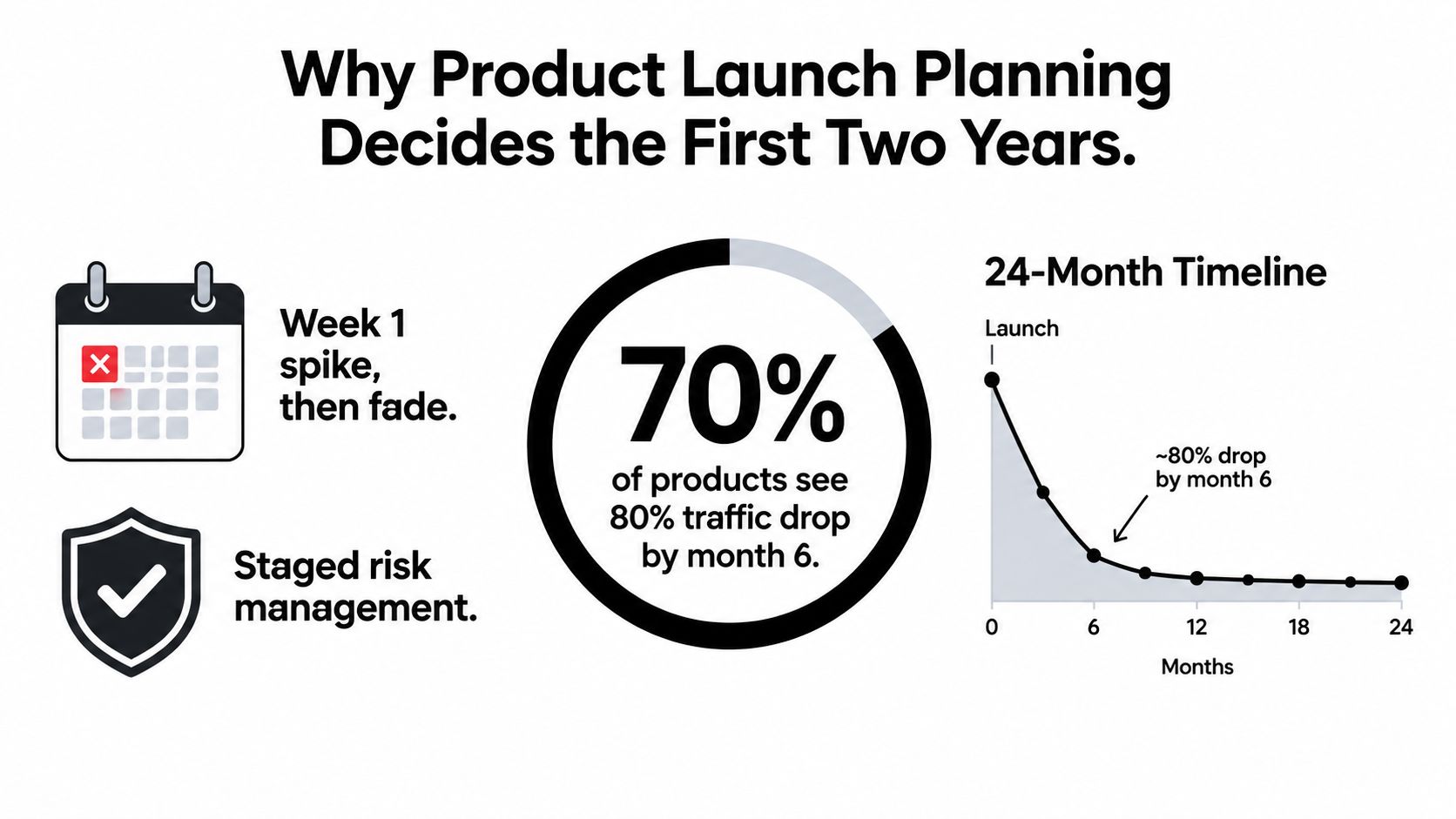
The operating distinction is clear. Launch day tests access and attention. The following months test usefulness, distribution, economics, and repeat behavior. Products entering crowded categories face tougher conditions. The empirical summary also identifies higher failure risk for launches from smaller-share parent brands and for products entering larger revenue categories. A lean team can still pursue an ambitious market, but it should validate demand before committing the full acquisition budget.
The launch is a sequence of decisions
Start by testing whether the customer problem is urgent enough to support a purchase. Then confirm that buyers recognize the language used to describe the product. After that, verify the purchase path, price, business model, and distribution plan. Each decision should have an owner, evidence threshold, and approval gate.
A useful launch plan includes:
- Pre-launch validation: Test the ICP, customer language, competitive alternatives, and willingness to pay before building every requested feature.
- Controlled availability: Use a soft or phased release while the team is still collecting evidence from real customers.
- Distribution development: Plan acquisition and channel expansion as active workstreams, not tasks added after the product is complete.
- Post-launch iteration: Reserve ownership and capacity for fixing friction, clarifying the message, and improving first use.
- Approval gates: Require the owner to approve positioning, pricing, publishing, and paid spend before each difficult-to-reverse step.
Practical rule: A launch date should mark the start of the next learning cycle, not the end of planning.
Industry summaries report that roughly 30,000 new consumer products launch globally each year, while only about 40% of developed products reach the market. Among products that reach market, only about 60% generate revenue, and one summary cites an average of 28 weeks for a new product to reach 75% of its highest distribution (go-to-market statistics). These figures describe a selective funnel before launch and a gradual adoption curve afterward.
Operational readiness and pricing deserve the same approval discipline as messaging. If research is weak, a larger campaign distributes confusion faster. If checkout or support workflows are unfinished, paid traffic creates avoidable service work. If packaging hides the value or gives away too much capability in a low-priced tier, acquisition may rise while profitability falls. Product launch planning protects the first two years by making research, build, pricing, distribution, and scale earn the right to continue.
Your 13 Week Product Launch Planning Timeline
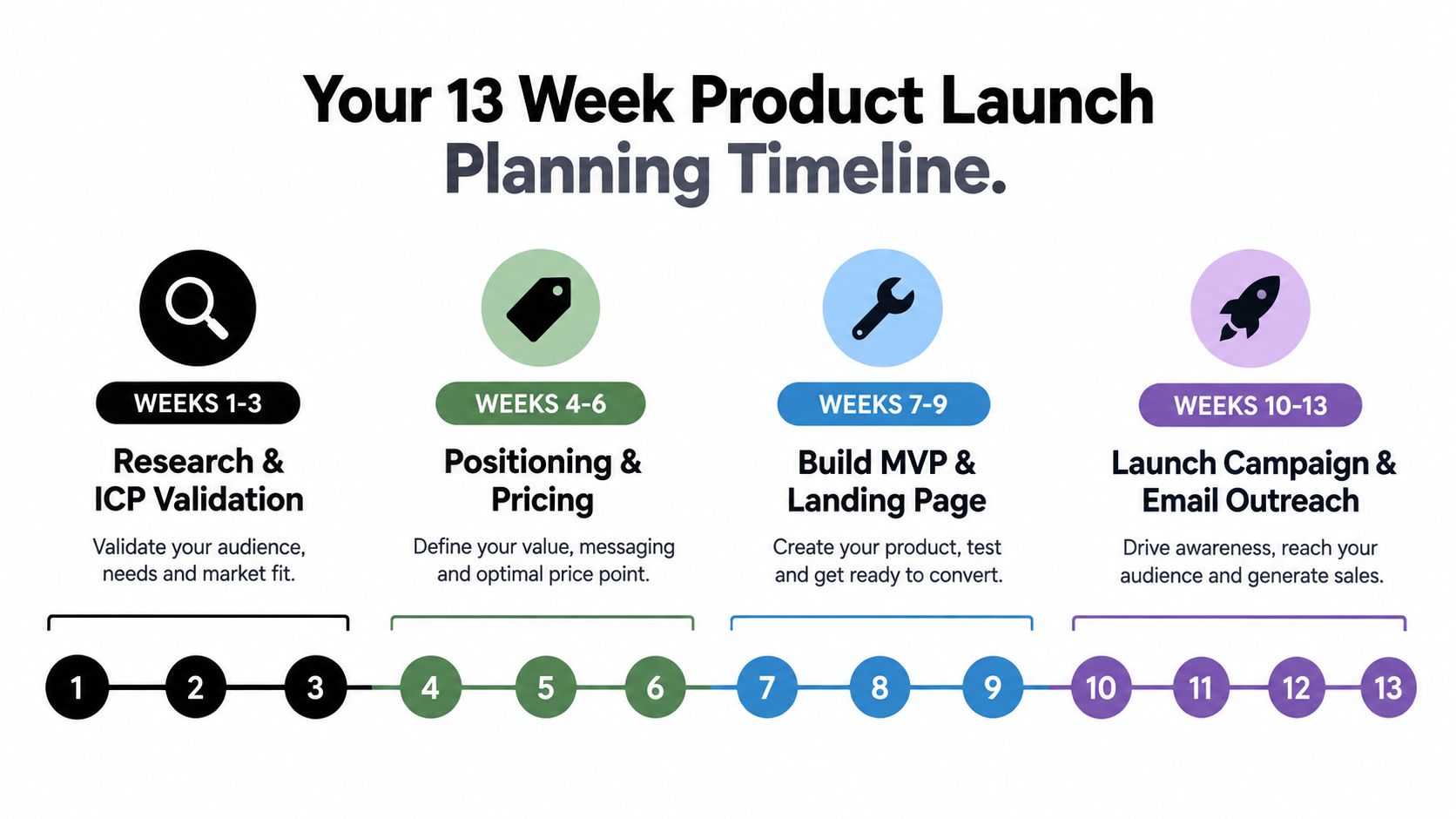
A compact launch can follow a 13-week decision sequence. The timeline below is a scaffold, not a rigid law. A solo founder may perform several roles in parallel, while a small team can assign research, product, creative, sales, and operations to separate owners. The order still matters because later work depends on earlier evidence.
Weeks 1 to 3 are for research and ICP validation. The team identifies the narrowest credible customer segment, studies alternatives, collects customer language, and records objections. The owner should approve the ICP and problem statement before the team writes final messaging. Research that doesn't change a decision is documentation, not validation.
Weeks 4 to 6 cover positioning and messaging. The team turns research into a clear promise, proof points, objection handling, landing-page copy, and sales language. Product marketing and sales should review the same brief. Messaging shouldn't be finalized while the team is still debating who the product serves.
Weeks 7 to 8 are for pricing and packaging, although the build work can continue alongside them. The team defines what's included, what requires an upgrade, how buyers start, and which plan matches the intended segment. The owner approves the commercial model before design and campaign assets lock around it.
Weeks 9 to 11 focus on sales enablement and asset creation. Product, marketing, sales, support, and operations prepare the landing page, store, checkout, product walkthrough, email sequence, paid creative, support responses, and internal talk tracks. The purpose isn't to create every possible asset. It's to make the core customer workflow usable from first impression through purchase and onboarding.
Weeks 12 and 13 become separate control points. Week 12 is launch readiness and final QA, including product testing, analytics, payment checks, link checks, customer support coverage, and approval of public copy. Week 13 is the public launch, with publishing, campaign activation, monitoring, and rapid escalation.
How to run the calendar without creating a bottleneck
Parallel work is useful only when dependencies are explicit. Engineering can build the MVP while research continues, but the public promise shouldn't outrun validated positioning. Design can explore a visual system early, but final conversion copy should wait until the ICP and offer are approved.
A lean calendar works best when every task includes:
- One owner, not a committee.
- One evidence requirement, such as approved copy, tested checkout, or verified payment flow.
- One decision-maker, usually the founder or launch owner.
- One deadline with buffer, especially for external reviews and payment onboarding.
- One stop condition, which makes clear when the team pauses rather than pushing a weak assumption forward.
The timeline is deliberately front-loaded with decisions. Research precedes messaging, messaging informs assets, pricing shapes the store, and QA protects the public release. That sequence reduces rework because the team doesn't ask design, sales, or engineering to repeatedly rebuild around unresolved strategic questions.
Defining Ready Across Product Marketing and Sales
“Ready” is the point where launches often stall. Product may mean the core feature works. Marketing may mean campaign assets are approved. Sales may mean representatives have a usable talk track. Support could still lack known-issue guidance, while finance has not approved checkout and refund handling.
A shared readiness standard converts those interpretations into observable evidence. It also reveals whether the product roadmap can support the go-to-market calendar. Late enablement, unclear ownership, and incomplete handoffs can make separate project views look finished while the customer workflow remains impossible to run.
Use the table to force a direct go or no-go decision.
Launch readiness go no-go checklist
| Readiness Area | Evidence Required | Owner Approval |
|---|---|---|
| ICP and customer problem | 5 to 10 customer discovery interviews with the target ICP | Founder or product owner |
| Competitive context | Map 5 direct competitors and 3 indirect competitors | Product marketing owner |
| Commercial validation | 3 pre-launch paying customers validating the offer | Founder and finance owner |
| Product workflow | MVP path tested from entry to the core customer outcome | Product owner |
| Positioning | Approved headline, value proposition, objections, and proof points | Product marketing owner |
| Pricing and packaging | Approved tiers, entitlements, upgrade logic, refund handling, and margin assumptions | Founder or commercial owner |
| Sales enablement | Talk track, demo path, qualification guidance, and objection responses available | Sales owner |
| Support readiness | Known issues, escalation route, response guidance, and ownership documented | Support owner |
| Acquisition | Approved campaign creative, audience, budget, landing page, and tracking | Marketing owner |
| Technical release | Checkout, analytics, forms, links, mobile experience, and publishing flow tested | Product and operations owners |
These thresholds are a recommended internal standard: 5 direct and 3 indirect competitors, 5 to 10 ICP interviews, and 3 pre-launch paying customers. They are not magic numbers. Their value is operational. The team must define what counts as sufficient evidence before enthusiasm becomes the approval criterion. The broader launch checklist guidance can support a separate review of verification requirements, but it does not establish these research thresholds.
Ownership prevents handoff failure
Each approval needs a clear consequence. If the commercial owner rejects the price architecture, acquisition cannot proceed with placeholder economics. If sales cannot explain the offer without reading product notes, enablement remains incomplete. If support cannot identify the escalation path, public availability is premature.
Pricing deserves its own gate because a working product can still fail commercially. Confirm who approves tiers, entitlements, upgrades, refunds, and margin assumptions before campaigns create demand. Changing those terms after acquisition begins forces copy, checkout, sales conversations, and customer expectations to change together.
A practical launch brief should record the evidence, decision, unresolved risk, owner, and next review date. Keep those fields in one controlled version. For example, once the owner approves the statement “reduce manual reconciliation for small finance teams,” marketing can use it as the product-page headline while sales uses the same outcome in the opening talk track. If either team needs a different promise, that change returns to the owner for approval instead of spreading through separate documents.
Teams refining the conversion path can use guidance on how to build a landing page that drives results to review page structure, messaging, and action design. Treat that resource as a complement to customer evidence, not as a substitute for it.
Building Your MVP Landing Page and Store Without Fragmentation
The build phase should produce one coherent customer path, not a collection of disconnected assets. A visitor should encounter the same promise in the advertisement, landing-page headline, product description, checkout, confirmation email, and onboarding experience. When brand, copy, design, product details, and payment logic live in separate briefs, small inconsistencies become purchase friction.
Start with a shared launch brief. It should contain the approved ICP, customer problem, positioning, offer, price, proof, primary call to action, objections, required product behavior, and escalation owner. Every contributor works from that version, and the owner approves changes that affect the promise or commercial terms.
Build the smallest transactable workflow
The MVP doesn't need every feature that might matter in the future. It needs a credible path from customer problem to usable outcome, with enough instrumentation to reveal where people hesitate. A practical sequence is:
- Define the core action: Identify the one action that demonstrates initial value, whether that's completing a purchase, booking a service, or reaching a product result.
- Create the landing page: Lead with the customer problem, explain the differentiated outcome, show what the buyer receives, answer material objections, and present one primary action.
- Connect the store: Ensure product names, descriptions, variants, inventory or availability, taxes where applicable, refunds, and confirmation messages agree with the landing page.
- Test the full path: Use test transactions and representative devices to check forms, payment, confirmation, account access, and support contact routes.
- Publish only after approval: The owner reviews the live page, price, terms, checkout, and mobile rendering before public traffic is allowed.
A domain such as pazi.site can serve as the public home for an early store or landing page when the team needs to move quickly. The domain isn't the strategy. The approved offer, clear page, working purchase flow, and accountable owner matter more than the publishing label.
Treat payments as an operational gate
Payment setup involves more than placing a button on a page. Stripe-based onboarding may require identity and bank information, and verification can fail or request additional documentation. Stripe says platforms can collect required information through Connect Onboarding or embed Stripe Identity in custom onboarding. If automatic verification fails, connected accounts may complete selfie verification, provide updated information, or upload separate proof of identity and proof of home address documents (Stripe verification guidance).
The owner should approve payments only after the account status, payout details, product configuration, refund flow, and test transaction are clear. A fragmented setup can leave the storefront live while payouts remain unresolved. That creates a poor first impression and forces the team to debug commercial operations under customer pressure.
The final build review should ask one question: can a new visitor understand the offer, complete the intended action, receive confirmation, and get help without founder improvisation? If the answer is no, the team has a demo, not a launchable MVP.
Driving First Visitors With Paid Campaigns and Email Outreach
Early acquisition works better as a controlled loop than as a single promotional burst. Paid campaigns create an initial stream of visitors, email outreach develops conversations with selected prospects, and analytics show whether the message attracts the right people or merely generates clicks.
A lean team can create Meta campaigns without maintaining a separate Ads Manager account, but that convenience doesn't remove platform approval requirements. Meta's identity policy states that the ID used for ads must come from the country where the advertiser wants to run ads, the country name must appear on the ID, the ID must be unexpired when it has an expiration date, and accepted ID types vary by country (Meta identity verification policy).
A controlled acquisition loop
The sequence begins with a narrow audience and one approved promise. The campaign owner prepares creative variations that reflect the same landing-page positioning, defines a spend limit, and submits the campaign for owner approval before activation. The team shouldn't increase spend because traffic arrives. It should first inspect whether visitors understand the page, reach the intended action, and produce useful conversations.
Email outreach serves a different function. A prospecting sequence can handle routine follow-ups, reminders, and simple routing, while replies that contain objections, pricing negotiation, complaints, or partnership requests should escalate to a human. Automation should preserve response speed without pretending that every reply has the same meaning.
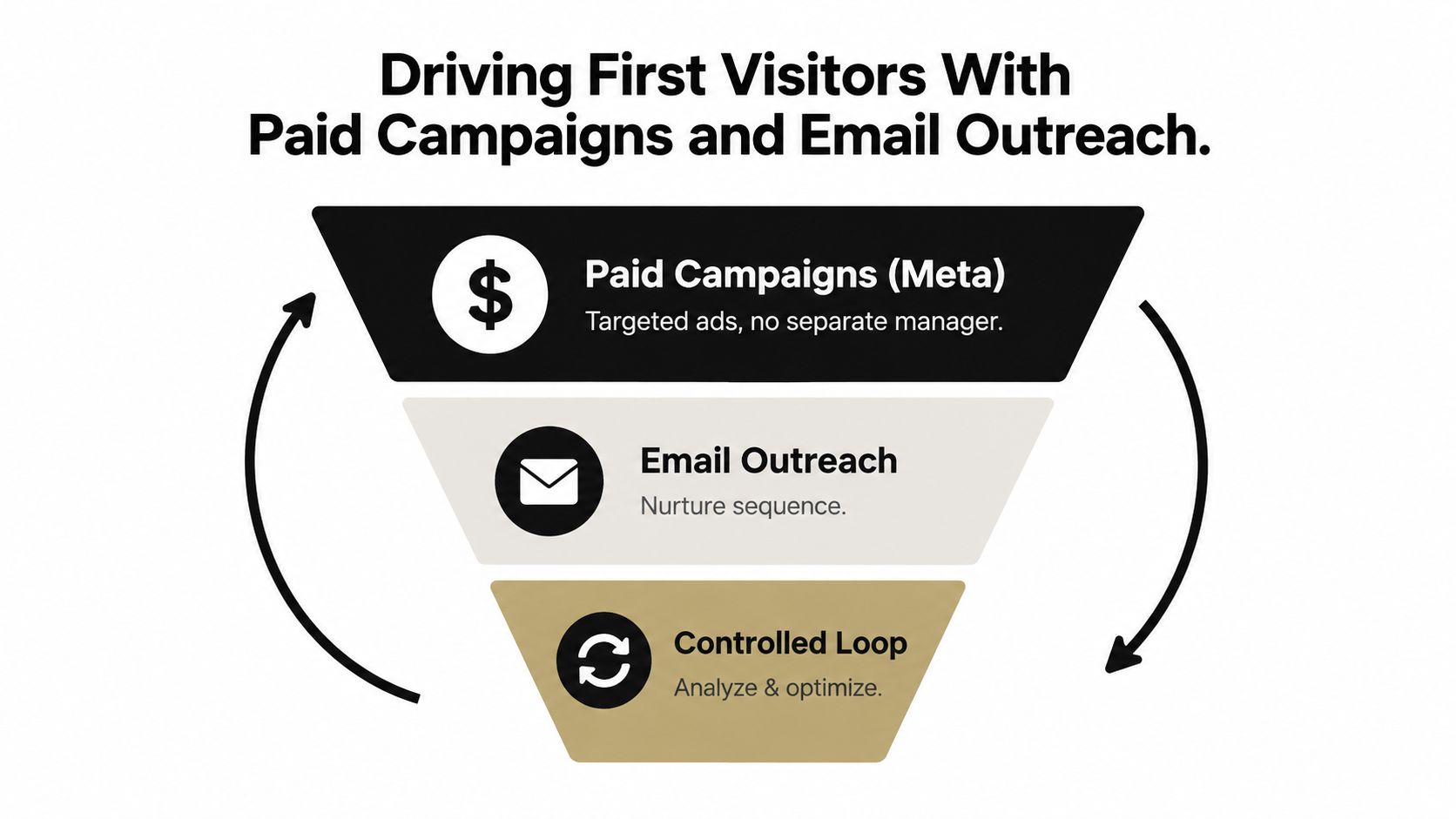
A coordinated workflow looks like this:
- Approve the audience and message: Confirm the ICP, offer, exclusions, landing page, and campaign budget.
- Verify the advertising account: Resolve identity and policy requirements before scheduling spend.
- Launch a restrained test: Monitor delivery, visitor quality, page behavior, and incoming questions.
- Run the email sequence: Personalize the opening, keep follow-ups relevant, and route judgment-heavy replies.
- Review behavior, not clicks alone: Compare channel activity with form completion, checkout movement, support questions, and privacy-protected session recordings.
- Change one meaningful variable: Adjust the promise, audience, creative, page, or sequence based on observed friction.
Owner gate: No campaign should spend against an unapproved landing page or unreviewed price.
A unified analytics layer helps connect channel performance to on-site behavior. Session recordings can reveal that visitors stop at a confusing plan comparison, miss the main action, or expect a feature the ad implied. Those observations are more actionable than a channel report that labels traffic as successful.
The first visitors are not only an acquisition audience. They're also a diagnostic group. Their questions expose positioning gaps, their behavior reveals page friction, and their replies help the team decide whether the next investment belongs in creative, distribution, product education, or the product itself.
Launch Day Operations and What Happens After You Ship
Launch day should follow a short, time-ordered runbook. The launch owner confirms product status, checks the live landing page and store, verifies checkout, reviews tracking, approves public copy, publishes, activates approved campaigns, and opens the support escalation channel. Every step needs a named owner and a clear pause or rollback decision.
The team should follow the customer path from first visit to entitlement. A broken form, missing confirmation email, incorrect access level, or unclear price can undermine the release while surface-level engagement remains positive. Keep a simple incident log, assign each issue an owner, and record whether the fix requires a content change, product change, or campaign pause.
The commercial risks that checklists miss
Pricing and packaging require a final owner review because launch choices can reshape the revenue model. One documented failure mode is portfolio price cannibalization. A low-priced tier may cover most enterprise needs and weaken monetization before the business scales (new product launch strategy).
Before publishing, inspect whether each tier has a clear customer, whether upgrade reasons are legitimate, and whether the entry plan creates a path to expansion. Discounts, bundles, and early-access offers need explicit limits, an end date or review point, and one owner who can revise or stop them.
The first 30 days
The post-launch period turns activity into evidence. Use a review rhythm that assigns each signal to a decision:
- First release review: Confirm publishing, checkout, analytics, campaign delivery, and support coverage.
- Early customer review: Record questions, failed actions, objections, refunds, and requests that expose product or message friction.
- Distribution review: Identify channels producing qualified attention and channels consuming effort without useful signals.
- Commercial review: Compare purchases, plan selection, discounts, refunds, and upgrade conversations with the approved packaging logic.
- Iteration decision: Choose the next product, positioning, or acquisition change, then assign an owner and date.
Distribution can ramp slowly. As noted earlier, a new product may need months to approach its strongest distribution level. The team should not abandon a product after a quiet opening, yet continued spending requires evidence that learning is taking place.
A cross-country PDMA benchmark reported a 76% average product launch success rate for best-performing firms versus 51% for other firms, according to an Ehrenberg-Bass Institute research summary. Treat that comparison as a reminder to connect readiness, execution, and post-launch measurement, not as a forecast for the next release.
Teams can also measure brand visibility in ChatGPT alongside site behavior, campaign data, customer conversations, and sales feedback. The useful practice is consistency. Each signal should support a decision rather than fill a dashboard.
A strong product launch plan becomes a living roadmap after release. It keeps the owner accountable for spend, publishing, pricing, and iteration while research, asset preparation, outreach, and analysis continue in parallel.
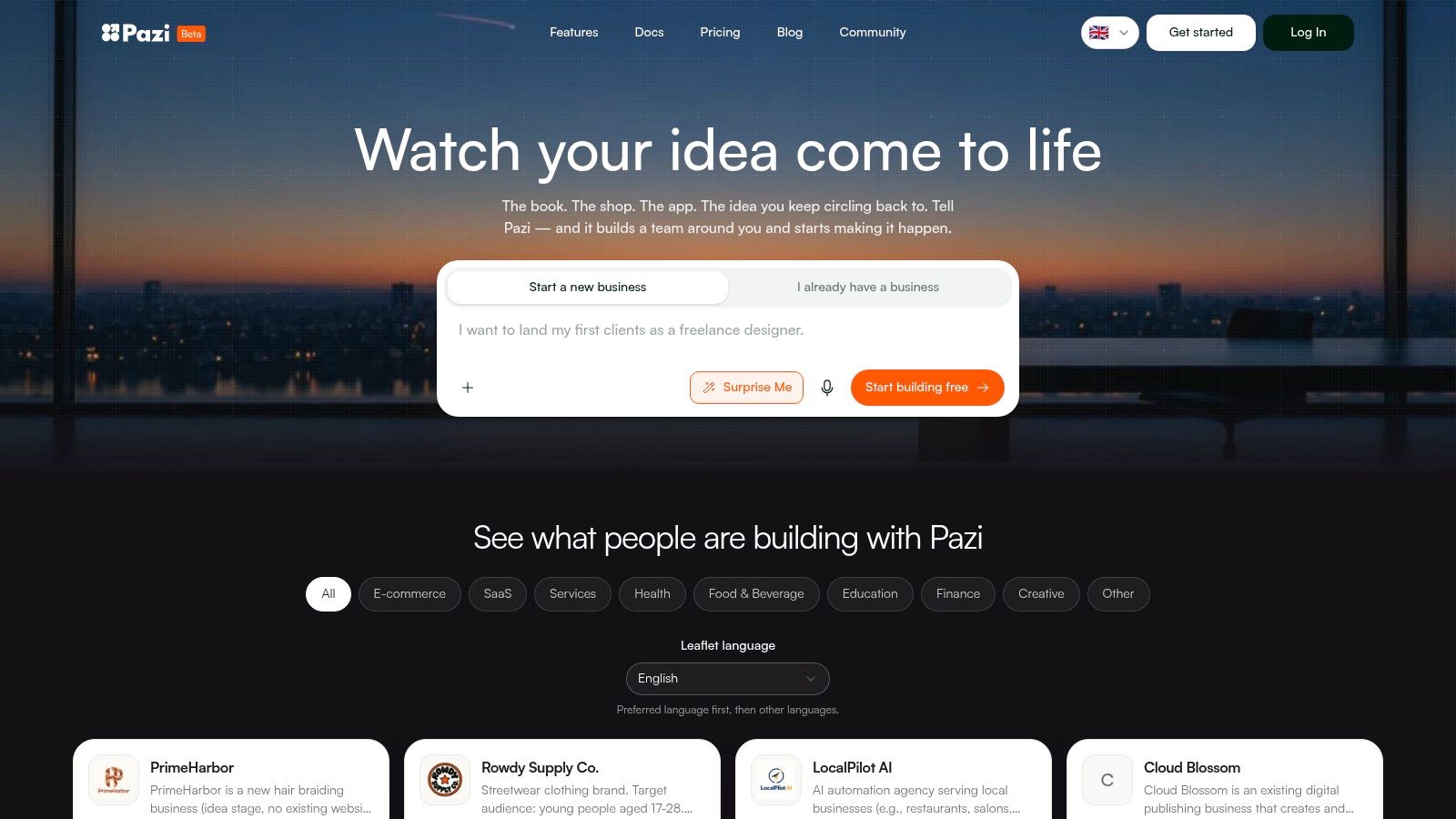
Pazi assembles AI agents for market research, website and store creation, checkout, Meta campaigns, email outreach, and unified business analytics inside one workspace. Visit Pazi to connect those launch activities in an owner-approved roadmap and move from validated idea to measurable execution without fragmenting the workflow.