Influencer programs keep growing while the marketing teams running them keep shrinking. Creator budgets are climbing every year, the creator universe is bigger than ever, and AI is in the middle of a lot of it. The people running the program are five where they used to be ten, and they're expected to find the right creators, brief them, run outreach, manage commercials, track performance, and keep relationships warm for the next campaign, on top of the rest of marketing.
The bottleneck isn't budget. It's the work. Discovery alone can eat a week. Personalized outreach to fifty creators is a full day of writing. Replies trickle in over two weeks and quietly fall through inbox cracks. By the time someone writes the campaign recap, the team is three campaigns behind and the relationship trail with the creators who delivered last time has gone cold. The role used to get filled by hiring a creator-ops manager. Now it's getting filled by an agent.
Matching creators to briefs
The phrase "find the right creator" hides most of the actual work. The right creator for a developer-tools brand is a different person from the right creator for a beauty launch, and the difference shows up across audience overlap, content style, historical performance on watch-time and conversion, and whether the creator will talk about the product the way the brief intends. Doing that well for fifty creators eats hours of opening tabs and scrolling channels. Doing it for five hundred is a job nobody on a shrinking team has the room for.
An agent reads the brief the way the rest of the team would, looking at audience, message, budget tier, and content fit. It runs discovery against the channels and platforms it's been configured against, scores creators along those dimensions, and returns a ranked shortlist with the reasoning attached to each name so the operator can disagree with any of it. The operator's judgment isn't being replaced. The operator is being handed a shortlist that already had the first few hours of work done.
Owning the entire journey
Most influencer marketing tools own one or two stages of the work — discovery, outreach, or analytics. An agent can own the full journey, from a creator being a name on a list to a creator being someone the team has worked with three times. The journey breaks into four loosely sequential phases, and most tools quietly skip the parts that don't fit a SaaS feature.
Research, vetting, and brief generation come first. The agent scrapes its configured discovery sources, builds a candidate pool against the campaign brief, and then does the part most platforms skip: per-creator vetting against deeper signals like recent video sentiment, comment quality, view-to-subscriber ratio, sponsor history, and risk flags such as paid-shill patterns or AI-generated content. Once a creator clears vetting, the agent generates a tailored outreach brief that fits the creator's voice and content style, instead of a template that gets sent to everyone with the creator's name swapped in.
Then comes the commercial middle, which is where most programs lose the most time. The agent drafts personalized first-touch emails per creator using channel context, recent video themes, and the brief, and the operator reviews and approves before anything sends, because cold contact from a brand domain is the wrong place to take a human out of the loop. Replies arrive over two weeks, and the agent watches the inbox, surfaces warm responses into the team channel, and drafts time-windowed follow-ups for silent threads. When a creator replies with a rate card, the agent surfaces it with comparable context: audience size, recent performance, and what similar creators are charging, so the operator can negotiate from data instead of guesswork. Once terms are agreed, the agent triggers the contract step the team has configured, whether that's drafting against a template or routing through the team's usual contract approval flow, tracking signature status and flagging blockers along the way. Invoicing routes to finance, payment gates on the milestone the team has set, and the operator only sees the moments that actually need their judgment.
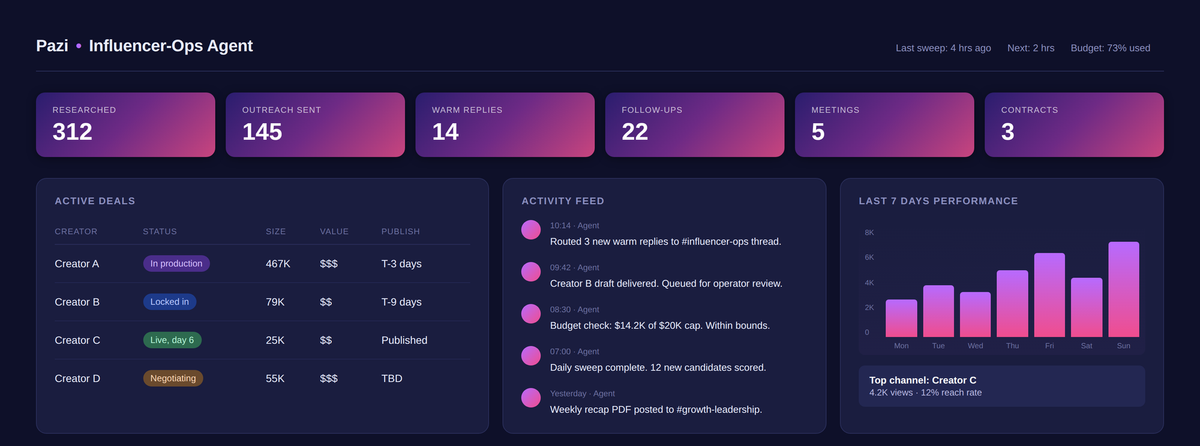
The back half of the journey starts the moment a creator says yes, and the gap between a booked creator and a published video is where many programs lose weeks. The agent monitors agreed delivery dates, runs a gentle chase if drafts slip, surfaces the draft for review, and logs feedback rounds so the team knows which creators are easy and which ones need more hand-holding next time. On publish day the agent doesn't wait for the creator to email "it's live"; it scrapes the channel directly, captures the URL, thumbnail, title, and description CTA verbatim, and then runs day-N performance tracking on views, engagement, comment quality, and signup signals in the comments. Recaps land in the team channel on a cron, daily or weekly or monthly per the campaign cadence, without anyone having to ask. The agent writes the read, surfaces the deltas, flags anything that needs an operator decision, and confirms the agreed-upon links and CTAs are still in the description, which is a check that has caught real misses.
The fourth phase is where the long-term math compounds. Most programs treat creators as one-off bookings, but the programs that actually grow across a year treat their creators as a roster. The agent keeps per-creator history, remembers what worked and what didn't, what each person prefers, and which campaigns they're a fit for, and it re-engages at sensible intervals when the next brief actually fits them. Repeat bookings cost less, ship faster, and tend to perform better, and that economics only works if the relationship trail is being maintained instead of starting cold every quarter. On top of that, the agent rolls cross-campaign reporting up to whoever needs it, marketing lead, founder, or board, on the cadence they want, with spend, performance, ROI signals, and an honest read of what's working and what's not.
Tools versus agents
There are good AI-native influencer marketing platforms in the market. Many of them have meaningfully reduced the discovery and outreach grind. They almost all share a shape: someone logs in, runs a search, sets up a sequence, reviews reports. The AI inside the platform helps the operator do the job, but the operator still drives every step of the day, and when the operator stops driving the work stops. Whatever the program learns about audience, conversion, creator quality, or campaign ROI also stays inside the tool, in a tab nobody else on the growth team opens.
A Pazi agent doesn't sit in a tab at all. It runs in the channel where the rest of the growth function already lives, posts updates and decisions where everyone else's signal is also landing, and runs on a cron whether anyone is at a keyboard or not, so the work moves between standups instead of waiting for them.
The agent also stops being a single-purpose tool. The same Pazi setup running an influencer-ops agent can be running a daily strategy dashboard for the marketing lead, a competitor-monitoring loop, an inbox-triage flow on the founder's email, an SEO-content cadence, or whatever else the growth function tracks. Each of those agents is configured for its own job, and they all post into the same operator signal flow. When a creator video lands and outperforms, that signal can show up in the growth lead's daily dashboard alongside whatever else the team tracks, instead of dying inside an influencer-marketing tab. When budget pressure changes mid-month, the rules the influencer-ops agent runs against can be updated from the same place the rest of the growth team works.
A SaaS tool can integrate with Slack and call itself collaborative, but the substantive difference is whose loop the work runs inside. With a tool, the loop runs inside the tool's product surface and the operator translates between it and the rest of the team's surfaces. With a Pazi agent, the loop runs inside the team's surfaces from the start, and the operator only steps in for the moves that actually need a human.
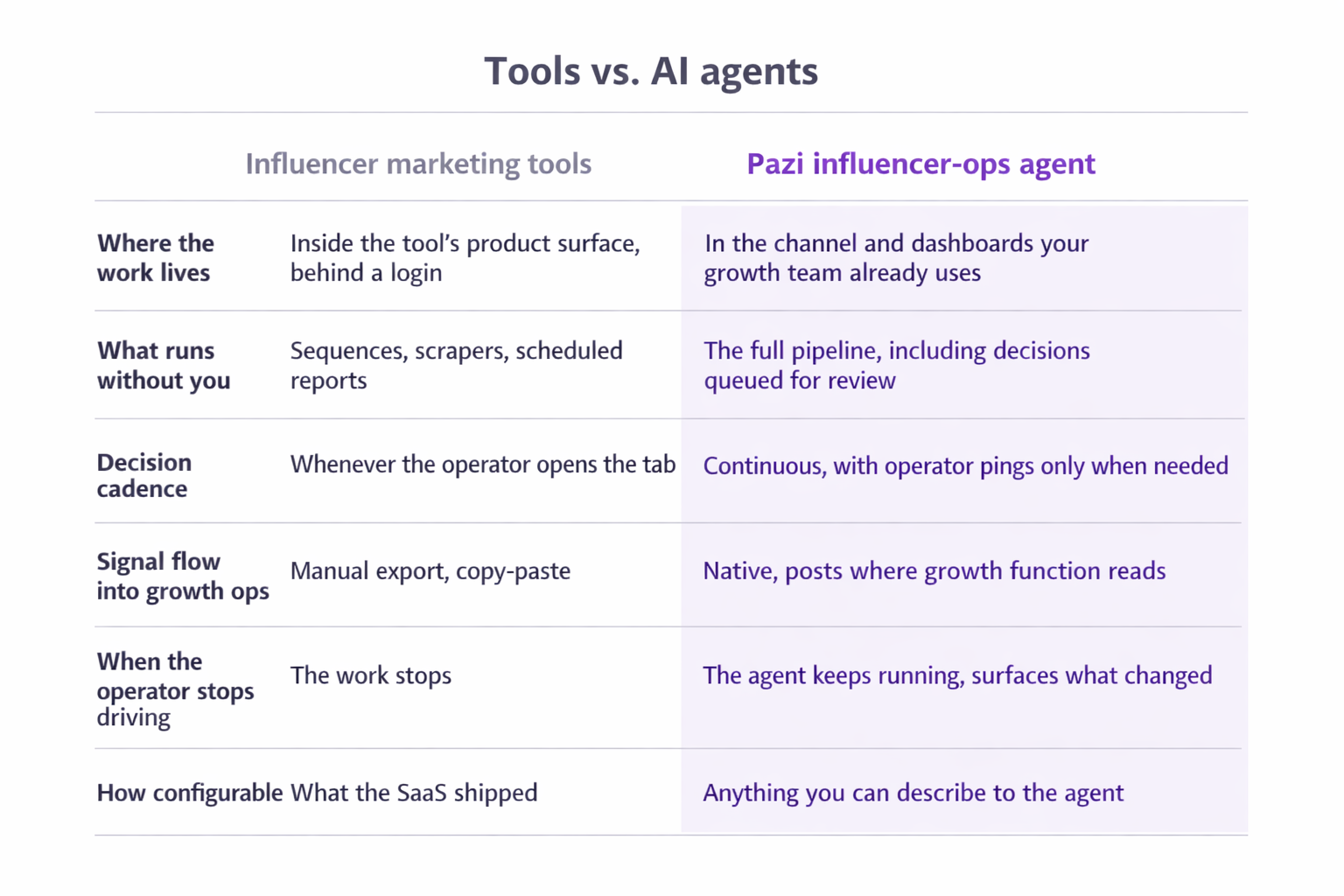
| Influencer marketing tools | Pazi influencer-ops agent | |
|---|---|---|
| Where the work lives | Inside the tool's product surface, behind a login | In the channel and dashboards your growth team already uses |
| What runs without you | Sequences, scrapers, scheduled reports | The full pipeline, including decisions queued for review |
| Decision cadence | Whenever the operator opens the tab | Continuous, with operator pings only when judgment is needed |
| Signal flow into broader growth ops | Manual export, the operator copy-pastes | Native, the agent posts where the growth function already reads |
| What happens when the operator stops driving | The work stops | The agent keeps running, surfaces what changed |
| How configurable the rules are | What the SaaS shipped | Anything you can describe to the agent (budget, contract flow, reporting cadence) |
Budget management shows the configurability difference clearly. On a Pazi agent, budget management is something the team configures: caps per creator, alerts at thresholds, reallocation logic when a campaign overdelivers, who to ping when something needs approval. The agent runs to those rules and surfaces the math in its reports. On most influencer marketing tools, budget management is either a hardcoded module that doesn't quite fit how the team thinks about spend, or it's not in the product at all, and the team is back in a spreadsheet. Same pattern as every other capability on a Pazi agent: the agent is programmable, the user instructs it on what to own, and budget rules are just another instruction.
The shorter version: a tool helps the team do influencer marketing, an agent runs the program with the team and plugs into the rest of the growth function, and the operator's hours go to the moves only an operator can actually make.
Build the agent
Build your influencer-ops agent on Pazi today. Configure it against your discovery sources, your outreach preferences, your contract and budget rules, and the reporting cadence your team works to. The work moves out of a tab and into where the team already operates, the loop keeps running while you sleep, and the operator gets back to the parts of the job that actually needed an operator.