Most Etsy SEO advice still treats tags as the main job. That approach keeps sellers busy, but it misses the harder question: why would Etsy continue showing a listing after it matches a shopper's query? Effective Etsy listing optimization has two parts. The listing must align with search intent, then its photos, clarity, trust signals, and buyer response must give shoppers a reason to click and purchase.
Etsy's own guidance says search evaluates titles, tags, descriptions, categories, attributes, the first photo, and reviews as a whole, not as isolated fields. Etsy's keyword guidance supports a practical conclusion: filling every tag while neglecting the product page is busywork.
Table of Contents
- What Etsy Listing Optimization Actually Means in 2026
- Finding Keywords Real Shoppers Actually Search
- Writing Titles and Tags That Match Search Intent
- Choosing Categories, Attributes, and a Description That Converts
- Photo Strategy Built for Mobile Buyers
- Pricing, Shipping, and Policies That Build Ranking Signals
- Running Experiments and Tracking What Actually Moves Sales
What Etsy Listing Optimization Actually Means in 2026
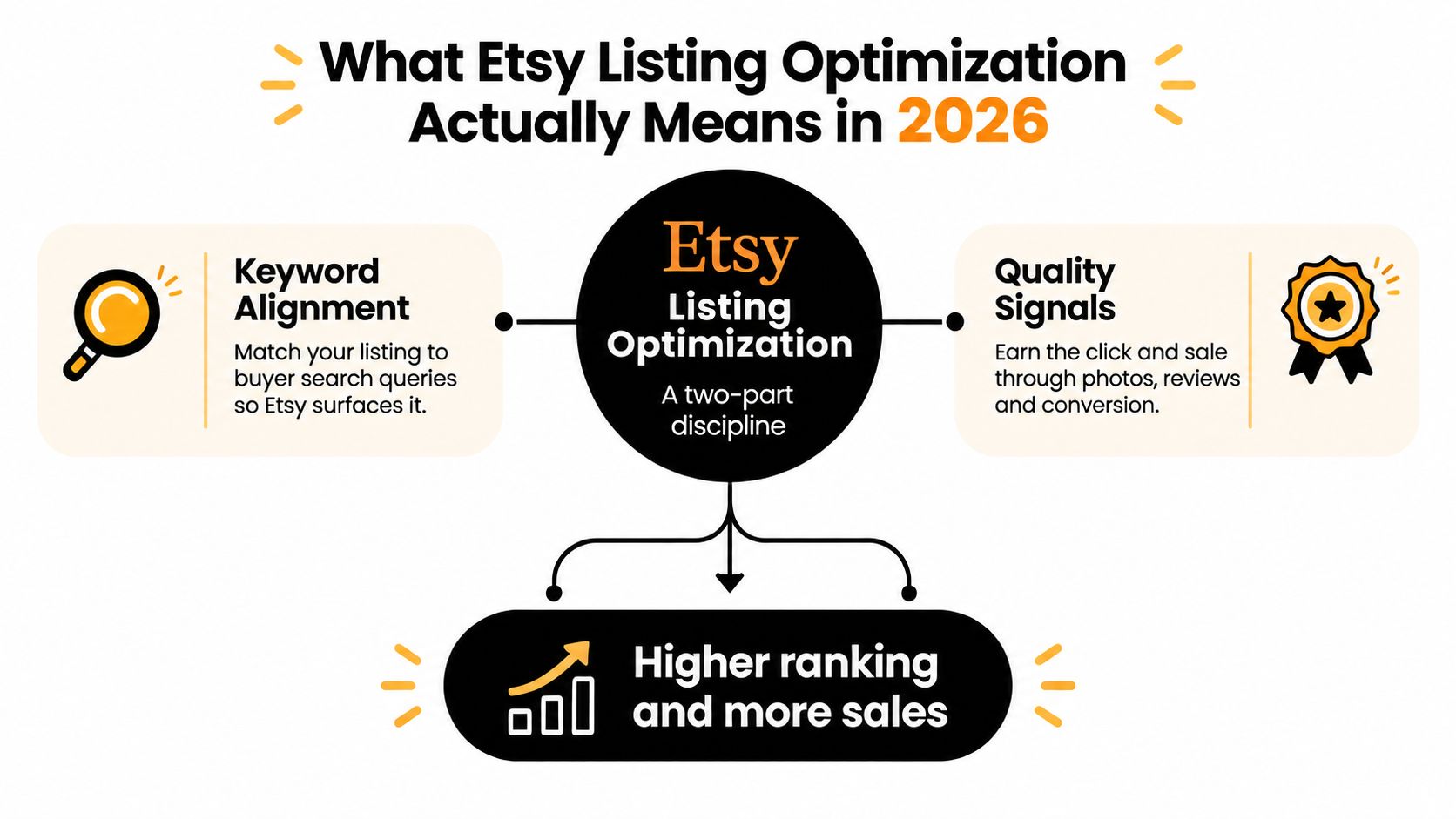
A strong listing answers two separate questions. Keyword alignment helps Etsy understand what the product is and which queries it may match. Quality signals help Etsy judge whether shoppers find the result useful and trustworthy.
Etsy's seller guidance connects search visibility with the relationship between a shopper's query and the listing's tags, title, description, category, and attributes. Etsy also advises sellers to use all 13 tags on every listing, with natural, multi-word phrases rather than awkward keyword fragments. Etsy's explanation of how search works frames each unused tag as a missed opportunity to match buyer language.
That doesn't mean every phrase belongs in a title. Etsy's newer title guidance recommends clear titles of less than 15 words, while the listing tool still permits titles of up to 140 characters. The practical compromise is simple: put the item's most important traits first, then use tags, attributes, and the description for supporting detail.
Relevance gets the listing considered
A listing can't perform for a search phrase that Etsy doesn't understand. Categories and attributes provide context, while titles and tags capture the language buyers use. Regional spelling matters too. Etsy notes that the same listing may surface for variants such as jewelry and jewellery, so optimization involves anticipating natural search behavior, not repeating one exact phrase mechanically.
Quality determines what happens next
Etsy's ranking policy says shop completeness, high-quality images, and return policies help buyers feel confident purchasing. Etsy's search, advertising, and recommendation policy also makes clear that relevance works alongside listing and shop quality.
Mobile presentation deserves more attention than it gets. Independent coverage of Etsy SEO argues that buyer behavior, including clicks, favorites, dwell time, add-to-cart activity, and completed purchases, matters beyond raw keyword matching, and one 2026 analysis cites 44.5% of Etsy sales happening on the mobile app. The Etsy SEO 2026 analysis makes the overlooked issue clear: a thumbnail, truncated title, and first photo can shape performance before a buyer reads the tags.
Sellers seeking broader help with structured product visibility can also review ecommerce SEO services, particularly when Etsy forms part of a wider online sales system. The essential principle remains the same: match the query, earn the click, remove purchase hesitation.
Finding Keywords Real Shoppers Actually Search
Keyword research works best as a validation process, not a creativity exercise. A phrase is worth pursuing only when real shoppers use it, the listing can realistically compete for it, and the phrase accurately describes the product.
Start with Etsy's own language
Begin typing the product into Etsy's search bar and record the autocomplete phrases that fit the item. These suggestions reflect how shoppers phrase searches on the platform, which makes them more useful than a seller's preferred description.
Next, open the listing workflow and review Etsy's tag suggestions. Save suggestions that stay close to the product's central use, style, material, recipient, or occasion. A suggestion isn't automatically good. If it describes a different product, reject it even if it sounds popular.
Add competitive context
Third-party tools can expose useful directional data. eRank, Marmalead, and Sale Samurai can help compare search demand and competition, while a manual scan of prominent listings shows how sellers describe comparable products.
Manual review matters because tools can't judge product fit. Look for repeated patterns across titles, tags, categories, and attributes. Don't copy a competitor's wording blindly. Instead, identify the underlying intent, such as a gift buyer seeking personalization or a home decorator seeking a particular style.
Check seasonality outside Etsy
Google Trends and Pinterest Trends can help reveal whether a phrase has seasonal interest. They're useful for deciding when to prepare listings, refresh imagery, or create occasion-specific variations. They shouldn't replace Etsy evidence, because broader web interest doesn't guarantee Etsy shoppers will use the same wording.
| Source | Cost | Data Returned | Best Use |
|---|---|---|---|
| Etsy autocomplete | Free | Suggested shopper phrases | Discover natural long-tail language |
| Etsy listing suggestions | Free | Platform-recommended tag ideas | Build relevant tag candidates |
| eRank | Paid and free options | Search and competition indicators | Compare keyword opportunities |
| Marmalead | Paid and free options | Keyword and market analysis | Assess demand alongside competition |
| Sale Samurai | Paid and free options | Keyword and competitor insights | Expand phrase research |
| Google Trends | Free | Relative interest over time | Check seasonal direction |
| Pinterest Trends | Free | Search interest and topic movement | Explore visual and gift-led demand |
A useful filter is to ask three questions before adding a phrase:
- Does the shopper mean this? The phrase must describe the intended product and use.
- Can the listing satisfy the query? A broad term may attract attention but bring poor-fit clicks.
- Can the product compete? The phrase should match the listing's quality, price, imagery, and category.
The best keyword often isn't the broadest one. A specific phrase can bring fewer irrelevant visitors and give the listing a clearer path from search result to purchase.
Writing Titles and Tags That Match Search Intent
Etsy titles can contain up to 140 characters, but available space isn't a reason to create a difficult sentence. Etsy's title guidance favors clarity, and mobile shoppers often see only the beginning before deciding whether to continue. The first phrase should identify the product in language a buyer would recognize immediately.
A useful structure is:
Primary keyword + secondary keyword + descriptive phrase + occasion or audience
For a ceramic mug, a crowded title such as “Mug Coffee Mug Ceramic Mug Gift Handmade Mug Cute Kitchen Gift” repeats the same idea without adding useful context. A clearer version might be “Ceramic Coffee Mug, Floral Stoneware Cup, Handmade Kitchen Gift”. The revised title gives Etsy product context and gives the shopper a readable reason to keep looking.
For a bridal hair piece, “Hair Accessory Wedding Bride Hair Clip Bridal Hairpiece Crystal Clip” is similarly repetitive. A more purposeful alternative is “Bridal Hair Comb, Crystal Wedding Hair Piece, Romantic Bride Accessory”. The product comes first, followed by style and occasion.

Build the full tag set without stuffing
Etsy allows 13 tags per listing, and each tag can contain up to 20 characters. Use the available set to cover different expressions of intent rather than repeating a title phrase.
- Core terms: Include the clearest product phrase and a close variant.
- Long-tail phrases: Add combinations that reflect use, recipient, style, or occasion.
- Attribute language: Cover relevant materials, colors, finishes, or forms that buyers may search.
- Audience terms: Include phrases such as bride, teacher, pet owner, or housewarming buyer when they fit.
- Regional variants: Use the spelling relevant to the target market, especially when a meaningful difference exists.
Etsy specifically notes that regional spelling variants can still connect shoppers and listings, with examples such as jewelry and jewellery. Sellers targeting a particular market should use that market's natural spelling rather than forcing every possible variant into one title.
Tags should sound like phrases a person would type, not a private list of disconnected nouns. If the title already contains an exact phrase, use tags to expand the listing's reach into related intent instead of duplicating it thirteen times.
Choosing Categories, Attributes, and a Description That Converts
Category selection establishes the listing's basic relevance. Choosing a broad parent category when a more specific subcategory exists can make the product's context less precise, so the seller should select the narrowest accurate path rather than the largest apparent audience.
Attributes add another layer of meaning. Complete every applicable field for material, color, occasion, room, style, and other available details, even when a field appears optional. Accurate attributes can help Etsy place the listing in filters and recommendations, while inaccurate ones create disappointed clicks.
| Field | Limit / Best Practice |
|---|---|
| Title | Up to 140 characters, but keep it clear and front-load the main traits |
| Tags | Up to 13 tags, using natural multi-word phrases |
| Tag length | Up to 20 characters per tag |
| Description | Lead with buyer value, then add dimensions, materials, care, and policies |
| Categories | Choose the most specific accurate subcategory |
| Attributes | Complete every applicable field accurately |
| Photos | Up to 20 photos and 1 video, with a recommended width of at least 2000 pixels |
The description should close the gap between curiosity and confidence. The opening sentences need to work on a phone preview, so they should state what the item is, who it suits, and why the buyer might need it. Natural keyword phrases belong there, but hidden keyword lists make the copy harder to trust and harder to read.
A practical description order
Use short paragraphs and bullets for details such as:
- Product purpose: Explain the use or problem the item addresses.
- Dimensions: State measurements in a format buyers can scan.
- Materials: Name the material, finish, and relevant construction details.
- Care: Explain cleaning, storage, or handling.
- Processing and policies: Set expectations without burying them.
A soft invitation at the end can encourage questions: “Need a different color or size? Send a message and the shop can help confirm the best option.” A useful question gives the buyer a clear reason to reply.
Sellers who manage products across several channels may find the principles in business leader's feed optimization useful, especially the emphasis on consistent product information. Etsy still requires a marketplace-specific approach, but clarity across fields remains valuable everywhere.
Photo Strategy Built for Mobile Buyers
A listing's first image has to work at thumbnail size. Buyers may never reach the description if the hero image is dark, cluttered, cropped badly, or unclear about the product itself.
Etsy allows up to 20 photos and 1 video per listing, and its listing guidance recommends an image width of at least 2000 pixels. Etsy's listing creation requirements make image quality a technical consideration as well as a creative one.
Give each image a job
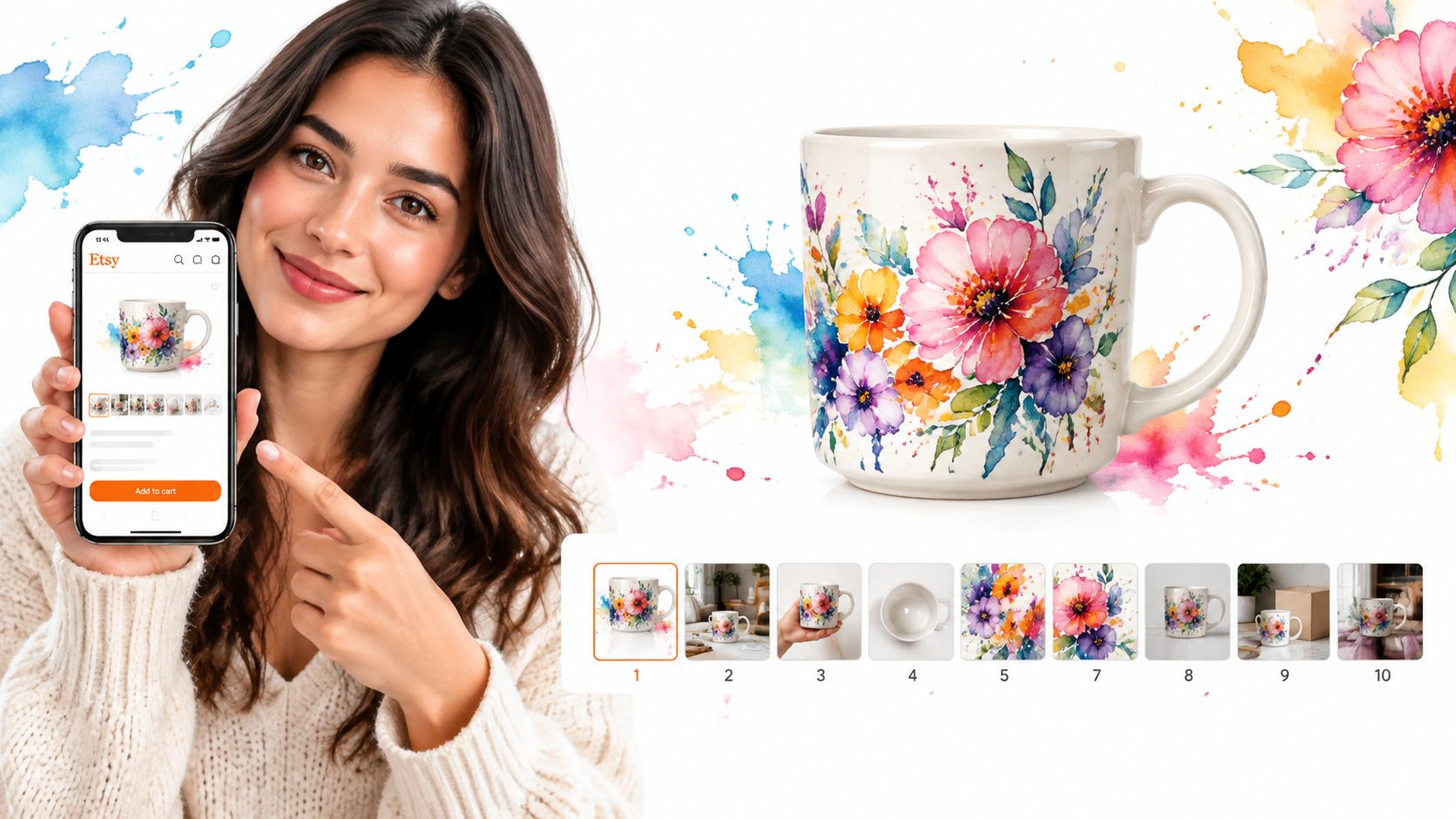
More photos don't automatically create a better listing. The sequence should answer the buyer's main objections in a deliberate order:
- Hero image: Show the complete item against a clean, uncluttered background.
- Lifestyle image: Place the item in the setting or activity where buyers will use it.
- Scale reference: Use a hand, familiar object, or clear measurement cue.
- Detail close-up: Show texture, finish, stitching, grain, or personalization.
- Variation view: Display relevant colors, sizes, components, or packaging.
The first photo should remain legible when reduced to the search grid. Etsy states that it should be at least 635 pixels wide and tall to avoid appearing lower in search. The Etsy image-size guidance summarized by Growtsy gives sellers a direct technical threshold to check before publishing.
Test the thumbnail, not just the full image
Open the image at a small size and ask whether the subject remains obvious. Keep the main product away from edges that may disappear during cropping, use consistent lighting across the set, and avoid watermarks that compete with the item.
The photo description should stay concise and describe the visible content naturally. Where Etsy indexes that field, a short phrase related to the listing's main product wording can reinforce relevance, but the description shouldn't become a duplicate tag list. Buyers need visual evidence first, and supporting text second.
Pricing, Shipping, and Policies That Build Ranking Signals
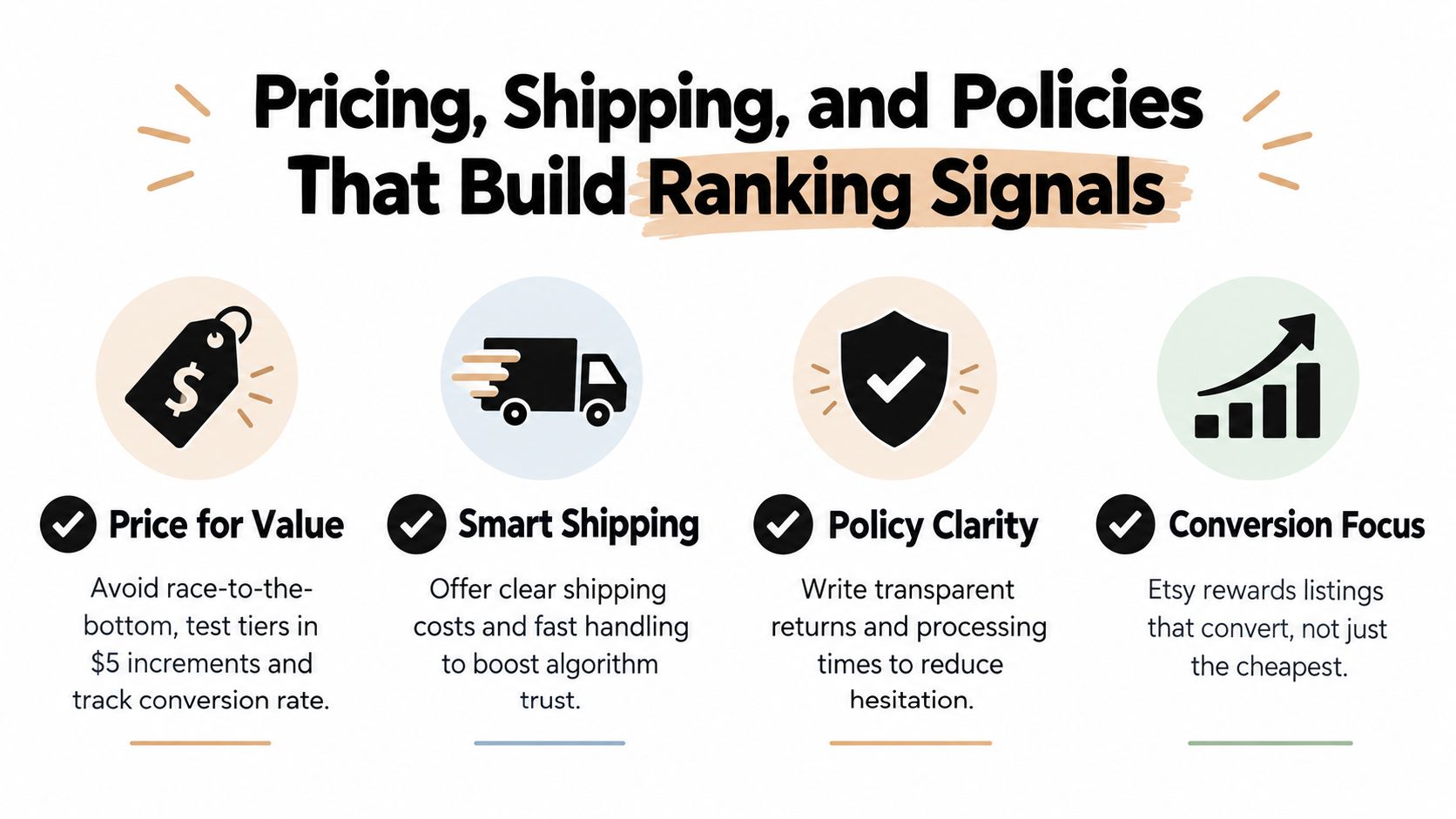
A low price can attract attention, but it can also create a mismatch between the listing promise and the buyer's expectations. Pricing should reflect materials, labor, finish, packaging, and the confidence communicated by the product page. The objective isn't to become the cheapest result. It's to make the offer feel credible beside comparable products.
Etsy's ranking policy identifies shop completeness, high-quality images, and return policies as confidence cues. That makes pricing, shipping, and policies part of Etsy listing optimization rather than administrative cleanup.
Price for a sustainable offer
Start with the complete cost of producing and fulfilling the item. Then compare the finished listing with similar products by material, customization, craftsmanship, presentation, and delivery terms.
Testing can be useful, but each price change needs a defined reason. A seller might compare a standard version with a premium finish or a single item with a bundle, rather than repeatedly discounting the same product and training buyers to wait.
Make delivery expectations believable
Enter processing time and origin information accurately. A buyer who sees an unrealistic delivery promise may abandon the purchase, while a clear and achievable window supports confidence. Shipping language should match the actual workflow, including personalization, production, packaging, and carrier handoff.
Free shipping can simplify the offer, but the cost still has to be recovered responsibly. Building shipping into the price may help the listing fit buyer filters, yet it can harm profitability if the seller treats “free” as costless.
Complete the trust layer
Shop policies, return information, FAQs, and processing details should answer the questions that prevent checkout. Clear policies don't guarantee a sale, but missing information gives hesitant buyers an easy reason to leave.
Practical rule: A listing shouldn't promise faster delivery, easier returns, or more customization than the shop can consistently provide.
Reviews also belong in the broader quality picture. Sellers can't control every review, but they can control accurate descriptions, protective packaging, responsive communication, and dependable fulfillment. Those operational choices support the confidence signals Etsy considers alongside search relevance.
Running Experiments and Tracking What Actually Moves Sales
Optimization isn't a launch checklist. It's a controlled loop in which the seller changes one meaningful element, watches the listing, and records what happened.
Shop Manager Stats and Search Analytics provide the working evidence. Track impressions, click-through rate, conversion rate, orders, and revenue per listing. The pattern matters more than one attractive number. A listing with many impressions but weak clicks has a presentation or intent problem, while a listing with clicks but few orders may need clearer information, stronger trust cues, better pricing, or a more convincing product.
Use a simple testing cadence
Change one variable at a time on a single listing and keep the other elements stable for a defined observation period. Etsy doesn't publish a universal waiting period for every listing experiment, so sellers should avoid treating a brief fluctuation as a conclusion.
Useful tests include:
- Title opening: Replace the first phrase with a different high-intent product description.
- Hero photo: Swap a styled image for a cleaner product-first image, or reverse the order.
- Description opening: Rewrite the first sentences to clarify the buyer, use case, and product benefit.
- Offer structure: Compare a single item with a bundle or variation that changes perceived value.
- Price: Test a deliberate price adjustment and watch buyer response rather than changing price and imagery together.
A testing log prevents memory from turning random movement into a false lesson.
| Metric | Where to Find It | What a Strong Signal Looks Like |
|---|---|---|
| Impressions | Shop Manager Stats and Search Analytics | The listing appears for relevant searches |
| Click-through rate | Shop Manager Stats and Search Analytics | Shoppers choose the listing after seeing it |
| Conversion rate | Shop Manager Stats and order analytics | Clicks develop into completed purchases |
| Orders | Shop Manager Stats | Demand produces actual transactions |
| Revenue per listing | Shop Manager Stats | The listing contributes useful commercial value |
Record the decision, not just the result
A practical experiment log needs columns for hypothesis, change, start date, end date, and outcome. Add a note about traffic conditions, seasonal timing, stock availability, or promotion activity so the result has context.
CTR often deserves more attention than rank alone. A listing can appear prominently yet fail to attract clicks, while another can earn meaningful buyer action from a less prominent position. Since Etsy's public guidance connects ranking and recommendations with shopper behavior and listing quality, the useful question is not “Where did it rank?” but “What did shoppers do after seeing it?”
Two failed tests can teach more than one lucky listing if the seller records the variables and applies the lesson.
A focused weekly review can begin with five checks:
- Identify listings with impressions but weak clicks.
- Inspect the first image and opening title phrase.
- Find listings with clicks but limited purchases.
- Review price, delivery promise, description clarity, and policies.
- Log one change and define the next review point.
The strongest Etsy listing optimization process combines the structural work Etsy documents with disciplined observation of buyer behavior. Tags earn consideration. Clear images, accurate information, and a trustworthy offer earn the next action.
Pazi gives sellers a coordinated workspace for market research, commerce setup, customer acquisition, and performance analytics, with specialized agents working from a shared roadmap while the owner approves key decisions. Visit Pazi to connect listing improvement with the wider work of launching and operating an online business.